
 | Updated:
 Rainbow oscillator
This lesson will cover the following
- Explanation and calculation
- How to interpret this indicator
- Trading signals generated by the indicator
Developed by Mel Widner and originally described in the July 1997 issue of Technical Analysis of Stocks and Commodities magazine, the Rainbow Oscillator, like the Rainbow Charts, is a trend-following indicator. It is derived from a consensus of the trends identified by the Rainbow Charts.
As with the Rainbow Charts, the core of the Rainbow Oscillator is a 2-period simple moving average to which recursive smoothing is applied. In this way, nine additional moving averages are created, with each new average based on the previous one. A total of ten moving averages is created; when plotted on a chart, they appear in the form of a rainbow. The oscillator is based on the following calculations:
r1: = Mov (C,2,S);
r2: = Mov (r1,2,S);
r3: = Mov (r2,2,S);
r4: = Mov (r3,2,S);
r5: = Mov (r4,2,S);
r6: = Mov (r5,2,S);
r7: = Mov (r6,2,S);
r8: = Mov (r7,2,S);
r9: = Mov (r8,2,S);
r10: = Mov (r9,2,S);
It determines the highest high and the lowest low of these moving averages. The Rainbow Charts and the Rainbow Oscillator are essentially the same indicator; the only difference is the way they are visualised.
As the Rainbow’s width increases, it suggests that the current trend may continue; however, if the oscillator registers a reading above 80, the market may begin to show signs of instability. The stage is set for a reversal.
If the price approaches the Rainbow and the oscillator line becomes flatter, this suggests that the market is stabilising. The oscillator bandwidth will narrow. If, however, the oscillator reading falls below 20, it again implies that the stage is set for a market reversal. The market is considered stable when oscillator readings are between 20 and 80.
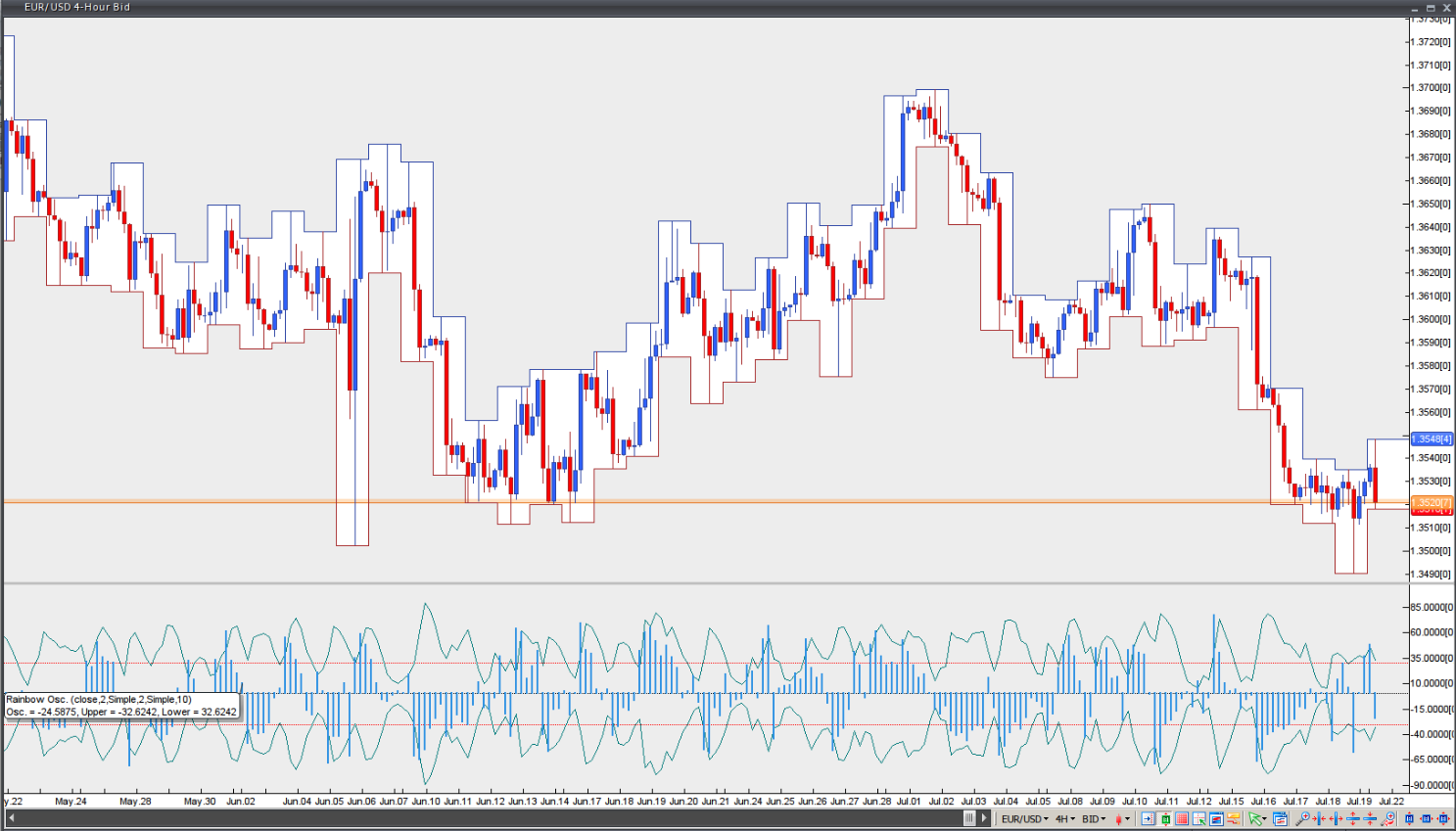
Chart source: VT Trader