
Alligator oscillator
This lesson will cover the following
- Definition
- Interpretation
In the next two articles, we will cover the Alligator and Gator oscillators. Both were developed by Bill Williams; they complement each other in helping the trader determine whether the market is in a trending phase. They serve as a guiding light, directing your trades in the right direction and steering them away from trading ranges. Let’s discuss the Alligator oscillator first and then move on to the combination of the two.
The Alligator oscillator is easy enough to use once you understand it. It consists of three moving averages, projected a number of bars into the future. They are called the Alligator’s Jaw, Alligator’s Teeth and Alligator’s Lips.
– The Alligator’s Jaw (typically visualised in blue) is a 13-period moving average calculated at the mid-price ((High + Low) / 2) and is projected 8 bars into the future.
– The Alligator’s Teeth (typically plotted in red) are an 8-period moving average, again at the mid-price, and are extended 5 bars into the future.
– The Alligator’s Lips (typically plotted in green, but sometimes in black) are a 5-period moving average at the mid-price and are moved 3 bars into the future.
Here is what it looks like.

- Trade Forex
- Trade Crypto
- Trade Stocks
- Regulation: NFA
- Leverage: Day Margin
- Min Deposit: $100
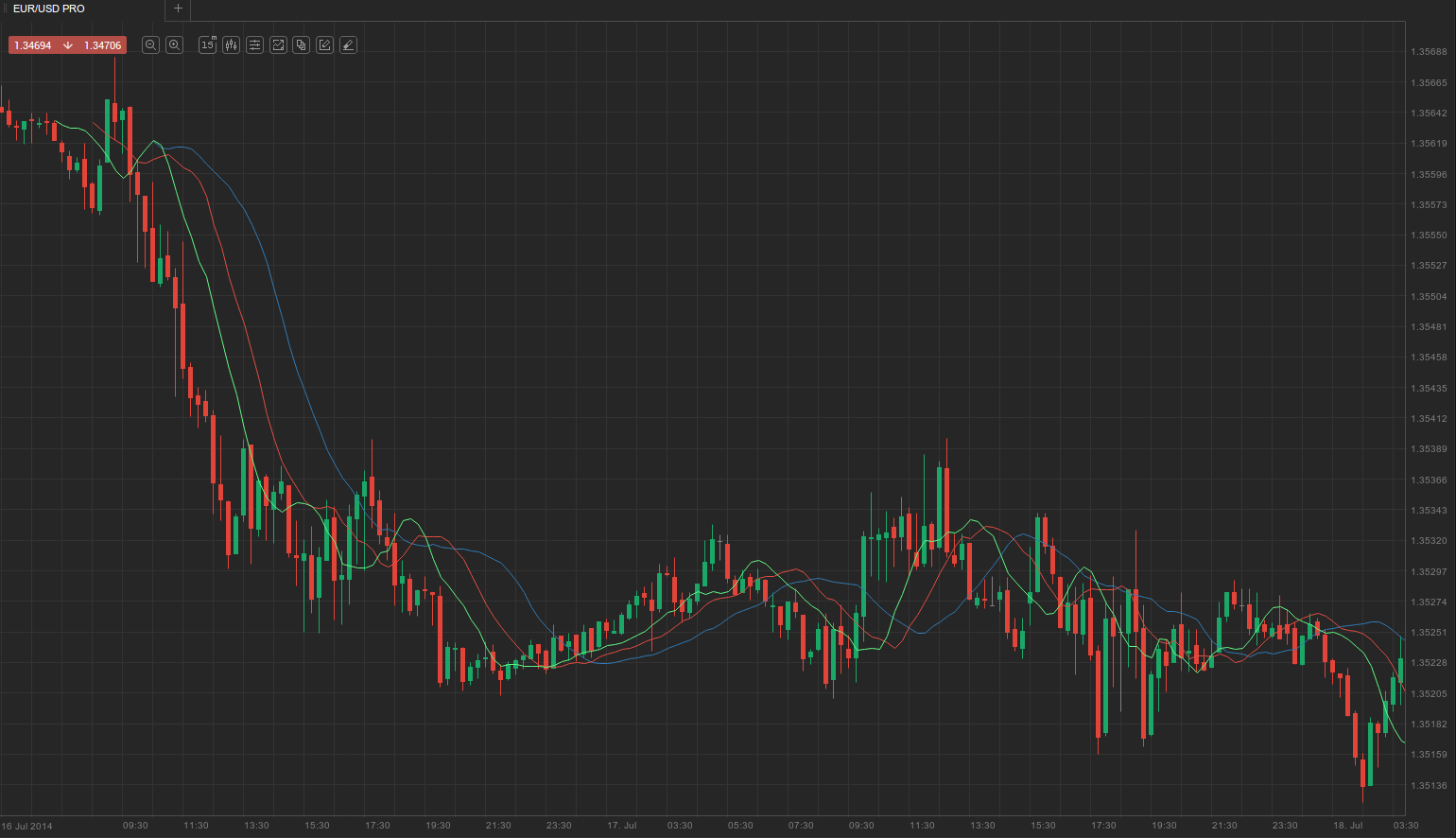
The indicator’s interpretation is based on the position of each moving average relative to the others and reflects the market’s current conditions. The Alligator can be in one of the following four phases:
– If all three lines are converging, then the Alligator is asleep (the market is ranging). The longer it remains in this state, the ‘hungrier’ it will become, thus the larger the chance for a breakout to occur. The longer the sleep phase is, the stronger the subsequent price movement is expected to be.
– When the green line (Lips) moves above or below the blue line (Jaws) after a period of consolidation, the Alligator is said to be waking up. This phase is marked by the beginning of a new trend.
– The next phase is when the Alligator eats. The red line (Teeth) is penetrating through the Lips (green or black line) as the mini-trend is well established and is in its acceleration phase. The market is now drawing closer to a climax.
– The last phase is when the Alligator has become sated, which signifies exhaustion in the trend after its peak. It is characterised by the Teeth (red line) dropping below the Jaw (blue line) and the three lines overall beginning to converge.
– Completing the cycle, the Alligator next falls asleep again and closes its mouth (the Jaw, Teeth and Lips are grouped in a tight consolidation area).
Because this strategy is essentially very similar to standard moving-average trading systems (moving-average crossovers, etc.), it will also require the same market conditions to be viable – the market must be trending. It can produce signals during sideways trading as well, but many of them will be misleading. Moreover, you shouldn’t base your entire decision-making on the Alligator oscillator; rather, combine it with other tools for further confirmation – such as Fibonacci levels, ADX, etc.