
 | Updated:
 Ehlers Laguerre Relative Strength Index
This lesson will cover the following
- Explanation and calculation
- How to interpret this indicator
- Trading signals generated by the indicator
This indicator is a variation of the popular Relative Strength Index (RSI). Designed by John Ehlers, the Laguerre Relative Strength Index attempts to avoid the whipsaws and lag that the traditional RSI tends to exhibit. The Laguerre Relative Strength Index uses a four-element filter to provide a ‘time warp’, so that low-frequency elements are delayed far more than high-frequency elements. This results in a more reactive indicator that produces fewer whipsaws than the traditional RSI.
Similar to the RSI, the Laguerre Relative Strength Index generates trading signals when it crosses its overbought and oversold levels. The oscillator’s original scale ranges from 0 to 1. A buy signal is generated when the Laguerre Relative Strength Index falls below 0.15 and then moves back above it. A sell signal is generated when the Laguerre Relative Strength Index climbs above 0.85 and then moves back below it.

- Trade Forex
- Trade Crypto
- Trade Stocks
- Regulation: NFA
- Leverage: Day Margin
- Min Deposit: $100
If the oscillator remains flat above its overbought level (0.85), it indicates that the bullish trend is strong. If it remains flat below its oversold level (0.15), it signals a strong bearish trend.
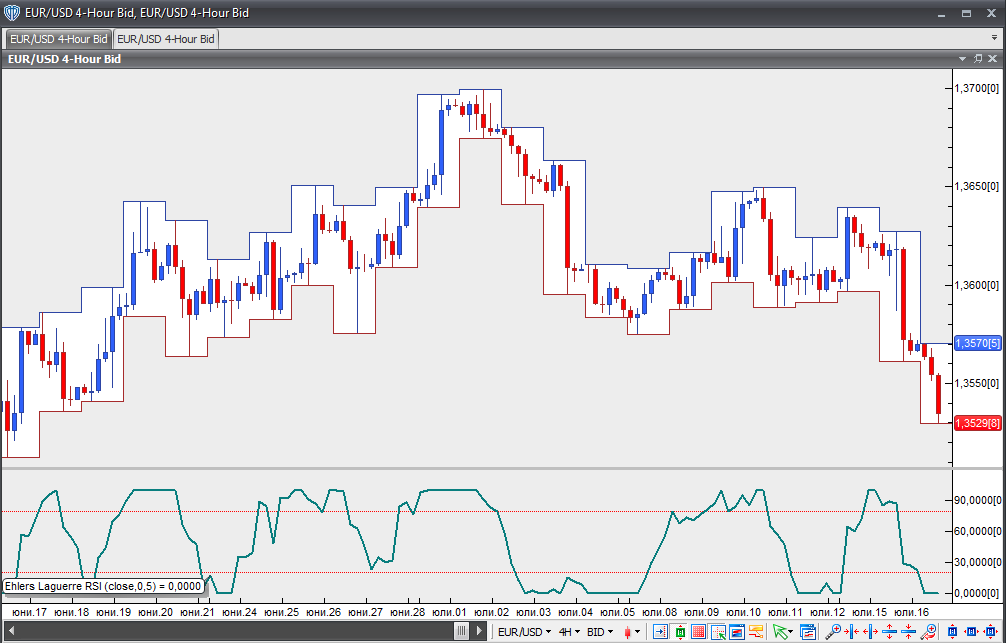
Chart Source: VT Trader