
Gator oscillator
This lesson will cover the following
- Definition
- Interpretation
As stated in the previous article, the Gator oscillator is closely tied to the Alligator indicator. Although it can be used independently, the two are usually combined, as they complement each other in providing a more complete overview of current market conditions. It shows the absolute degree of convergence and divergence of the Alligator’s three moving averages.
Below you can see their combination visualised.
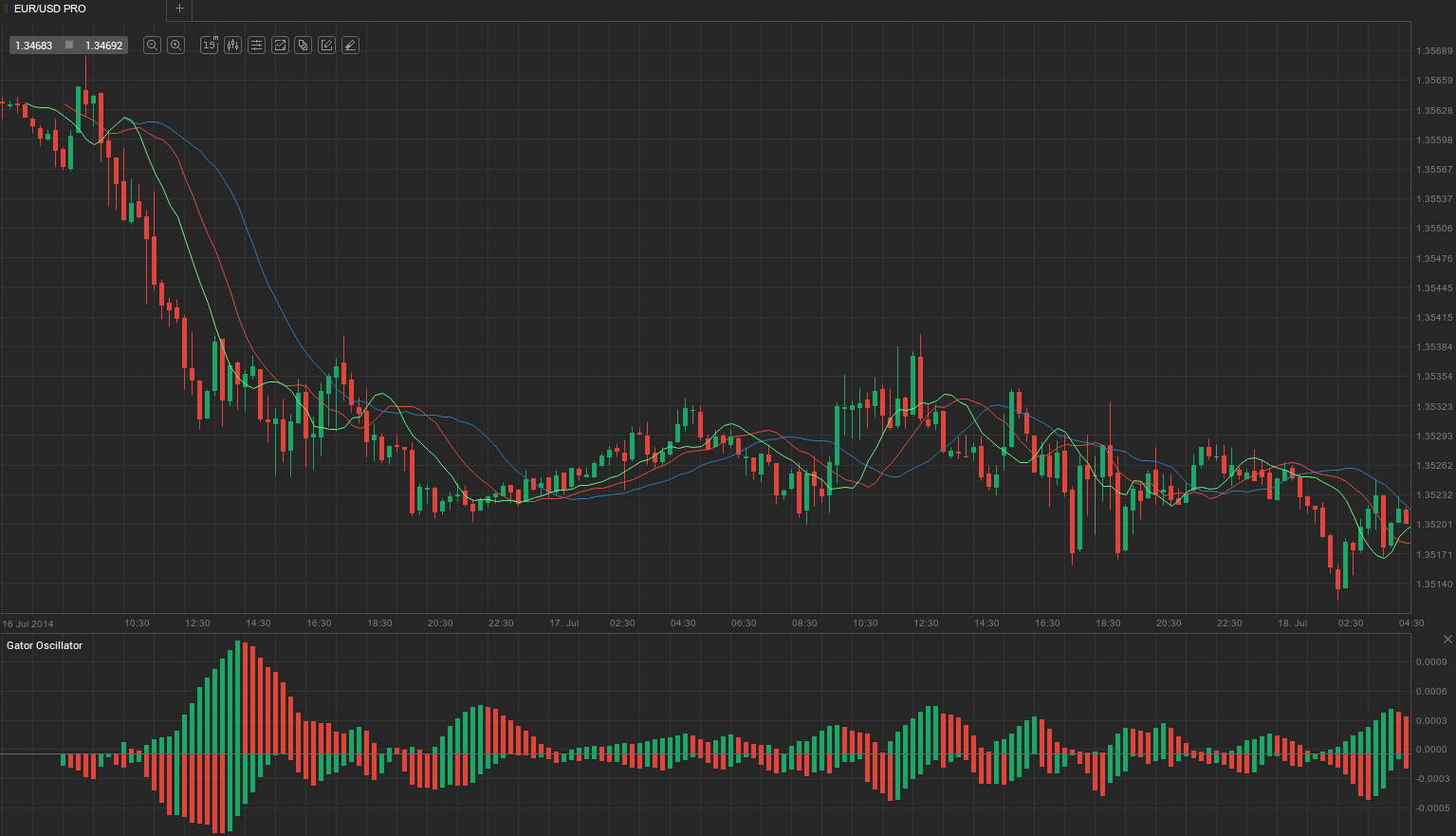
As shown, the Gator oscillator is displayed as a histogram split in half by a nought line. In the positive area, the indicator plots the absolute difference between the Alligator’s blue and red lines (jaw and teeth), while the negative zone represents the absolute difference between the Alligator’s red and green lines (teeth and lips) with a minus sign.
The bars can be either green or red. A green bar reflects a rise in the difference (the bar is larger than the previous one), whereas a red bar is formed when the difference declines (the bar is smaller than the previous one).

- Trade Forex
- Trade Crypto
- Trade Stocks
- Regulation: NFA
- Leverage: Day Margin
- Min Deposit: $100
As with the Alligator oscillator, the Gator also has four distinct stages of everyday life.
– When the bars on both sides of the nought line are red, the Gator is in the sleeping phase.
– When one side turns green while the other remains red (both sides are now differently coloured), the Gator is awakening.
– When both sides turn green, indicating that the absolute difference between the two sets of moving averages is growing, the Gator is in its eating phase.
– After the eating phase, when one of the two sides changes colour, the Gator is sated. This marks a deceleration in the trend and generally precedes a trend reversal or the start of a trading range.
– The cycle is completed when both sides of the nought line turn red, signifying that the Gator has fallen asleep once again.
Because both the Gator and Alligator oscillators rely on readings derived from moving averages, they are most effective in trending market conditions. In general, positions are opened as the Gator awakens and are maintained through the trend’s exhaustion phase until both sides of the indicator turn red. A more conservative approach is to lock in profits and exit positions in the third phase (when the Gator is sated), once one side turns red. This, of course, will reduce potential returns but will also diminish risk.
The Gator oscillator can also be used as a standalone indicator because of its simplicity; the Alligator’s three moving averages can clutter your screen. However, using the two in conjunction provides a more complete picture of market conditions.