
 | Updated:
 DeMark’s Range Expansion Index
This lesson will cover the following
- Explanation and calculation
- How to interpret this indicator
- Trading signals generated by the indicator
Developed and introduced by Thomas DeMark in the book ‘DeMark on Day Trading Options’, the Range Expansion Index (REI) is a market-timing oscillator designed to address the problems encountered by exponentially calculated oscillators, such as the Moving Average Convergence Divergence. The REI is calculated arithmetically.
The oscillator fluctuates between -100 and +100. Its default setting uses a period of 8. Traders who want fewer but more reliable signals may choose a longer period, while those seeking more frequent but less reliable signals may opt for a shorter period. Thomas DeMark recommends sticking to the default setting.
If the indicator value rises above +60 and then falls back below it, a sell signal is generated. If the indicator value drops below -60 and then climbs back above it, a buy signal is generated.

- Trade Forex
- Trade Crypto
- Trade Stocks
- Regulation: NFA
- Leverage: Day Margin
- Min Deposit: $100
Thomas DeMark advises against trading in extreme overbought or oversold conditions, indicated by six or more bars above or below the thresholds.
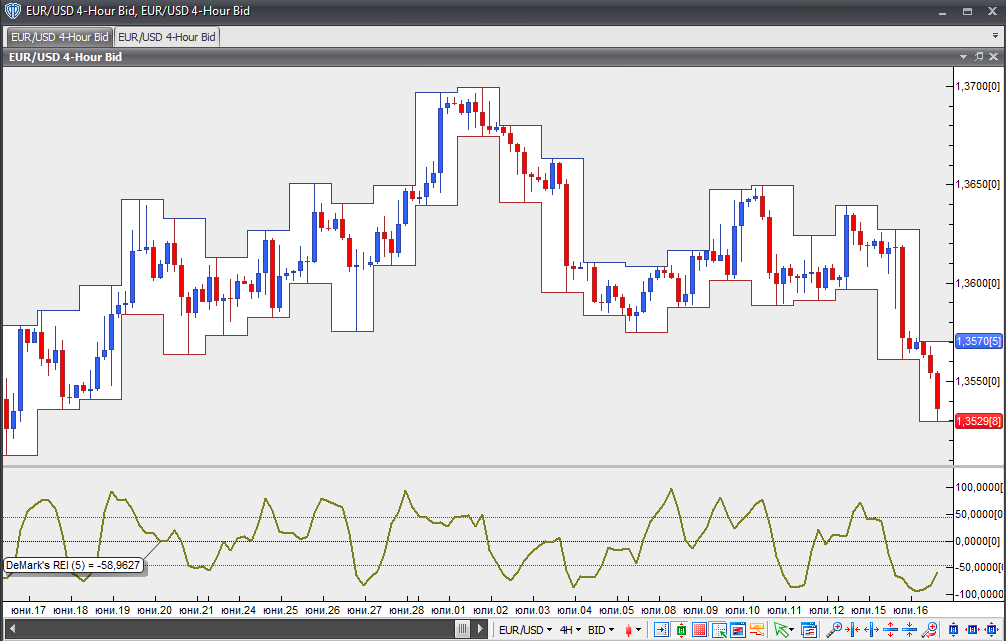
Chart source: VT Trader