
Double exponential moving average
This lesson will cover the following
- Definition
- Calculation
- Interpretation
Developed by Patrick Mulloy, the double exponential moving average (DEMA) is a fast-acting moving average designed to reduce reaction lag and be more responsive than a traditional moving average.
The DEMA’s advantage is that it eliminates false signals during choppy price movements, thus filtering entries for better opportunities during strong trends.
It can be used either as a stand-alone indicator directly on the chart, or incorporated into other technical indicators to smooth their values.
The double exponential moving average is calculated using both a single exponential moving average and a double exponential moving average, producing less lag than either of its individual components. It is not simply a combination of two EMAs, nor is it a moving average of a moving average; rather, it is a single EMA calculated in conjunction with a double EMA. The screenshot below illustrates one.

- Trade Forex
- Trade Crypto
- Trade Stocks
- Regulation: NFA
- Leverage: Day Margin
- Min Deposit: $100
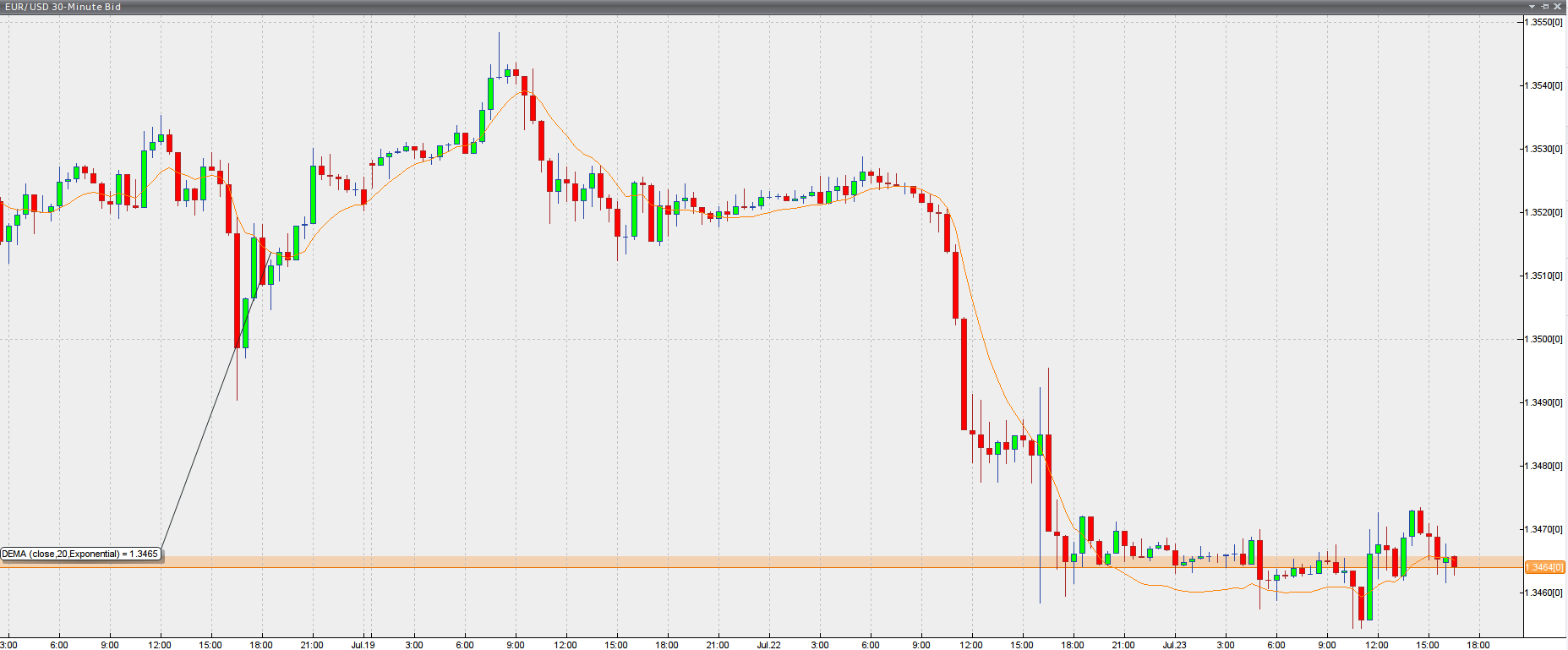
Chart source: VT Trader
The DEMA is calculated as follows:
Double EMA = 2*EMA – EMA(EMA)
If you require further details, here is the full calculation (not necessary for trading):
Since the DEMA is based on the EMA, we first need to estimate the error of the price’s deviation from the EMA value:
err(i) = Price(i) – EMA(Price, N, i), where:
– err(i) is the current EMA error
– Price(i) is the current price
– EMA(Price, N, i) is the current EMA value of the price over period N
To calculate the DEMA, we need to add the value of the EMA error to that of the EMA:
DEMA(i) = EMA(Price, N, i) + EMA(err, N, i) = EMA(Price, N, i) + EMA(Price – EMA(Price, N, i), N, i) = 2 * EMA(Price, N, i) – EMA(Price – EMA(Price, N, i), N, i) = 2 * EMA(Price, N, i) – EMA2(Price, N, i), where:
– EMA(err, N, i) is the current value of the exponential average of the error
– EMA2(Price, N, i) is the current value of the double consecutive smoothing of prices.
The double exponential moving average is generally used as a replacement for traditional moving averages in trading strategies based on them. It is available on most trading platforms, and many traders prefer it to conventional MAs because of its responsiveness and ability to spot reversals sooner, which allows for an earlier entry into a newly formed trend.
A viable strategy is to add two or three DEMAs with different look-back periods and trade their crossovers (just as with ordinary moving averages). Apart from its use as a stand-alone indicator, the DEMA can complement other indicators used for trending markets (MACD, Parabolic SAR, etc).