
Chande’s variable index dynamic average
This lesson will cover the following
- Definition
- Calculation
- Interpretation
Another indicator developed by Tushar Chande, the Variable Index Dynamic Average is a method of calculating an Exponential Moving Average which, however, does not use a static averaging period; instead, it automatically alters its speed in accordance with shifts in market volatility.
This oscillator uses the CMO (Chande Momentum Oscillator) value as a gauge of volatility. It measures the ratio between the sum of positive and negative increments for a certain period. The CMO value is then used in the calculation of the Variable Index Dynamic Average. The calculations are as follows.
The standard Exponential Moving Average is calculated as follows:
EMA(i) = Price(i) * F + EMA(i-1) * (1 – F), where:
– Price(i) is the current price
– F is the smoothing factor and is equal to 2/(Period_EMA + 1), where Period_EMA is the EMA averaging period
– EMA(i-1) is the EMA’s previous value.
The value of the Chande Momentum Oscillator is calculated using the following formula:
CMO(i) = [UpSum(i) – DnSum(i)] / [UpSum(i) + DnSum(i)], where:
– UpSum(i) is the current sum of positive price increments for the period
– DnSum(i) is the current sum of negative price increments for the period.

- Trade Forex
- Trade Crypto
- Trade Stocks
- Regulation: NFA
- Leverage: Day Margin
- Min Deposit: $100
The VIDYA is calculated as follows:
VIDYA(i) = Price(i) * F * ABS[CMO(i)] + VIDYA(i-1) * {1 – F * ABS[CMO(i)]}, where:
– ABS[CMO(i)] is the absolute current value of the Chande Momentum Oscillator
– VIDYA(i-1) is the VIDYA’s previous value.
Chande’s Variable Index Dynamic Average is used as a replacement for traditional moving averages. Its boundaries, which are placed above and below the VIDYA at a certain percentage distance, create a channel that is traded in a similar way to Bollinger Bands. The following screenshot illustrates the VIDYA in a trading platform.
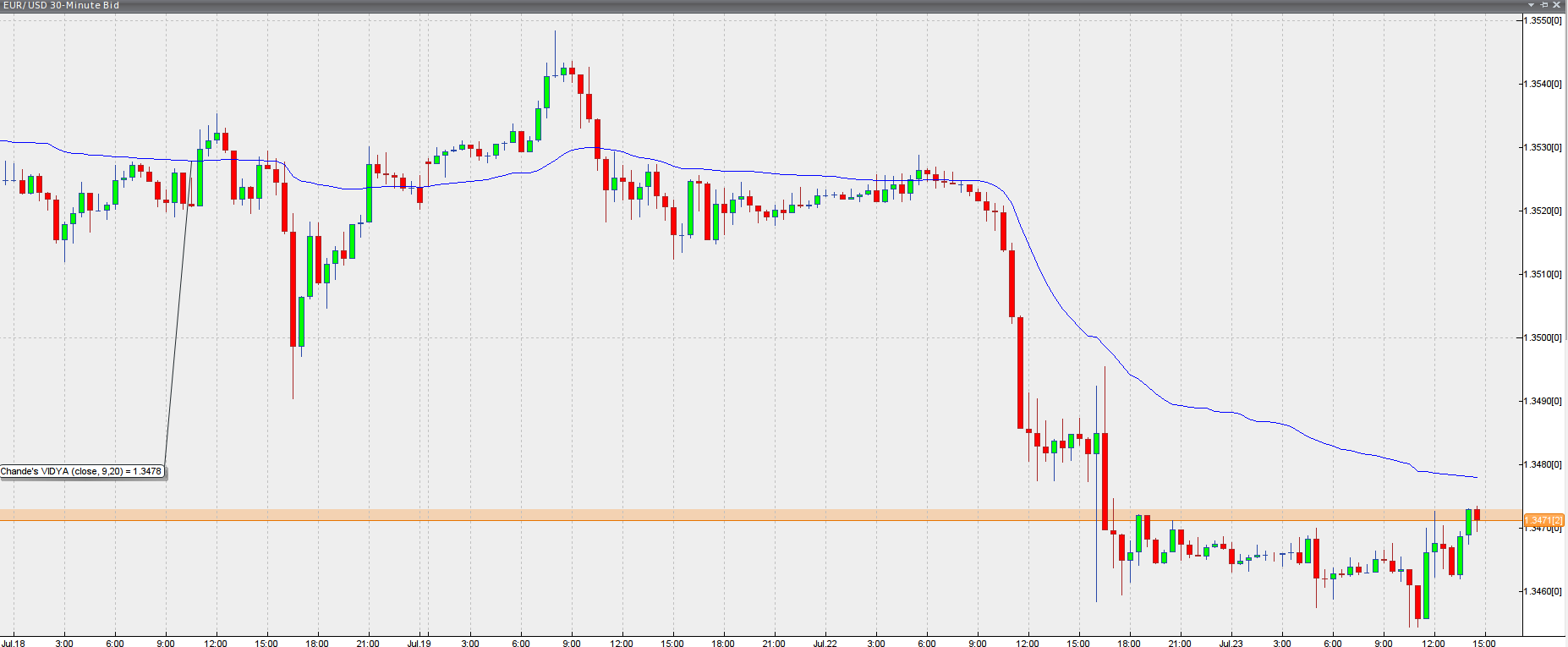
Chart source: VT Trader