
Two attempts to shift market movement
This lesson will cover the following
- As stated previously
- General thoughts on market movement
- Two attempts to shift a trend’s direction
- Failure of the second attempt
- Variations of the two-leg move
We know that market movement is rarely straightforward, and when it is, the move usually does not last long. The market often shifts direction, reaching levels that act as support or resistance and halting its movement, after which a second attempt frequently follows. In general, the market regularly tries to do something twice, and if it fails both times, it usually attempts to do the opposite. This applies to both with-trend and counter-trend moves.
A trend-line break is the beginning of a new leg in the opposite direction. Whenever bulls or bears temporarily lose control of the market, or a new trend is beginning, there is usually a two-legged move. A two-legged move occurs whenever market participants judge that a move is strong enough to warrant a test before it becomes clear where the market will head next.
If the momentum of the first leg after a reversal (basically a counter-trend move, because the new trend has not yet been confirmed) is strong enough, it will cause both bulls and bears to speculate whether the move is the beginning of a series of legs that will form a new trend. Consequently, both sides anticipate that a test of the old (still current) trend’s extreme will fail, and with-trend traders lock in profits as the price approaches it instead of adding to their positions.
Explanation
 Imagine a prolonged bear trend. If there is a decisive move up after the bear trend and the move extends above the moving average and the last lower high of the bear trend, traders will expect that on its way back down the price will test a low that will hold above the bear trend’s low. Once the up-move (first leg) loses momentum, longs will lock in profits, while shorts will enter, thinking that bears are still able to maintain control of the market.
Because the bulls have exited the market and are waiting for more bullish price action, while bears are shorting, the price will retreat. As it drops, bulls begin to return to the market, while new bears will look to exit quickly so that they do not incur losses. This buying pressure will push the market up, forming a higher low – just as in the following example. You can see that the market made a two-bar reversal and penetrated the 14-day EMA (first leg), after which it retreated, forming a higher low.
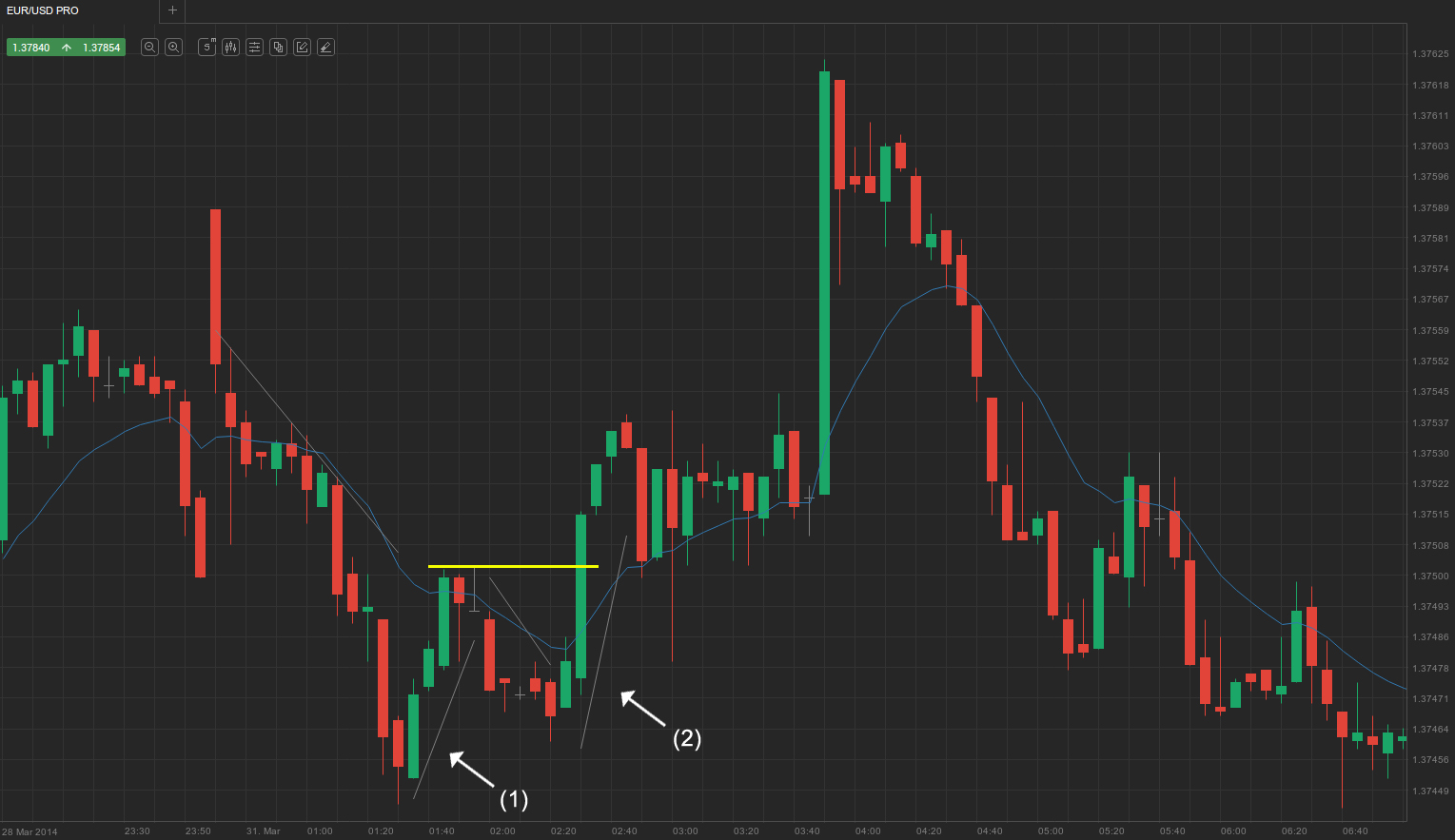
Bears will be reluctant to sell again unless the second move up (second leg) fails to exceed the top of the first leg and instead rebounds from its resistance level, forming a double-top bear flag. If it breaks above that level, there is a good chance that the trend has reversed, but if not – bulls will be quick to exit there and bears will short aggressively, having realised the second leg up has failed.
Don’t aim for perfection
 As we’ve said in previous chapters, perfect signals are rarely seen, and two-legged moves are no exception. Sometimes the move will form over many bars (10-20 or more), which will be harder to see on the chart. Switching to a higher time frame will surely make the pattern clearer, but spending your time scouting higher time frames for a pattern that will occur only once or twice per day is time-consuming and will cause you to miss other good entry points on the normal time frame you use.
Sometimes a two-legged pattern will actually be a three-legged pattern if the first push was not decisive enough to mark the end of a trend. Usually, when you have a double top or double bottom, the first move signifies an attempt at a trend change and the second move is a test of the level where the price rebounded. If it breaks that level, market movement usually shifts in that direction, but if it fails again to penetrate the price level, the market will likely pull back.
However, when the first move is not decisive enough to be regarded as an attempt to end the current trend, the market will often test it with a two-legged pattern. If both legs are above the previous move’s high, it becomes a three-legged pattern.
You can also have a three-push pattern when one of the two legs is made up of two separate legs. This is quite often seen in three-push patterns, but when you take a closer look you will see that the leg with the two smaller components often has properties very similar to those of the second single move. Practice makes perfect, and being able to distinguish such variations takes time to learn. We’ve said previously that traders should be in their comfort zone, so if you don’t feel confident enough to take this trade, you should simply hold back and wait for the next one. It will surely come eventually.