
 | Updated:
 Micro channels in price action trading
This lesson will cover the following
- A general overview of micro channels
- The environment in which micro channels occur determines how they should be traded
Micro channels – a general interpretation
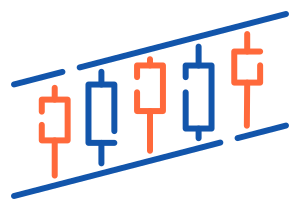
Generally, when we refer to a micro trend line, we mean a trend line that can be drawn on any time frame across two to about ten bars, where the majority of bars are relatively small and either touch this trend line or form close to it. In addition, the trend channel line can be drawn along the opposite ends of the bars. As a result, a very tight channel is created, known as a micro channel.
A specific feature of these micro channels is that unlike traditional channels, they have no pullbacks or, in rare cases, only tiny pullbacks.
If there is a large number of bars with large trend bodies in the direction of the micro channel, together with bars that have tiny wicks, this implies that the micro channel itself is strong, and it is very likely that the first pullback will not lead to a trend reversal.
A micro channel is usually about ten bars long. However, it may occasionally last for ten bars, be followed by a small pullback, and then continue for another ten bars. Regardless of how a trader interprets such a situationn – either as two micro channels separated by a pullback or as one large tight channel – they will generally trade it in the same way. They will wait for any reversal attempt to fail (in other words, for a pullback to occur) and then enter in the direction of the trend as it continues to develop.
The environment in which micro channels occur determines how they should be traded
Bull and bear micro channels can occur in uptrends, downtrends and trading ranges alike. Both types of micro channels can be breached to the upside or to the downside.
 Just as with any breakout, three possible scenarios can develop. First, the breakout can be real and can be followed by further trading in its direction. Second, it may turn out to be a failed breakout and be considered a small climactic reversal. Third, the market may go in either direction, and the breakout gradually transforms into a trading range.
Market participants will either enter in the direction of the breakout because they anticipate further price action, or in the opposite direction if they expect a fakeout. Traders usually compare the strength of the breakout with the strength of the reversal attempt. If one clearly outweighs the other, they will probably conclude that prices will move in that direction. If both appear equally strong, it is better to wait for additional price action before making a decision.

- Trade Forex
- Trade Crypto
- Trade Stocks
- Regulation: NFA
- Leverage: Day Margin
- Min Deposit: $100
 If a bear micro channel appears during an uptrend, it can be considered a bull flag or the final leg of a bull flag. A trader should look for a suitable signal bar and place a buy stop a few pips above its high in order to enter on the breakout from that bear micro channel.
If a bull micro channel appears during a downtrend, it can be considered a bear flag or the last leg of a bear flag. A trader should look to go short below the low of an appropriate signal bar (either the breakout to the downside or the pullback following it).
If the bull micro channel appears after a possible bottom in a downtrend, it may turn into the final flag of that downtrend, while the price may break out to the upside rather than the downside. Moreover, this breakout may represent a sudden move (spike) that marks the beginning of an uptrend.
If, instead of a bear micro channel in a bull flag, this micro channel is bullish and forms during an uptrend, the first breakout to the downside will probably fail. It will be treated as a pullback, and many traders will go long at that point. If the bull micro channel contains more bars, it is highly likely that the breakout to the downside will not manage to reverse the uptrend.
Example
 Let us imagine the following situation. If a micro channel in an uptrend consists of seven bars, it is quite possible that there are far more buyers at or below the low of the seventh bar than sellers. If prices move below this seventh bar, it produces a breakout to the downside from the channel. However, this selling is unlikely to last for more than one or two bars, because buyers will probably be keen to go long on the first pullback. Many traders will have been observing this seven-bar rally, waiting for any pullback so they can enter. They will probably go long below the seventh bar and above the high of the bar where the pullback occurred.
If a bull micro channel appears during an uptrend, higher prices are more likely. Market participants will usually try to go long near the middle or the low of the preceding bar.
It is also possible for the micro channel to be so tight that, when viewed on a higher time frame chart, it appears as a spike. This spike may be followed by a wider channel, producing the so-called spike and channel type of trend.