
 | Updated:
 Trend reversal targets
This lesson will cover the following
- Prior failed reversals are targets for future reversals
- An example
Previous reversals that failed often provide target levels for a successful reversal. In a downtrend, if there have been a number of long entries that failed as the price continued to fall, each of these entry prices (the high price of every signal bar) will be a potential target for a successful reversal to the upside. The price may surge to the highest signal bar’s high before showing a considerable pullback.
It is important for a trader to be aware of the market’s tendency to pull back after it has tested earlier signal bars. It is possible that some traders who opened positions on earlier signal bars may choose to scale into these positions when the market moves in the opposite direction to theirs. In this case, they will probably consider their initial entry as their final profit target, allowing them to exit at breakeven on their worst entry while locking in gains on all other entries.

- Trade Forex
- Trade Crypto
- Trade Stocks
- Regulation: NFA
- Leverage: Day Margin
- Min Deposit: $100
Many traders may find themselves holding losing positions and, as they watch their losses widen while the market moves in the opposite direction, they hope the price will eventually return to their entries. When this happens, they will close their positions and, hopefully, learn from their mistakes. Savvy price action traders may anticipate this behaviour and may use the aforementioned targets to close their long positions. In addition, very experienced traders choose to exit their positions at these target levels because they recognise the reliable recurring pattern of pullbacks ending near earlier entry levels. As the market has failed at these levels before, experienced traders will probably enter, assuming the market may fail again and that the correction could end at these prices.
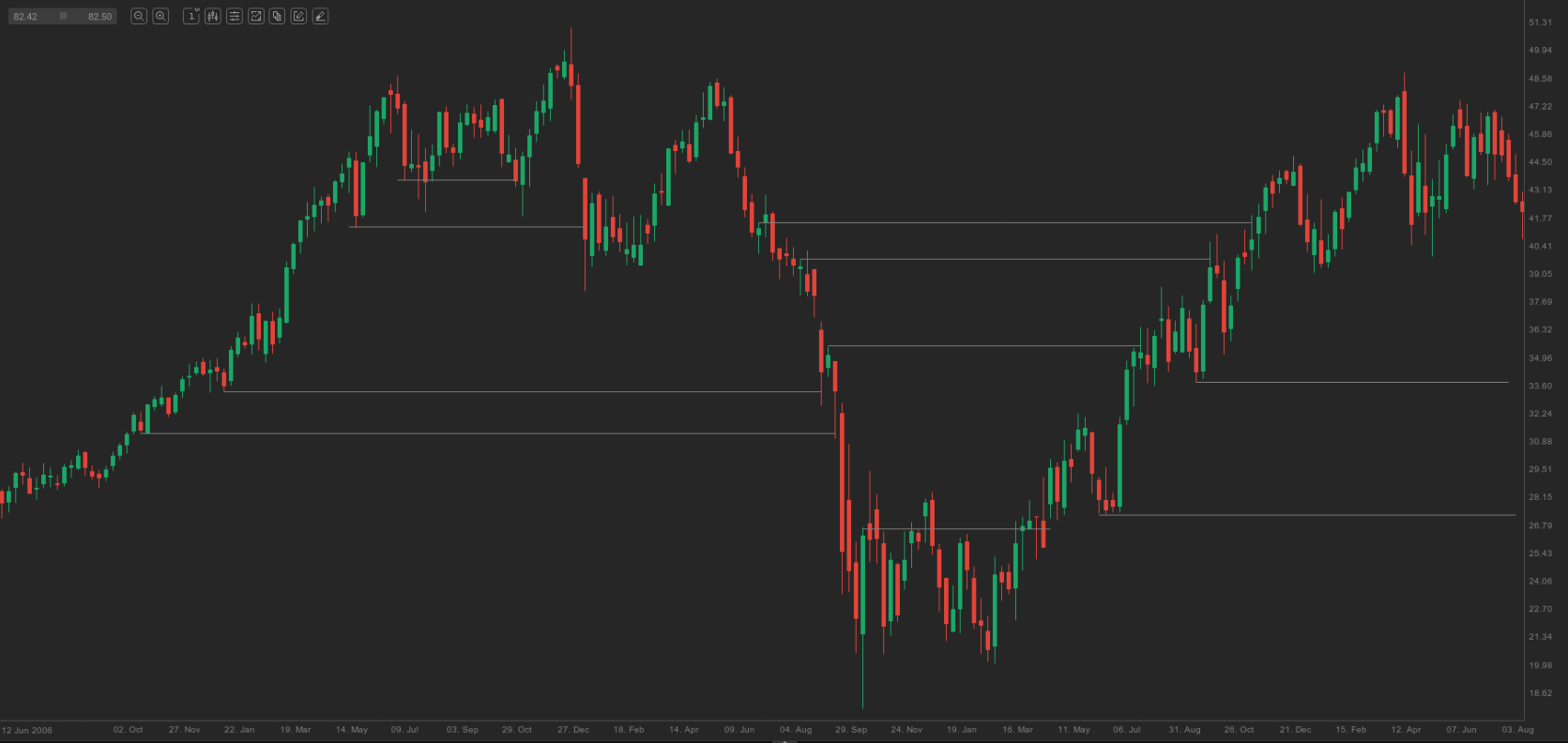
On the weekly chart of BASF above, there was a strong uptrend that ended on 16 July 2007, but several reversal attempts were evident on the way up. Each low of the bear signal bars represents a target for any retracement on the way down. Later, the downtrend that ended on 20 October 2008 displayed a few failed attempts at a reversal to the upside, while the high of each bull signal bar became a target for any correction during the subsequent rally. The move up from 9 March 2009 showed several failed attempts at a reversal to the downside, and each of them is a target for any subsequent move down.