
 | Updated:
 ‘Spike plus channel’ type of trends – general interpretation
This lesson will cover the following
- A quick view of spike plus channel trends
- The spike phase of these trends
- The three possible scenarios following the spike
During daily trading sessions, one can very often detect the so-called ‘spike plus channel’ type of trend. It may develop in many variations, while smaller trends are usually part of a larger trend. If one scrutinises a single trend, one will probably find that two different phases can be identified – a phase during which a strong move (a spike) is present and a phase during which a channel is formed. Every trend is usually in one of these two phases at any given time.
A quick view of spike plus channel trends
 At first, a sudden move (spike) consisting of one or more bars can be observed. What is specific about this phase is that prices move quite rapidly and a sense of anxiety can be observed in the market. This occurs because traders believe that prices may go further. The spike can appear as a breakaway gap, meaning the whole market rapidly moves from one price level to the next.
The move that follows is a pullback, which may consist of a single bar or several bars. Sometimes it may retrace beyond the beginning of the sudden move (spike). If a sudden move to the upside occurs, the following pullback may cause prices to plunge below the low of this bull spike. This is the point where a channel may begin to form.
 The phase that follows the pullback is where the trend transforms into a channel (sloping trading range). Anxiety now decreases and uncertainty takes hold of the market, which is typical of any trading range. As market participants observe that two-sided trading is now present, it is logical to think that the trend may be coming to an end. However, that is not what is actually happening. The trend continues to develop. Traders rush to lock in their profits but, as the trend extends, many will look to enter the market again (or add to existing positions) because they do not know when the trend will end. They also want to ensure they are in active positions (no one wants to miss a good trading opportunity).
After the channel phase, another sudden move (spike) may occur, which in turn may be followed by another channel. However, the second sudden move usually proves to be a false breakout, after which a retracement may follow. If a sudden move to the upside occurs and is followed by a bull channel where prices demonstrate weak momentum, the market may break out from the upper area of the channel (a second spike to the upside). In rare cases, this second spike will be followed by another channel. This spike is usually a fake-out, after which a retracement to the downside occurs.
The spike phase
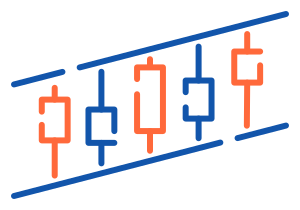 It is common for a trend to begin with a sudden move (spike), even if it consists of just one trend bar. This cannot be identified as the possible start of the trend until more price action unfolds. We can say that almost all trends are variations of the ‘spike plus channel’ type of trend.

- Trade Forex
- Trade Crypto
- Trade Stocks
- Regulation: NFA
- Leverage: Day Margin
- Min Deposit: $100
If price action consists of a string of bars encompassing a considerable number of pips with little or no pullbacks, this strong move is considered a spike. It may appear as a single medium-sized trend bar, as a string of trend bars (ten or more) with little or no overlap, or as a tight channel. A spike on a larger time frame chart often appears as a steep channel on smaller time frames. This spike usually ends at the first pullback; however, if it continues within the next one or two bars, it effectively becomes a second spike or a spike viewed on a larger time frame chart.
A spike to the upside means that traders agree this area is of no interest to sellers; thus, prices will probably climb further to an area where both sides (buyers and sellers) will be willing to trade. Prices will continue to accelerate to the upside until buyers prefer to lock in gains and refrain from entering new long positions, while sellers open short positions. Such a situation leads to a pause in the move up or to a pullback, which provides traders with the first clue that two-sided trading may have begun. The opposite applies to a spike to the downside.
The spike ends just before the first pause bar or pullback bar, as the pause itself indicates the end of the sudden move. From this point on, the market has to make one of three possible moves: first, resume the trend; second, enter a trading range; and third, undergo a trend reversal.
Three scenarios
 The first scenario is very often observed. Prices pull back over several bars, sometimes ten or more, after which the trend resumes. This pullback actually tests the spike and marks the beginning of a channel. When the trend continues, it usually demonstrates less strength than before (as signified by a larger number of overlapping bars, a shallower slope, pullbacks, and trend bars in the opposite direction). It therefore appears more like a channel, and the entire configuration has now become a spike plus channel trend.
The second scenario involves a pullback that lasts for more than ten bars. This usually leads to a trading range; thus, prices may break out in either direction. Very often, the breakout from the trading range occurs in the direction of the original trend. Although the trend usually resumes before the trading day ends (a trend resumption day), at times the breakout from the trading range may fail and reverse within the next several bars. In rare cases, the trading range continues for several hours or days and, as the swings within it are quite short, it is known as a tight trading range.
The third scenario involves a trend reversal. If the pullback from the sudden move (spike) lacks the strength to reverse the always-in trade to the opposite direction, it is highly likely that the original trend will continue. In almost every case, this continuation will appear as a channel. In fewer cases, prices will reverse and a spike in the opposite direction will appear. If this occurs, the market may soon enter a trading range as buyers and sellers seek more price action in their respective directions. Bulls will continue to go long in an attempt to create a bull channel that would follow their bull spike. Bears will continue to go short in an attempt to create a bear channel that would follow their bear spike. Even though this trading range may persist throughout the remainder of the trading day, eventually one side will overpower the other, and a breakout will occur. In such a case, the breakout is either followed by a channel (a spike plus channel trend day) or followed by another trading range (a trending trading range day).