
Trend trading guidelines, part I
This lesson will cover the following
- General thoughts on trend trading
- Low-probability trades
- High-probability trades
- Suitable entry points
More experienced traders also use limit orders to improve their performance, but because these orders involve higher risk due to their nature of betting against the current market movement, they are not suitable for most novice traders.
In many of the previous articles we’ve mentioned that betting against the market is a high-risk game and almost always has one outcome for the inexperienced trader – heavy losses. Entering with-trend positions is the safest way for a trader to ‘live to trade another day’ and gain as much experience as possible while minimising the possibility of wiping his account. However, we must note that because trading in general carries a big risk, it applies to with-trend trading as well. Therefore, we will dedicate this article to discussing with-trend trading and hopefully provide some useful tips.
 Strong trends impose different difficulties for traders. For example, when the market suddenly breaks out with large trend bars, many less-experienced market players panic. The price’s rapid acceleration catches wrongly positioned traders by surprise, leaving them unable to reduce their exposure or tighten their stops quickly enough. For instance, in a strong bull trend, as the market reaches a previous swing high, many participants expect a reversal. However, such attempts during strong trending movement usually fail and instead evolve into bull flags.
When the market enters a bullish channel, it will most often present weak buy signal bars that are quite tricky to exploit. They force us to buy at the top of the bullish channel, which is a low-probability trade. Most traders avoid such trades because of the higher risk they entail, but those with experience will still enter positions. Low-probability trades carry higher risk but also have the potential to yield much bigger profits (for example, if another large trend bar forms).
However
 High-probability traders, who make up the majority of market participants, tend to avoid with-trend trades near the top of a bullish channel (or the bottom of a bearish channel). During strong uptrends they often miss most of the action as they sit back and wait for a high-probability setup, such as a pullback to the moving average, after which they can go long. While waiting, they can only observe how the strong trend continues to edge higher without any pullbacks for many bars.
Keep in mind that this is not a bad thing, because each trader should remain in his comfort zone – if you are a high-probability trader, wait for high-probability setups, and vice versa. Market movement is almost never straightforward and the trend will eventually shift, providing high-probability traders with favourable opportunities to enter.

- Trade Forex
- Trade Crypto
- Trade Stocks
- Regulation: NFA
- Leverage: Day Margin
- Min Deposit: $100
No matter what type of trader you are, remember that the majority of successful traders follow the trend and do not bet against the market. During a bull trend, successful players are either long or they abstain from entering. During a bear trend, they are short or flat. Very few people manage to be consistently profitable when going against the market, and you should assume that you are not one of them.
Suitable entry points
 There are many suitable points a trader can find during a strong trend for a stop-entry order. The mere fact that the market is moving decisively in one direction should be reason enough to enter with at least a small fraction of your usual trading size.
A trader should also feel comfortable entering a very strong uptrend by placing a stop order above a prior swing high.
You can buy a pullback in a strong bull spike during an uptrend as well, but not if the spike is a climax, because that would commonly signify trend exhaustion. As we’ve said before, climaxes most often end with the trend reversing or entering a trading range.
Another reasonable entry would be to buy a wedge bull-flag pullback in an uptrend, or a pullback to the moving average from a higher high. All these scenarios are mirrored in a downtrend.
Limit orders
 More experienced traders also use limit orders to improve their performance, but because these orders involve higher risk due to their nature of betting against the current market movement, they are not suitable for most novice traders. Here are several entry opportunities.
You can buy at the close of the first bearish bar in a bull spike, or below the low of the prior bar.
You can also buy at the trend line of a bull trend (as it tends to act as a support), or at a prior swing low (which also tends to act as a support level).
When the price reaches the moving average, there are several possibilities. You can buy at or below the prior bar in a bull flag at the moving average. You can also buy on the close of the first bearish trend bar that closes below the moving average, as shown in the screenshot below.
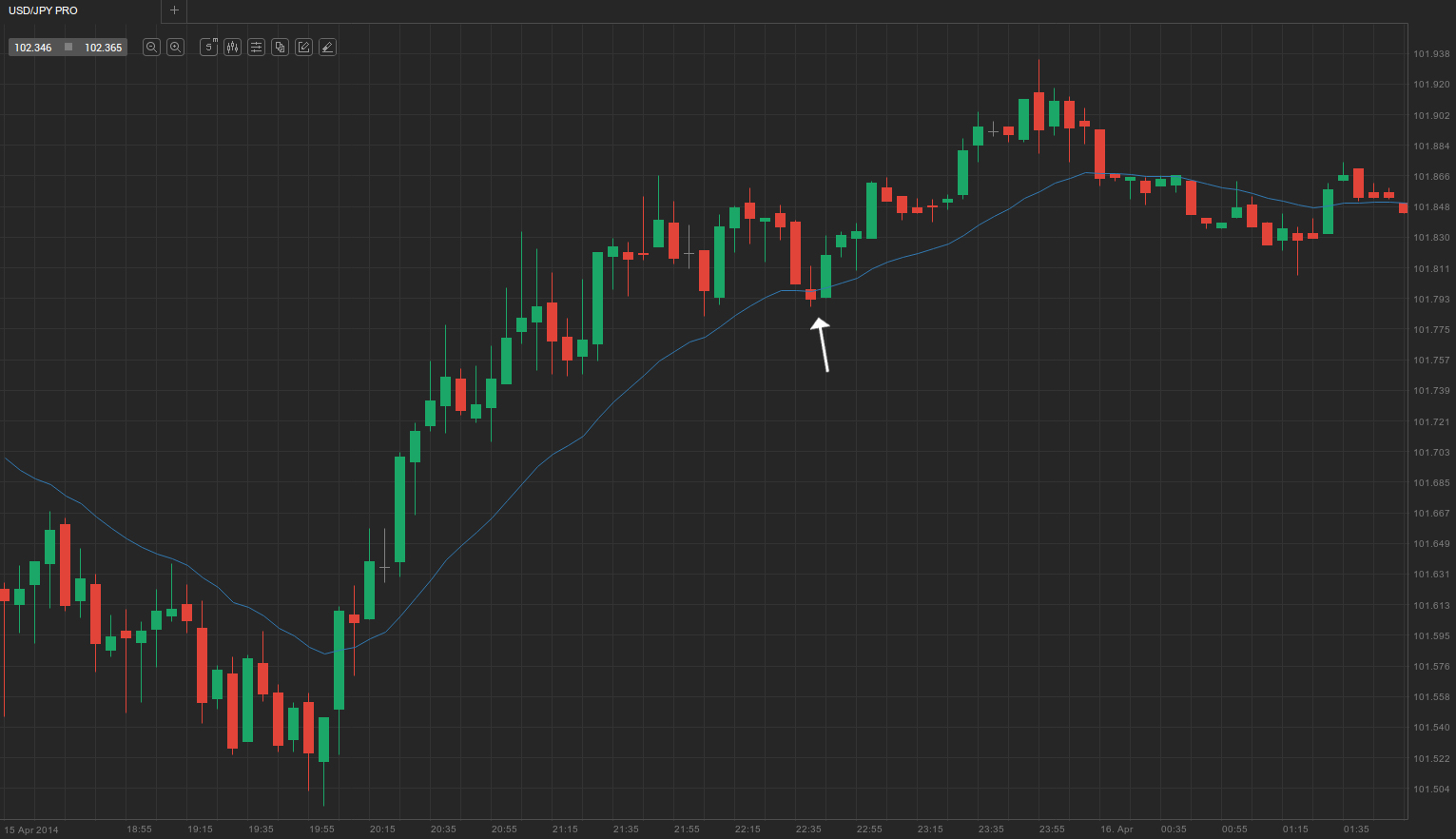
Moreover, if the trend has been so strong that it has not pulled back to the moving average for more than 15 bars and then retreats to it, you can buy at the moving average and scale in as the price continues to fall. You should exit the entire position at the price level of the first entry, but if the uptrend is very strong, aim to lock in profits at a test of the trend’s high.
Alternatively, you can buy at or below a swing low or a lower low at the bottom of a trading range, or after a bullish reversal that is likely to precede the formation of a new bull trend.
You can also consider buying a certain number of pips below the trend’s high, depending on the market’s recent (in some cases daily) movement. A 15-25% pullback from the trend’s high would be reasonable. This means that if the price has seen a daily fluctuation of 100 pips, as the price begins to pull back from the trend’s high, you can buy at 15-25 pips below the extreme. If the market has recently made a pullback, use that pullback as a guideline for the point below the trend’s extreme at which to enter. For example, if the market has previously pulled back by 50 pips, then you should buy a 45-55-pip pullback from the trend’s top.