
 | Updated:
 Overview of channels – the vacuum effect
This lesson will cover the following
- Explanation of the vacuum effect
- What actions do strong market participants actually take?
- Trend channels as sloping trading ranges
Vacuum effect
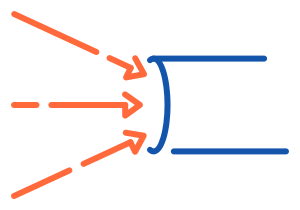 Within a channel, prices oscillate between the upper and lower areas of the channel because of the so-called vacuum effect. Let us imagine a bull channel. Prices are in a leg that tends to approach the trend channel line (upper line). As traders expect the price to touch this line, and possibly exceed it, they are likely to hold back on their short positions. Buyers will look to exit their long positions and take profits, while sellers will aim to enter new short positions. This relative absence of selling in the market triggers an imbalance and, as with any imbalance, prices tend to move more rapidly.
A huge bull trend bar often forms as the price tests the upper area of the channel. This may lure anxious bulls to go long at the top of the sudden move because they assume the price is creating a stronger leg up. However, as the majority of breakout attempts tend to fail, this move may also fail because of the presence of institutional participants. Bears with huge capacity intend to go short, but they will probably wait until prices touch the trend channel line (upper line). As soon as the price reaches that level, they begin to sell aggressively and overpower the bulls. Institutional bears prefer to see a large bull trend bar because, as they anticipate prices will fall, they place their sell orders at the best possible spot – the top of that bar.
The price may halt in the upper area of the channel because both sides of the market are deciding whether an actual breakout will occur. After that, the price will usually tumble rapidly because both strong (institutional) bulls and bears have probably realised that the breakout attempt may fail.
What actions do these strong participants actually take?
 In the upper area of the channel, strong bulls stop buying and close their long positions for a brief profit. They are aware that such an opportunity will be short-lived, as the market tends not to remain at an extreme level for long. As these bulls exit the market, they will probably not go long for a few bars.

- Trade Forex
- Trade Crypto
- Trade Stocks
- Regulation: NFA
- Leverage: Day Margin
- Min Deposit: $100
A relative absence of buying now prevails. At the same time, strong bears begin to sell heavily, causing the price to plunge rapidly to the lower area of the channel. Both sides now anticipate that the trend line (lower line) will be tested. Strong bears will continue to go short until the price actually reaches the trend line, and they will probably take their profits there. In the meantime, strong bulls will likely abstain from action until the price touches the trend line.
 Such a situation will lead to a quick, sharp move to the downside, which may urge beginner traders to go short because they expect a breakout below the trend line. You can now see that they intend to act in exactly the opposite way to institutional players. So, beginners should take note that their main goal is to follow the actions of these institutional traders and never take the opposite action.
As the price enters the lower area of the channel and eventually touches the trend line, strong bulls will enter new long positions, while strong bears will take profits on their short positions. Both sides now anticipate that the price may form a new high and test the upper area of the channel. There, the whole process will begin once again. This process applies to all channels – from trading ranges to triangles.
Trend channels as sloping trading ranges
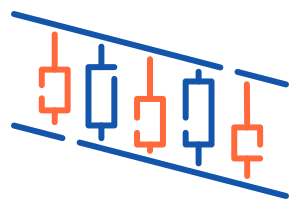
Within a trend channel, two-sided trading occurs, which is behaviour inherent to trading ranges. Every trend channel can be viewed as a trading range with a slope. If this slope is of considerable steepness and the channel itself appears narrow, the channel exhibits trending behaviour. Therefore, traders should make their entries only in the direction of the underlying trend.
If the slope is shallower and the price has demonstrated larger swings within the channel itself (for instance, over five bars), the channel behaves more like a trading range. In such cases, traders can make entries in either direction.
On the image below we can see what a bear trend channel should look like.
![trend channel bearish[1]](https://www.tradingpedia.com/wp-content/uploads/2020/09/trend-channel-bearish1.svg)
There seems to be a magnetic pull in the middle area of the channel, which contains price action within the channel. This is typical of all trading ranges. Prices remain in the channel and do not accelerate sharply because of the high level of uncertainty, just as is the case with all trading ranges.
If we imagine a bull channel again, the bulls will look to bolster their positions at the lowest possible price. Bears with limited capacity, on the other hand, will hope a sell-off occurs so that they can exit at the smallest possible loss. Because the bulls are not certain whether a pullback that will allow them to buy as much as they intend at a better price will actually occur, they will probably continue to purchase in stages as the price rises. Meanwhile, bears with limited capacity will look to buy back their losing shorts. Such a scenario will surely bolster buying pressure in the market.