
 | Updated:
 Forex Brokers and Where They Fit in the Market
This lesson will cover the following
- How the forex market works
- What is a forex broker and what can they offer investors
- What is a liquidity provider
As you’ve already read in the previous chapters, the foreign exchange market is the biggest and most liquid market in existence, with a daily turnover of US$5.3 trillion as of April 2013. It keeps growing with each passing day, as the limitless possibilities for profit, the use of leverage and the relatively low capital requirements compared with other markets attract more and more investors.
However, many people, most often individual traders who have only recently entered the market, picture a particular brokerage firm when they are asked what Forex is and how the system works. But there is much more to it, and understanding it is of significant importance. In order to choose a reliable and suitable broker and to avoid disadvantages such as latency risk, negative rather than two-way slippage and many others, a trader must first learn how the Forex market actually works and how an order is executed.
Brokers and their use
 Brokers make the market easily accessible to any trader, as their platforms—some proprietary and custom-made, others white-labelled or purchased outright—provide a user-friendly interface that allows everyone, whatever their level of experience, to execute orders within a fraction of a second. This is the source of their value.
Forex brokers allow their customers to apply a wide variety of strategies by providing them with a broad set of trading instruments and indicators. Some companies, of course, excel above others by giving their users far more interface customisation options, instruments and indicators, a wider choice of deposit and withdrawal methods and, as in any other business, superior customer support.
But where exactly do brokers sit in the market chain? If you look at the Forex market from a different, top-down perspective, you will notice that it, like any other market, consists of buyers and sellers, with the product being the service of providing the ability to trade currencies. Traders (the clients) pay sellers (the brokers) a fee—the bid/ask spread of the traded asset or a fixed commission—to gain access to the Forex market. But in this chain, brokers are merely the retailers who provide the service. Have you ever wondered where the actual money (liquidity) comes from? The next few lines will answer that question.

- Trade Forex
- Trade Crypto
- Trade Stocks
- Regulation: NFA
- Leverage: Day Margin
- Min Deposit: $100
Liquidity providers
The institutions responsible for providing the Forex market with sufficient funds are the so-called liquidity providers, also known as market makers. A liquidity provider links many traders and brokers, creating a joint market whose increased liquidity benefits all participants by driving spreads down and therefore reducing the cost of trading. Market makers sell to and buy from their clients, profiting from the bid-offer spread, thereby facilitating trade and reducing transaction costs.
 Liquidity providers are most often large banks and other financial institutions. In Forex, some of the biggest and best-known providers are HSBC, Bank of America, Citibank, UBS, Credit Suisse, Goldman Sachs, JPMorgan Chase, Deutsche Bank and others, with the last of these ranking first.
So, how do traders connect with market makers?
Before a Forex broker can begin to operate, it must invest a certain amount of capital to acquire three elements of utmost importance: a trading platform, a sophisticated back office and a bridge interface through which it can establish a connection with the interbank currency market.
The trading platform, as we have already noted, is what the user sees and experiences during their everyday trading sessions. The constantly updating information displayed on the screen—prices, quotes, charts, news, etc.—comes from the back-office systems, where you can find the price engine, trade and account servers, news servers, and so on. The entire flow of information streamed from the back office is integrated into the trading platform which, as we have already said, gives the broker a competitive edge if it is user-friendly, lag-free and provides access to an extended set of tools.
Some brokers have the capital to create their own proprietary trading platforms, while others use white-labelled products which they customise, and still others simply buy a licence to use an existing platform such as MetaTrader by MetaQuotes Software Corp.
Price quotes
This brings us to the third fundamental element a broker needs in order to operate—obtaining Forex price quotes from market makers. To receive quotes from a liquidity provider, a broker must set up a connection with the interbank market through a so-called bridge interface. A broker will use the Application Programming Interface (API) instructions supplied by the liquidity provider, a major participant in the interbank market, to establish the link and receive real-time streamed quotes.
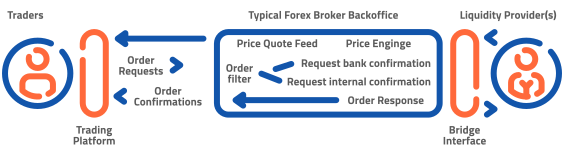
Typically, larger brokers establish a network with more than one market maker—often up to four—allowing them to be flexible when executing orders, since the different banks’ prices vary to some extent. Meanwhile, smaller Forex brokers usually have only one liquidity provider, leaving them dependent on whatever prices that single market maker announces. Remember, no matter which broker you choose to trade with, you will be interacting with only a fraction of the Forex interbank market, because brokers operate with a limited number of market makers.
Example
 Let’s illustrate the whole process with an example. A trader decides to place a long order on EUR/USD and sees a current price of 1.3000 – 1.3003 on the screen. The user submits a request to buy at the 1.3003 ask price, which is then forwarded to the broker’s back-end bridge. At this point the broker receives streamed quotes from its liquidity providers.
Let’s imagine our broker operates with two market makers. One of them has set prices at 1.3001 – 1.3003, while the other quotes 1.3000 – 1.3002. The broker will now confirm the trade and profit through its bid/ask spread. Brokers, of course, always choose the better asking price and, in our case, buy at 1.3002 (one pip below the price paid by the client), offsetting trade risk and leaving the broker indifferent to whether the trader wins or loses money.
Now, let’s move to closing the position. Suppose the euro has gained versus the US dollar and the broker shows its clients that the EUR/USD cross has risen to 1.3100 – 1.3103 after seeing that the first liquidity provider has set 1.3099 – 1.3101, while the other quotes 1.3100 – 1.3103. As soon as the trader closes the position at 1.3100 (the rate the broker offered), the broker itself closes at the best price provided by the market makers—1.3099—earning an extra pip. In this way the broker remains indifferent to whether the user makes or loses money.
Types of brokers
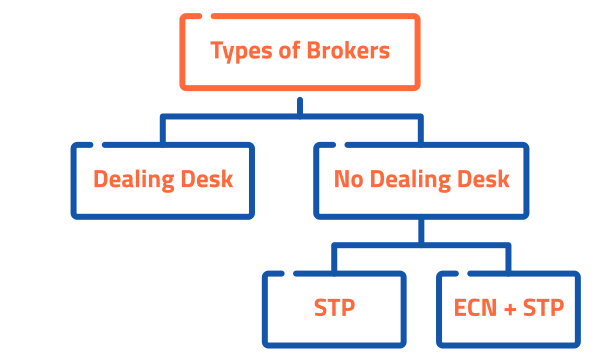
There are two major categories of brokers: Dealing Desk and No Dealing Desk. The latter can operate as a Straight-Through Processing (STP) broker or as an STP broker with Electronic Communications Network (ECN) access.
Dealing Desk brokers
 Dealing Desk brokers are market makers and act as a counterparty to their clients’ orders. A Dealing Desk broker will set a bid and an ask price at which it is willing to buy and sell and may decide to quote above or below actual market levels. When a user enters a trade, the broker will always open the opposite position, eliminating the possibility that an order will not be executed.
Dealing Desk brokers profit by buying at lower prices and selling at higher ones, or from the bid/offer spread, allowing them to earn money when prices move in either direction. Orders placed with a DD broker rarely leave its own liquidity pool and reach the interbank market, making the model largely self-sustaining.
Some may think that, by setting their own prices and always entering the opposite position, such brokers may be in a conflict of interest, but the trader always has the right to reject the terms. Dealing Desk brokers usually offer fixed spreads.
No Dealing Desk brokers
 No Dealing Desk brokers are the opposite of Dealing Desk brokers and provide traders with direct access to the interbank market. Because they do not set their own prices, they profit by adding a mark-up to the bid/offer prices quoted by the liquidity provider. An NDD broker will not take the opposite position when a client places an order; instead, it matches the order with a counterparty. In this case the broker serves only as an intermediary.
An NDD broker can be either STP (Straight-Through Processing) or STP + ECN (Electronic Communications Network). There is no requoting of prices, which means it is possible to trade during economic announcements without restrictions, but the spreads are not fixed and may spike during periods of heightened volatility.
– Straight Through Processing broker – an STP broker is a type of online NDD broker that is connected to one or more liquidity providers. In this model, clients’ orders are fully computerised and immediately forwarded, without any broker intervention, to the interbank market where they are processed.
– Electronic Communications Network – an ECN broker uses an electronic communications network to put its clients directly in touch with other traders. ECNs provide real-time order-book information, featuring processed orders and the prices offered by banks in the interbank market, which helps to improve market transparency by sharing information with all participants. This enables ECN brokers to offer their customers more competitive spreads and, because those spreads are narrow, they profit by charging a fixed commission per transaction.