
 | Updated:
 Types of Financial Markets
This lesson will cover the following:
- Nature and functions of financial markets
- Types of financial markets in terms of instruments’ maturity
- Main divisions of financial markets
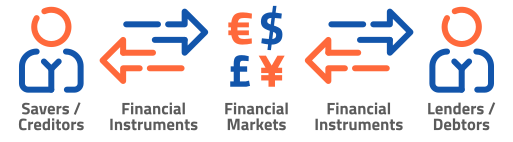
A financial market is a venue in which people and entities trade financial securities, commodities and other fungible assets at prices determined purely by the forces of supply and demand. Markets function by bringing the two counterparties – buyers and sellers – together in one place, allowing them to find each other easily and thereby facilitating the transaction between them.
Financial markets can be viewed as channels through which loanable funds flow from a supplier with an excess of assets towards a demander facing a deficit of funds.
There are different types of financial markets, and their classification depends on the characteristics of the financial claims being traded and the needs of the various market participants. We recognise several types of markets, which vary according to the instruments traded and their maturities. A common breakdown is as follows:
- Trade Forex
- Trade Crypto
- Trade Stocks
- Regulation: NFA
- Leverage: Day Margin
- Min Deposit: $100
Capital market
The capital market facilitates the raising of capital on a long-term basis, generally for periods exceeding one year. It consists of a primary and a secondary market and can be divided into two main subgroups – the Bond market and the Stock market.
- The Bond market provides financing by accumulating debt through bond issuance and bond trading.
- The Stock market provides financing by sharing the ownership of a company through the issuing and trading of stocks.
The primary market, or the so-called “new issue market”, is where securities such as shares and bonds are created and traded for the first time without the use of an intermediary such as an exchange. When a private company decides to become a publicly traded entity, it issues and sells its shares through an Initial Public Offering (IPO). IPOs are strictly regulated and facilitated by investment banks or syndicates of securities dealers, which set an initial price range and then oversee the sale directly to investors.
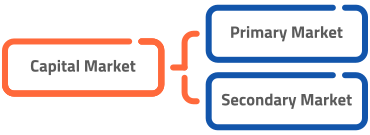
The secondary market, or the so-called “aftermarket”, is where investors purchase previously issued securities such as shares, bonds, futures and options from other investors rather than from the issuing companies themselves. The secondary market is where the bulk of exchange trading occurs and is what people mean when they refer to the “stock market”. It includes the NYSE, Nasdaq and all other major exchanges.
However, some previously issued shares are not listed on an exchange; instead, they are traded directly between dealers over the telephone or by computer. These are known as over-the-counter (OTC) shares, or “unlisted shares”. In general, companies traded in this way usually don’t meet the requirements for listing on an exchange. Such shares are traded on the Over-the-Counter Bulletin Board or on the pink sheets and are typically issued by companies with poor credit ratings or by penny-stock firms.
Money market
 The money market enables economic units to manage their liquidity positions through the lending and borrowing of short-term funds, generally for periods of less than one year. It facilitates interaction between individuals and institutions with temporary surpluses of funds and those experiencing temporary shortages.
Funds can be borrowed for very short periods via a standard instrument known as “call money”. These funds are borrowed for one day—from 12:00 p.m. today until 12:00 p.m. the next day—after which the loan becomes “on call” and can be recalled at any time. In some cases, call money can be borrowed for up to one week.
Besides the call-money market, banks and other financial institutions use the so-called “Interbank market” to borrow funds for longer periods—from overnight to several weeks and up to one year. Retail investors and smaller trading parties do not participate in the Interbank market. While some trading is carried out by banks on behalf of their clients, most transactions occur when one bank has excess liquidity while another faces a shortage.
Such loans are made at the Interbank rate, the rate of interest charged on short-term loans between banks. An intermediary, called a dealer, quotes a bid and an offer rate; the difference between the two represents the spread, or the dealer’s income. The Interbank rates in London are known as LIBOR (London Interbank Offered Rate) and LIBID (London Interbank Bid Rate). Similarly, in Paris we have PIBOR, in Frankfurt FIBOR, in Amsterdam AIBOR, and in Madrid MIBOR.
Foreign exchange market
 The foreign exchange market facilitates currency trading and is the largest, most liquid market in the world, with an average daily turnover of more than US$5 trillion. It includes all of the world’s currencies, and any individual, company or country can participate in it.
Commodity market
 The commodity market oversees the trading of primary products, a process that occurs in roughly 50 major commodity exchanges where purely financial transactions increasingly outstrip physical purchases scheduled for delivery. Commodities are commonly classified into two subgroups.
- Hard commodities are raw materials typically mined, such as gold, oil, rubber, iron ore, etc.
- Soft commodities are typically grown agricultural products such as wheat, cotton, coffee, sugar, etc.
Derivatives market
 It facilitates the trading of financial instruments such as futures contracts and options, which are used to help control financial risk. These instruments derive their value from an underlying asset, which can take many forms, including shares, bonds, commodities, currencies or mortgages. The derivatives market is divided into two segments that differ completely in legal nature and method of trading.
Exchange-traded derivatives
 These are standardised contracts traded on an organised futures exchange. They include futures, call options and put options. Trading in such uniform instruments requires investors to pay an initial margin that is settled through a clearing house; this mechanism removes the risk of either counterparty failing to meet its obligations.
Over-the-counter derivatives
 These contracts are privately negotiated and traded directly between the two counterparties, without the services of an intermediary such as an exchange. Securities such as forwards, swaps, forward-rate agreements, credit derivatives, exotic options and other complex derivatives are almost always traded in this way. They are tailor-made, remain largely unregulated and provide both buyer and seller with greater flexibility to meet their specific needs.
Insurance market
 It helps to redistribute various risks. Insurance transfers the risk of loss from one entity to another in exchange for a fee. The insurance market is where an insurer and the insured (the policyholder) meet to strike a deal, primarily enabling the client to hedge against the risk of an uncertain loss.