
Positioning within trading channels and following breakouts
This lesson will cover the following
- General thoughts on trading channels
- Volatility in different trading sessions
- The most common strategy for trading channel breakouts
Trading channels are a very common occurrence in the financial markets and, as such, day traders tend to use breakouts from channels as another tool for generating additional profit. Channel breakouts are a viable strategy for currency trading because the forex market is very liquid and also experiences high volatility during releases of major economic data. The market spends much more time trending in a certain direction than moving within a set of tight boundaries, so it is bound to break out sooner or later.
As you know, the forex market is open around the clock except at weekends, and the different trading sessions favour the trading of specific currency pairs. Moreover, overall trading activity varies and picks up during the sessions when data from the US are released, thus presenting a higher chance of breakouts. If you want to read more about the different trading sessions, visit Trading Pedia’s Forex trading academy and, particularly, our Trading sessions article.

- Trade Forex
- Trade Crypto
- Trade Stocks
- Regulation: NFA
- Leverage: Day Margin
- Min Deposit: $100
Varying volatility
 Because the Asian session is known for its lower volatility, channels are often formed during those trading hours. However, as key European and US economic data are released during the respective sessions, and especially during their overlap, trading volumes experience significant spikes, which often lead to breakouts from the previously formed channels. Thus, it is of utmost importance for day traders to keep a close watch on significant economic releases, especially when the price is near the top or bottom of a trading channel. If this is the case, you should aim to enter in the direction of the breakout and not fade it (counter-bet). Because channels are easily spotted and drawn, the majority of market players will also likely be aware of their existence, and thus broad market reactions can be expected.
We have spoken on several occasions about trend lines, trend channel lines and the trading channels they form. You can read our “Channel” article, “The Trend – a Trader’s Best Friend“, and also the article “Trend Channel Lines in Price Action“.
Plotting
 Having read those articles, you should have learned that there are several ways for a trend channel line to be drawn, which depend on a trader’s unique perspective and understanding of trading. The most common way, however, is to plot it as a parallel line to the trend line. If the market is not trending but trading sideways, the channel will be horizontal and the two boundaries are broadly accepted support and resistance levels.
In the best-case scenario, the resulting channel will contain all – or at least most – of the price action within it. This is due to the nature of the two boundaries as strong support and resistance levels. The goal a day trader seeks to achieve is to predict accurately a penetration of one of the boundaries that will be supported by enough follow-through buying or selling and thus become a successful breakout. Because this strategy works at times of high volatility, it will be most effective at the opening of the major financial markets and during the release of critical economic indicators, such as US non-farm payrolls, ISM reports, consumer inflation data, interest-rate decisions, etc.
Common strategy

The most common breakout strategy day traders use involves the following steps:
– identify a trading channel that is as close as possible to perfect – most of the price action must be contained within it
– enter a long or short position as the price penetrates the channel’s upper or lower boundary
– place a protective stop below the upper channel line in a long position or above the lower channel line in a short position
– trail your stop higher or lower as the price moves in your favour.
Details

These were the general guidelines, so let’s discuss some of the details. When you see a distinctive trading channel, you should place entry orders on both sides of the channel so that you can benefit from a breakout in either direction. It would be best if those entry orders were placed around 10-15 pips beyond the penetration point so that they are not triggered by random noise. The stop-loss order must be positioned the same number of pips from the entry point but on the other side of the trend channel line. Your profit target should be double the channel’s range and should be combined with a trailing stop if you want to squeeze more profit out of the breakout. You can use either a percentage or an absolute value for the trailing stop.
For example, if the trading channel is between EUR/USD 1.3200 and 1.3160, you should place entry orders at 1.3210-1.3215 for a long position or 1.3150-1.3145 for a short position. Protective stops must then be placed at around 1.3190 for the long order or 1.3170 for the short order. Because the channel’s range is 40 pips, your profit target should be double that amount, or 80 pips, beyond the entry point. In our case, the long position’s profit target would be touched at EUR/USD 1.3290-1.3295, while the short one should be closed at around 1.3070-1.3065 dollars.
Let’s take a look at a market example.
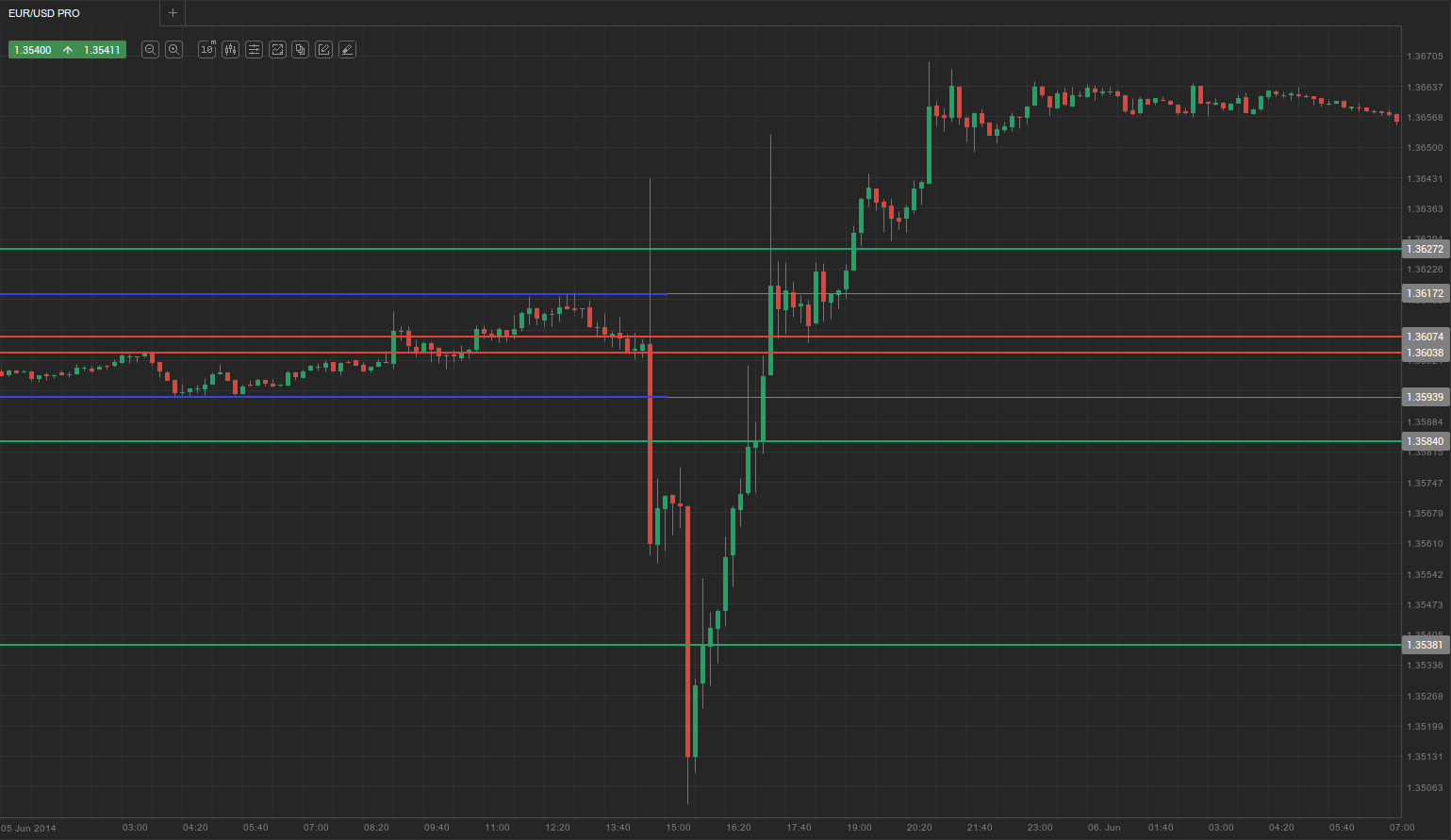
As you can see, the market stayed within a relatively tight trading range throughout the Asian session and into the early European trading hours, before the sharp move that followed. Market players expected significant volatility as the European Central Bank was anticipated to cut its benchmark interest rate, while consumer inflation within the euro area continued to drift away from the ECB’s target level and sparked fears of deflation. And so it did. The market’s knee-jerk reaction was a major decline, which would have benefited bears.
On the screenshot you can see the trading channel, encompassed by the two blue lines, approximately 23 pips wide. Based on our trading strategy, we place entry orders 10 pips above and below the channel, as visualised by the green lines. Our protective stops are then placed 10 pips below and above the upper and lower channel boundary, as shown by the red lines. As the price drops and triggers our short-entry order, our profit target is double the channel’s range – 46 pips. Once it is hit, you might choose not to close your position but rather to milk the move down by trailing your stop.