
United States dollar index
You will learn about the following concepts
- What is the US dollar index
- How is it calculated
- Which are the index’s components and what are their weights
- Correlations between the USDX and its components
- Trade-weighted US dollar index
In the previous article, we profiled the US dollar by compiling the most significant economic indicators and other events that influence its valuation. We will now turn our attention to a measure that gauges the greenback’s relative strength against its major trading counterparts – the US dollar index.
The US dollar index is a geometrically averaged calculation of six currencies weighted against the US dollar, namely the euro, the Japanese yen, the British pound, the Canadian dollar, the Swedish krona and the Swiss franc. After the end of the Bretton Woods fixed exchange rate system in 1973, the greenback began to float freely against other global currencies. This necessitated the creation of the US dollar index by the Federal Reserve to provide an external, trade-weighted average of the dollar.
The US dollar index started with a value of 100.000 and has since ranged between its record high of 164.7200, reached in February 1985, and its all-time low of 70.698, recorded on 16 March 2008. The figure is interpreted by comparing the current value, and the change in the dollar’s strength against its counterparts, with its initial value. Thus, if the index is at 80.000 in 2014, the US dollar has lost ground against the basket of six currencies compared with its position in 1973 (a 20% loss in value).

- Trade Forex
- Trade Crypto
- Trade Stocks
- Regulation: NFA
- Leverage: Day Margin
- Min Deposit: $100
Currency components
 We said that the index comprised six component currencies. There has been only one alteration of the basket – when the euro was created and adopted as the national currency of several countries. Prior to that change, the US dollar index contained ten currencies – the five current ones, apart from the euro, plus the West German mark, the French franc, the Italian lira, the Dutch guilder and the Belgian franc. The euro replaced the last five.
Logically, the currencies comprising the US dollar index have different weights in its calculation – the Swedish krona can hardly equal the euro. These percentage weights are used in the index’s calculation formula and are as follows:
– Euro (EUR) – 57.6% weight
– Japanese yen (JPY) – 13.6% weight
– Pound sterling (GBP) – 11.9% weight
– Canadian dollar (CAD) – 9.1% weight
– Swedish krona (SEK) – 4.2% weight
– Swiss franc (CHF) – 3.6% weight
It is not surprising that the euro has the biggest weight in the dollar index – the Eurozone currently consists of 18 countries and, for many economists, the euro is the world’s second reserve currency. Meanwhile, Japan is the world’s fourth-largest economy (fifth if you count the European Union).
The US dollar index is calculated using the following formula: USDX = 50.14348112 × EURUSD^-0.576 × USDJPY^0.136 × GBPUSD^-0.119 × USDCAD^0.091 × USDSEK^0.042 × USDCHF^0.036 (note that when the US dollar is not the base value in the currency cross, the value is negative).
The dollar index is calculated by Reuters in real time every 15 seconds, based on the spot prices of the index’s underlying currencies. The price used for the calculation is the mid-point between the Reuters top-of-the-book bid/offer in the component currencies. The real-time quote is then delivered to the Intercontinental Exchange and redistributed to other data suppliers.
You can trade cash or futures contracts based on the US dollar index, and options on those futures contracts, only on the ICE electronic trading platform. The value of a dollar index futures contract is $1,000 × the index value; therefore, a change of one full point in the index is worth $1,000 (if you went long with one futures contract at 81.000 and the index rises to 82.000, you earn $1,000). The minimum tick size (the smallest increment) is 0.005, which is worth $5, so each tick up or down will earn or cost you $5 per contract.
Correlations
 Based on historical data, you can calculate for yourself that there is a very strong negative correlation between the US dollar index and its underlying currencies, which can be used in different trading strategies. If you want to read more about inter-market correlations, check out our article ‘Correlations within the Forex market’.
According to data from the ICE and Bloomberg, the euro has a correlation of -0.941 with the dollar index, based on statistics dating back to 1999. The yen stands at -0.506, the pound at -0.729, the Canadian dollar at -0.385, the Swiss franc at -0.896 and the Swedish krona at -0.826.
Although some of the currencies have distinctly lower correlations with the US dollar and may lead to errors in trading, those with the highest negative correlation can have fairly reliable applications. For example, knowing that EUR/USD has a 94% negative correlation with the US dollar index, we might expect that when EUR/USD reaches a new low, the dollar index (USDX) should surge to a new high. Take a look at the following screenshot.
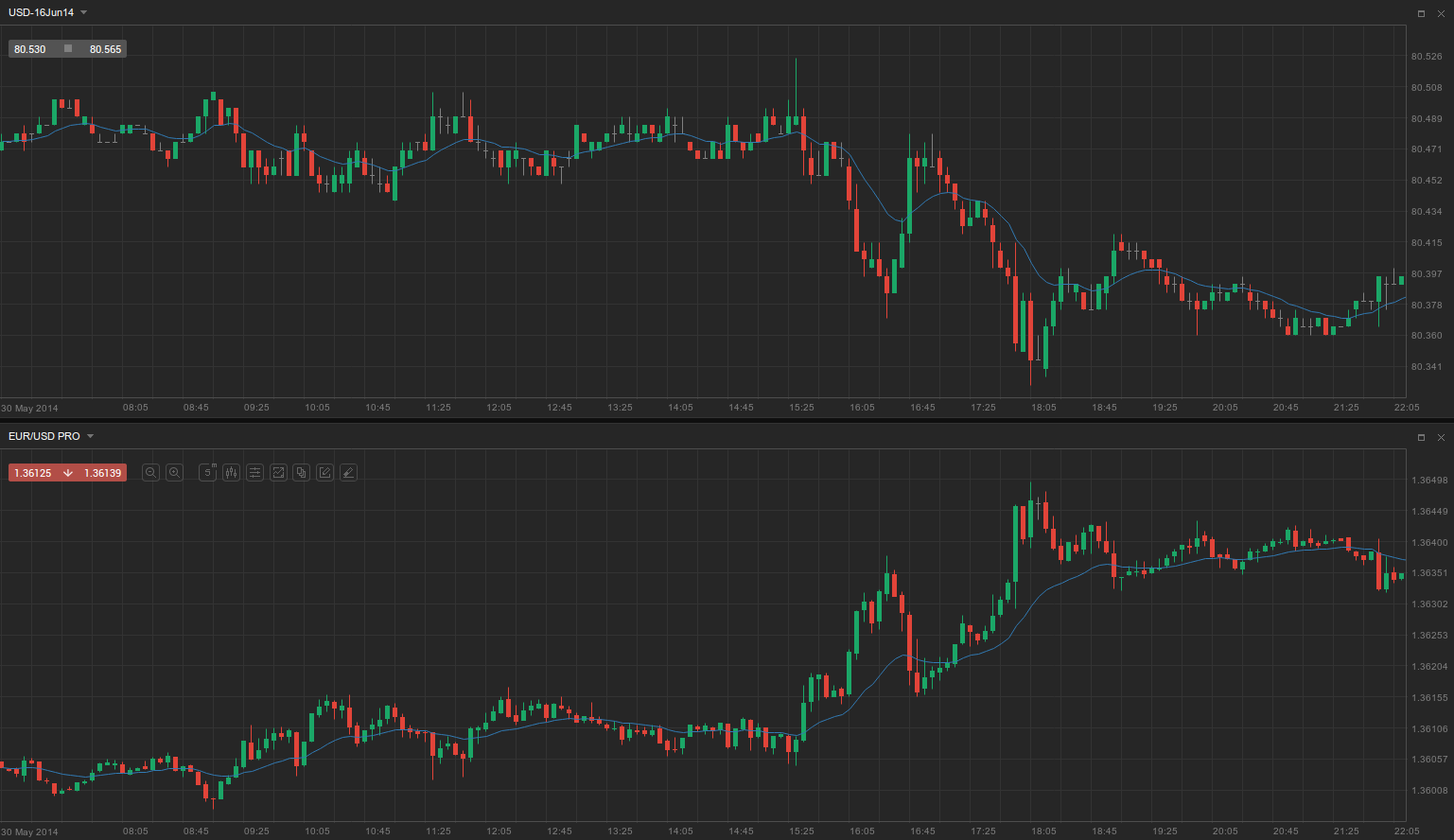
As you can see in the example above, the EUR/USD cross almost mirrors the dollar index’s movement, as each new high is confirmed by a new low in the other counterpart. If, however, there is a divergence between the two and the dollar index has not posted a new high, you might anticipate a possible reversal in the EUR/USD cross. It is common practice for traders to treat this like an ordinary divergence, but to use the dollar index chart instead of an indicator.
Thus, when you see a currency strengthening against the dollar, such as CHF/USD, but that appreciation is not supported by an overall weakness in the dollar (US dollar index), it is likely a sign not to go long on that currency in the long term. As a measure of the dollar’s strength, a gain in the USDX should be coupled with a decline in the opposing currencies and vice versa. Discrepancies should be viewed and traded as divergences.
Apart from helping you find divergences, the dollar index can be traded in another, more conventional, way. If, for example, you want to trade USD/CAD but are unsure of the US dollar’s relative strength against the Canadian dollar, and therefore fear an entry might result in a loss or unsatisfactory results, you can trade the overall strength of the dollar – via the index. Just as a trader who is unsure whether a company’s stock will underperform, but sees that the overall stock market is performing solidly, may prefer to purchase an index, you can do the same. For instance, if better-than-expected key economic data have been released from both the US and Canada, and both readings were stronger than forecast, leaving you with ambivalent expectations for USD/CAD, you can go long on the USDX if the greenback is outperforming its major trading partners overall.
Trade-weighted US dollar index
 So far, we’ve discussed only the first measurement of the exchange value of the dollar – the US dollar index. However, there is a second measure, known as the trade-weighted dollar index (the Broad Index). It was introduced by the Federal Reserve as a response to the adoption of the euro by several European countries and to better reflect current US trade patterns.
The trade-weighted dollar index is similar to the US dollar index in that it is calculated as a weighted average of the value of a number of currencies relative to the US dollar. However, this measure is based on the export-import values of American goods and includes 26 currencies whose weights are determined by US trade activity with each country. When it was introduced, the countries included in the trade-weighted basket accounted for more than 90% of total US imports and exports.
The weight of each currency here is reassessed much more frequently than in the US dollar index traded on the ICE. According to some economists, the larger pool of underlying currencies makes this measurement of the US dollar’s value more accurate. Also worth noting is that the trade-weighted dollar index includes currencies of emerging economies, whose trade activity is expected to continue growing at a considerable pace. Below you can see the up-to-date list of all currencies included in the index and their weight.
Broad Index of the Foreign Exchange Value of the Dollar
| Country or Region | 2014 |
| China | 20.81 |
| Euro area | 16.22 |
| Canada | 12.618 |
| Mexico | 11.67 |
| Japan | 7.552 |
| Korea | 3.8 |
| United Kingdom | 3.393 |
| Taiwan | 2.381 |
| Brazil | 2.204 |
| India | 1.958 |
| Singapore | 1.889 |
| Switzerland | 1.634 |
| Malaysia | 1.467 |
| Australia | 1.415 |
| Thailand | 1.408 |
| Hong Kong | 1.269 |
| Russia | 1.202 |
| Saudi Arabia | 1.071 |
| Indonesia | 1.063 |
| Israel | 1.034 |
| Chile | 0.876 |
| Sweden | 0.734 |
| Colombia | 0.664 |
| Argentina | 0.63 |
| Philippines | 0.553 |
| Venezuela | 0.485 |
| Total | 100 |