
Positioning according to central bank interventions
This lesson will cover the following
- Why central bank interventions are important
- Central bank meetings
- Speculative fading
- Examples of major interventions
Central bank interventions are among the most influential drivers of the forex market. They cause wide fluctuations both in the short term after they are announced and in the long term, as intervention programmes usually continue for a prolonged period. Despite their significance, however, some short-term traders tend to ignore these events and focus only on regular everyday economic releases, which is a mistake.
Regardless of a trader’s short-term focus, they should also keep a lookout for the general macroeconomic picture of the economy whose currency they are trading. Moreover, central bank interventions in G-7 countries have a strong impact well above the national level due to these economies’ dominant positions on the international trade scene. Because interventions have such a strong impact at both national and supra-national level, they tend not only to cause a temporary price change for a few days, but also to reshape sentiment and expectations towards a currency for months to come, and in some cases even years.
Short-term traders may experience intraday currency moves of up to 200 pips if the central bank’s decision catches markets off guard, while long-term traders may witness a 180° change in sentiment and in the prevailing trend if policy-makers agree on a shift in the bank’s stance.

- Trade Forex
- Trade Crypto
- Trade Stocks
- Regulation: NFA
- Leverage: Day Margin
- Min Deposit: $100
Regular meetings
 Many day traders succeed in using upcoming policy changes to their favour. The latter are usually announced at scheduled meetings, which central bankers hold several times per year. Unscheduled policy meetings can also be organised when extraordinary circumstances require it, but they usually don’t surprise traders, as the central bank typically gives sufficient indication through reports and media announcements that a shift in policy may be imminent. Moreover, the intervention’s direction is typically known as well, since policy-makers tend to issue several warnings (verbal interventions) if the national currency is becoming too weak or strong.
These warnings give traders enough time to assess the situation and predict when a possible intervention might come, allowing them to enter appropriate positions or to stay out of the market. This, of course, reduces the move’s initial strength, as many traders’ expectations are already ‘priced in’, but the magnitude of such events is still significant enough to offer solid profit potential.
Speculative reversal
 However, as clear as interventions usually are for future market developments, there is always the possibility that an intervention-fuelled rally or sell-off will be reversed shortly afterwards by speculative selling or buying. Whether the market counters the central bank and offsets the initial price movement depends on a number of factors, including the size of the intervention, its frequency (whether it’s a one-off move or a recurring one), its success rate and whether it is backed by fundamentals or not.
However, the majority of traders, and especially novice ones, should avoid fading (betting against) interventions. We’ve advised numerous times that the best and most secure way to profit from trading is to follow the trend – in our case the intervention’s direction – and always use protective stops. Although intervention after-effects are commonly one-sided, it would be wise to always keep your stops in place, as they would protect you from a misjudgement, especially when the intervention is at risk and speculators have a chance of fading the central bank.
Examples of interventions
 Central bank interventions are common in emerging economies, as they need to keep their currencies at weaker levels in order to ensure competitiveness on the international trade scene, which boosts exports and supports economic growth. Thus, the rarity of interventions by the central banks of the most developed countries, and especially the G-7, makes their occurrence even more important from a global point of view, as they tend to signal serious policy changes.
The most significant interventions among developed economies in recent years have been seen in the United States and Japan, but also in the United Kingdom and the Eurozone. Apart from previous policy moves the Bank of Japan had made in the last decade in order to spur economic growth, BoJ’s new anti-deflation policy sent waves through the global financial system as the yen hit record lows against both the US dollar and the euro.
The BoJ set the ‘price stability target’ at 2% in terms of the year-on-year rate of change in the consumer price index (CPI) in January 2013, and committed to achieving this target in the earliest possible timeframe through a programme far exceeding the scale of the Fed’s quantitative easing. Below you can see the weakening of the Japanese yen in the last two years relative to the US dollar.
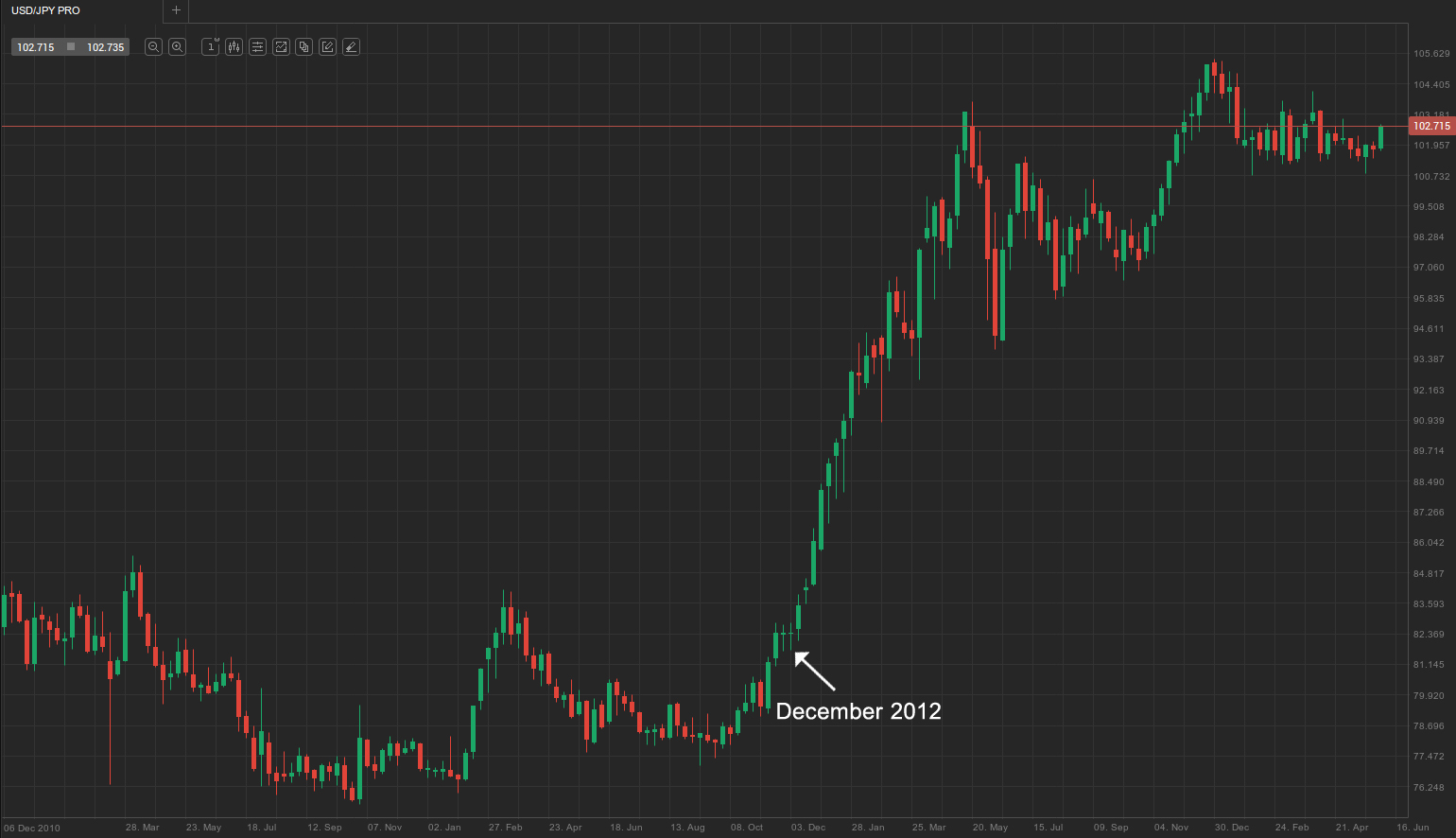
Continuous measures to weaken the Japanese yen were needed as flagging exports dragged on economic growth. Given the threat of a constantly appreciating yen as investors sought relative safety while uncertainty in Europe lingered, BoJ Governor Haruhiko Kuroda, who took the lead in March 2013, announced a decisive break with his predecessor’s policies. He said the BoJ would double the amount of currency held by banks and individuals within his first two years in office in order to reach the 2% annual inflation target. On 4 April 2013, the Bank of Japan announced it would expand its asset-purchasing programme by $1.4 trillion over two years.
Federal Reserve
 After the plunge in the 2007-2008 financial crisis, the Federal Reserve lowered interest rates, but additional measures were required to spur growth. The Federal Reserve held between $700 billion and $800 billion of Treasuries on its balance sheet before the crisis. In November 2008, the central bank began the first round of its quantitative easing programme and started purchasing mortgage-backed securities (MBS). By March 2009, it held $1.75 trillion of bank debt, MBSs and Treasuries, followed by a surge to $2.1 trillion by June 2010. The purchases were paused for a short period as economic conditions improved, but were resumed in August 2010.
The second round of purchases was announced in November 2010 and consisted of buying $600 billion of Treasuries by the end of the second quarter of 2011. The third round was announced in September 2012 as policymakers agreed to begin purchasing $40 billion in mortgage-backed securities, but the amount was raised at the December 2012 Federal Open Market Committee meeting to $85 billion per month.
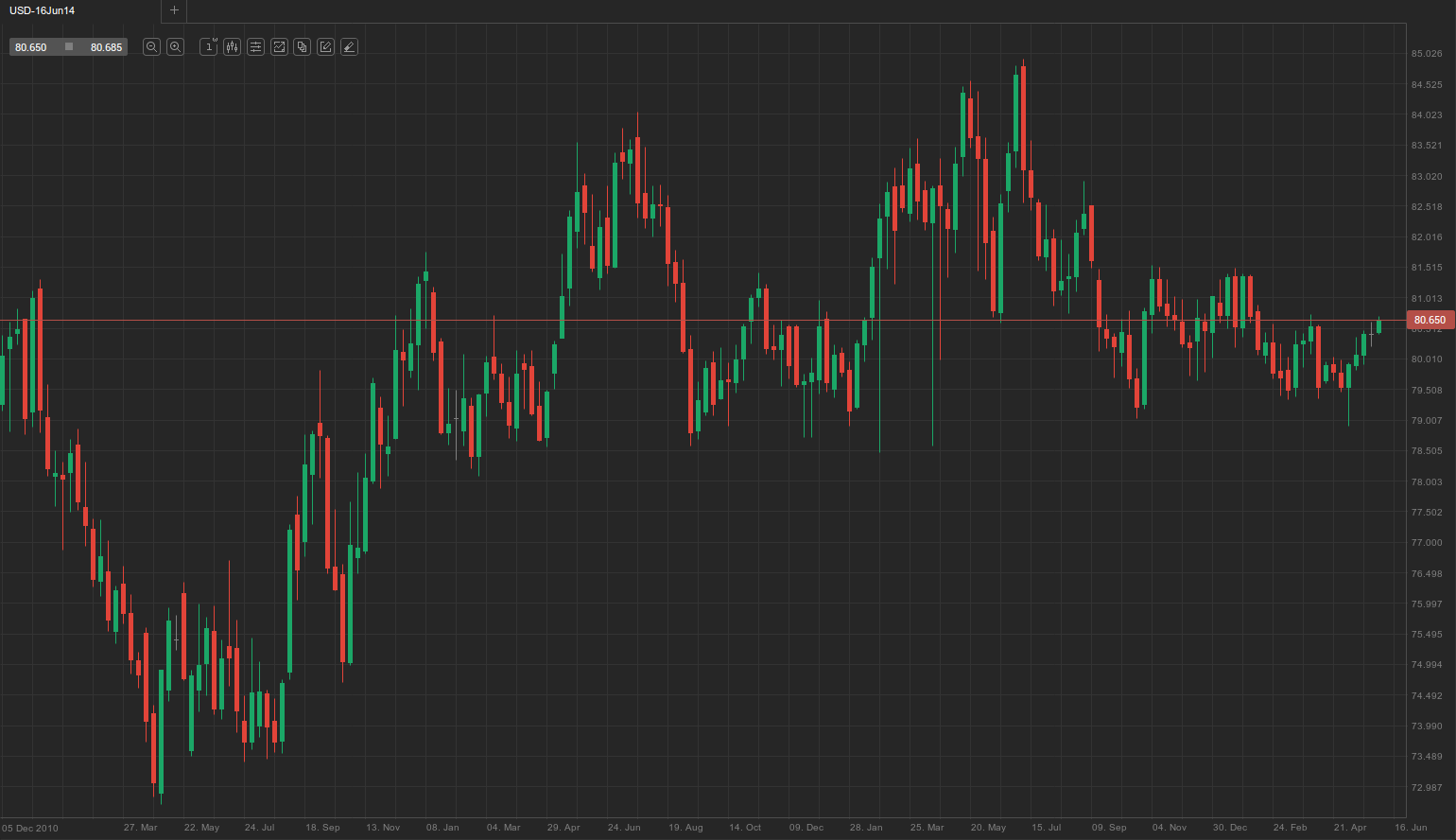
In the summer of 2013, former Federal Reserve Chairman Ben Bernanke announced policymakers were expected to begin gradually reducing the Fed’s bond-purchasing pace by the end of the year, presumably in September. Market players were caught off guard when the Fed decided to hold off the tapering, but it unexpectedly trimmed the monetary stimulus by $10 billion to $75 billion at its December meeting and vowed a reduction of another $10 billion at each successive meeting. On the screenshot below you can observe the sideways movement of the US dollar index, as the greenback largely fluctuated based on policymakers’ announcements and decisions.
Thus, day traders should closely follow all announcements by central bankers, especially those with a vote at FOMC meetings, in order to capitalise on currency fluctuations. Substantial volatility is usually observed during speeches by the Federal Reserve Chair, as well as before, during and after Federal Open Market Committee meetings and the later release of the Federal Reserve minutes.