| Updated:
 How to sift out failed breakouts (swing trading strategy)
This lesson will cover the following
- A quick overview
- Steps a trader needs to follow for this strategy
As we underscored in our Price Action guide, many breakouts tend to fail. This can often be observed in the foreign exchange market, because it is among those financial market segments more driven by technical trading, and there are market participants who deliberately look to break a currency pair out in order to wipe out other, often inexperienced, traders. To filter out a potential false breakout, a trader needs to pay close attention to price action in order to detect those breakouts that have a greater chance of becoming genuine. Filtering out false breakouts is intended to give a trader an edge in strongly trending markets where the following scenario occurs: a new high is reached, then the price reverses and takes out the recent low, after which another reversal to a new high follows.

- Trade Forex
- Trade Crypto
- Trade Stocks
- Regulation: NFA
- Leverage: Day Margin
- Min Deposit: $100
What does a trader need to do?

As with any trading approach, there are certain steps to be followed.
When going long:
 The trader needs to look for a currency pair that is currently registering highs not seen in the past 20 days;
 The pair needs to reverse within the next three days and register a two-day low;
 The trader will usually go long if the currency pair exceeds the 20-day high within the three days following the two-day low;
 A protective stop should be placed several pips below the two-day low identified earlier;
 The trader needs to move the stop or take profit at twice the amount they put at risk.
When going short:
The trader needs to look for a currency pair that is currently registering lows not seen in the past 20 days;
The pair needs to reverse within the next three days and register a two-day high;
The trader will usually go short if the currency pair moves below the 20-day low within the three days following the two-day high;
A protective stop should be placed several pips above the two-day high identified earlier;
The trader needs to move the stop or take profit at twice the amount they put at risk.
Example

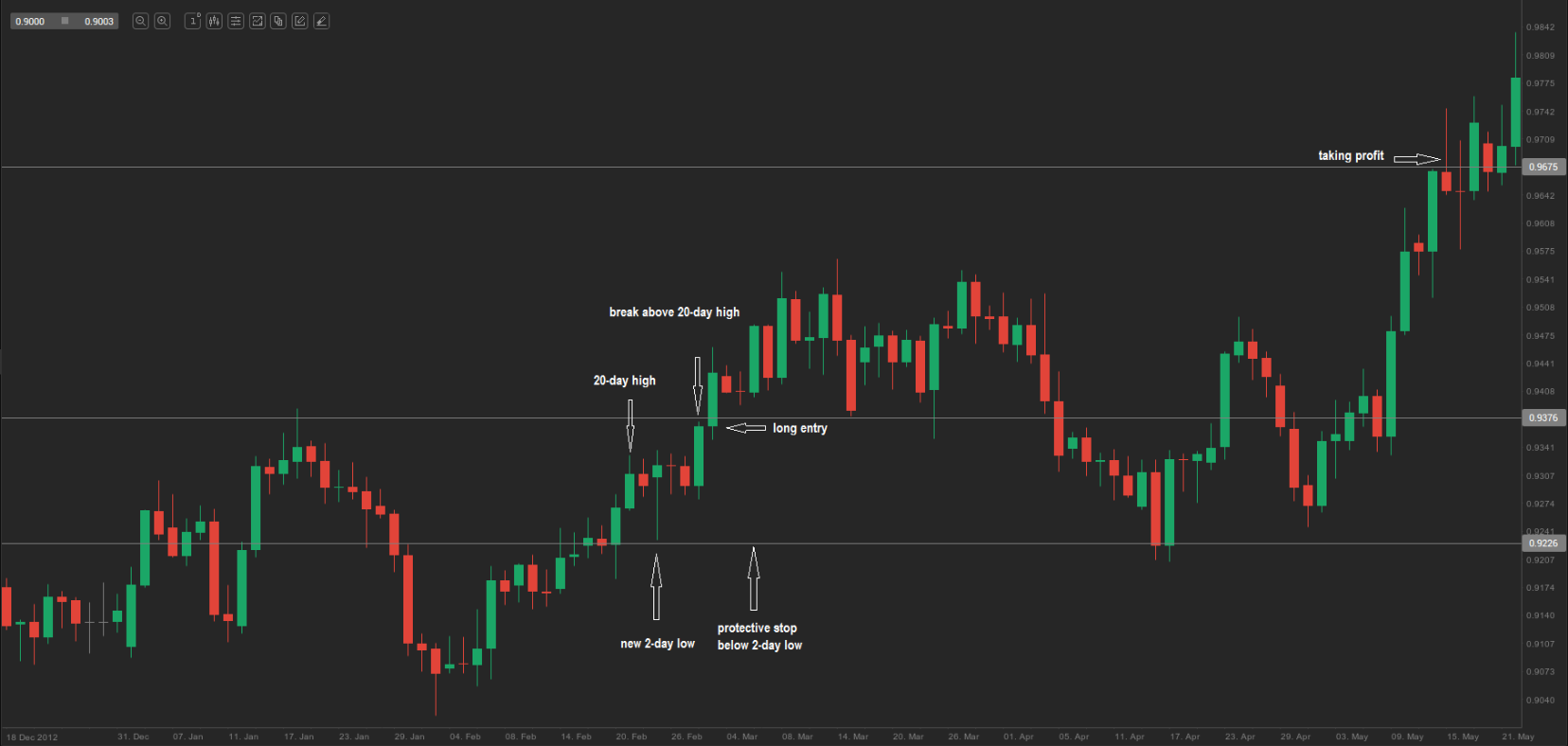
Let us examine the daily chart of USD/CHF. The pair registered a new 20-day high on 21 February at 0.9332. We then look to see whether it will reverse within the next three days to form a two-day low (this actually occurred on 25 February, with the low at 0.9230). After that, we watch to see whether the pair will surge to a new 20-day high within the following three days (this actually occurred on 28 February, with the new high at 0.9372). With this scenario completed, we choose to enter long several pips above the new 20-day high, at 0.9376. We place our protective stop several pips below the two-day low already identified, at 0.9226. As the market moves in our favour, we must choose between two options: taking profit at twice the amount risked (a profit of 300 pips) or trailing our stop. We decide to take profit at 0.9675 on 15 May.