
Evaluating strategy performance
You will learn about the following concepts
- Strategy performance evaluation
- Compound average rate of return
- Modified Dietz method
After a trader has chosen a strategy, backtested it and undergone prolonged simulations on demo accounts, they will ultimately begin using it in real-money trading. Although it may have yielded satisfactory results during simulation or for some time in real-money trading, this is not guaranteed to continue. Conditions in the financial markets are constantly shifting, especially as they are fuelled by developments in modern technology, thereby rendering some trading strategies obsolete. In order to retain a competitive edge, a trader must regularly evaluate the performance of their trading system. And what better way to determine whether you are satisfied with your trading performance than by calculating your strategy’s returns and seeing whether they are sufficient.
Calculating the returns on an investment (in our case, the initial capital and time we have invested) can be done in several ways, depending on the time period, any subsequent withdrawals or deposits in the account, etc.

- Trade Forex
- Trade Crypto
- Trade Stocks
- Regulation: NFA
- Leverage: Day Margin
- Min Deposit: $100
Compound average rate of return
 The most common way to calculate the returns on an investment is the compound average rate of return. If it is over a single period and you are neither adding nor withdrawing funds from the account, you would use a simple percentage change, as follows:
(EOY – BOY)/BOY, where
– EOY is the value at the end of the year
– BOY is the value at the beginning of the year
Multiply the result by 100 and you will have the percentage change. A negative value indicates a loss in the value of the asset.
For example, if you start with $1,000 and at the end of the year there is $1,500 in your trading account, then your annual return is: (1,500 – 1,000) / 1,000 = 0.50, or 50%.
However, we said that this calculation is on a single-period basis. If we are calculating the returns for, let’s say, several years, the maths is different because, for example, in the second year you will have returns on top of the first year’s returns. Thus, you are looking for the compound return on your investment, not the simple return for a single year. Here is the formula:
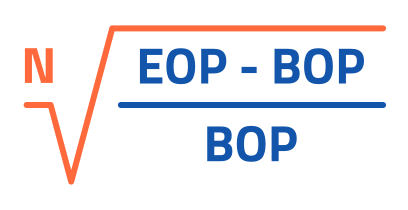
– EOP is the value at the end of the total time period
– BOP is the value at the beginning of the total time period
– n is the number of periods
Money flows
 However, neither of the return calculations above includes any additional deposits or withdrawals during the period under review. This is unlikely to work for most day traders, as trading is their primary job and source of income. Withdrawals from trading accounts will therefore be needed on, say, a weekly basis to cover everyday expenses. Money flowing in and out of your trading account would distort the performance evaluation provided by the previous formulas. There are several methods to assess your performance while taking these variables into account.
The first formula is the so-called Modified Dietz method. It is based on the simple percentage change formula but is adjusted for money inflows and outflows. This method is less accurate but compensates with its simplicity. Here’s how it looks:
(EOY – BOY – deposits + withdrawals)/(BOY + deposits – withdrawals)
Let’s say, for example, that during the year we withdrew $200 in April but later, in August, deposited $300. Our return would then be:
(1,500 – 1,000 – 300 + 200)/(1,000 + 300 – 200) = 0.36, or 36%.
Time-weighted rate of return
 The second method involves a more complicated two-step calculation but yields more accurate results. It’s called the time-weighted rate of return. First, you need to calculate the simple percentage change for each period (in our case, for the three months to April, the four months to July, and the five months from August). A second calculation is then required to combine all those returns over the longer period (in our case, the whole year). Let’s do the maths.
January – March – starting capital $1,000; ending capital, say, $1,200; return rate 20%.
April – July – starting capital $1,200; withdrawal $200; adjusted beginning for the period $1,000; ending capital, say, $1,100; return rate 10%.
August – December – starting capital $1,100; deposit $300; adjusted beginning for the period $1,400; ending capital $1,500; return rate 7.1%.
The second calculation looks like this:
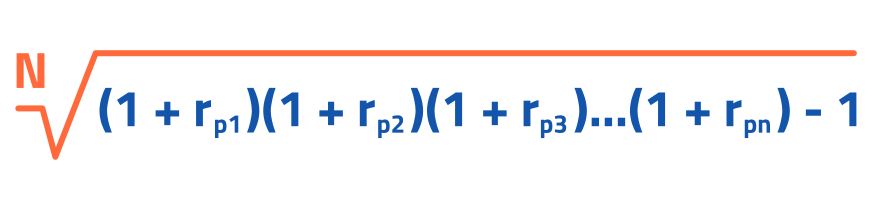
– N is the total number of periods (in our case it is one year, thus 1)
– r is the return for that period
The calculation is therefore: (1+0.2)*(1+0.1)*(1+0.071)-1 = 0.41372
Thus, the time-weighted rate of return is 41.4%.