
Wide channel trends
This lesson will cover the following
- What wide channel trends are
- What they consist of
- What types of positioning traders use
- Profit targets
Previously in our guide, we dedicated time to explaining some of the characteristics of trending trading ranges, and now we will turn our attention to a variety of those overall weak trends – the wide channel trend, or, as some refer to it, stairs.
This is essentially a succession of at least three trending ranges in which the market makes wide swings but still displays trend extremes. The broad swings allow market participants to trade both with- and counter-trend, but, as we’ve always advised, inexperienced traders are best advised to stick to with-trend positioning.
This type of market behaviour consists of successive breakouts followed by pullbacks that exceed the breakout point (there is overlap) yet remain below the previous swing high (or above the previous swing low in a bullish trend). The movement closely resembles stairs going down or up. Very often, you can see one or two pullbacks extending slightly beyond the most recent extreme high or low, trapping traders who think the trend is reversing; it usually resumes afterwards, given there was only a minor break of the trendline.
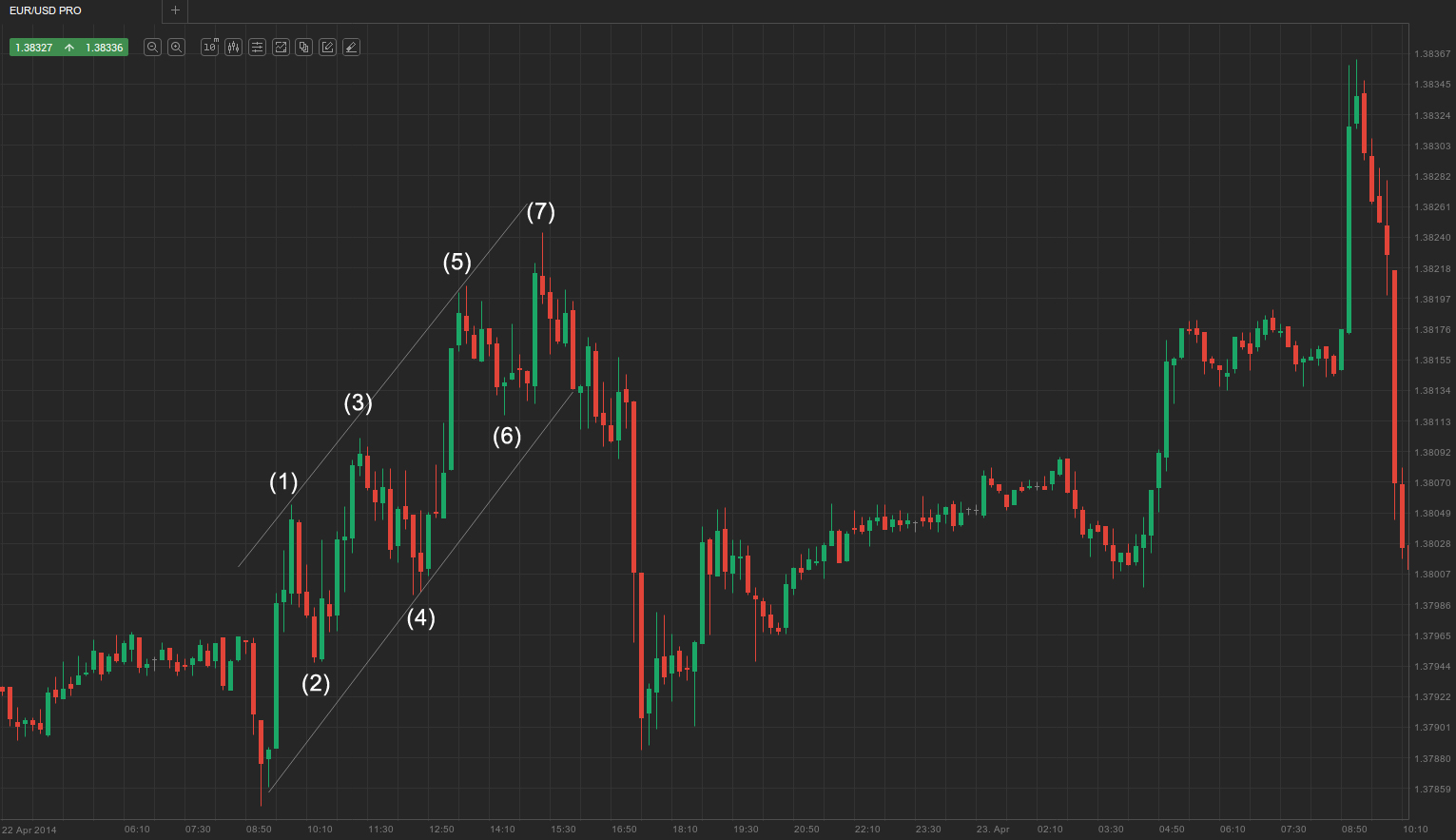
As you can see in the screenshot above, the breakout to bar (3) marked a new high above bar (1), and the pullback to bar (4) retreated beyond the breakout point (bar 1) but remained above the low of bar (2). Furthermore, the leg to bar (5) was a breakout above the previous high at bar (3), while the pullback to bar (6), although it failed to return to the breakout point, also formed a higher low above bar (4). The next move to bar (7) marked a new high, but it was also a shrinking stair because the move from bar (5) to bar (7) extended less than the move from bar (3) to bar (5). This suggests that market momentum is waning and that a reversal or a trading range might be on the way – and so it was. The pullback from bar (7) extended beyond the breakout point, but it also broke the trendline after a strong down-shaved bear trend bar.

- Trade Forex
- Trade Crypto
- Trade Stocks
- Regulation: NFA
- Leverage: Day Margin
- Min Deposit: $100
Sideways trading is possible
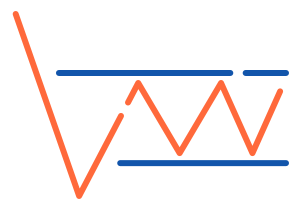 Because this is not a spike-and-channel trend but a weaker one, traders have the opportunity to enter positions in both directions. However, as the market is still forming trending highs and lows – i.e. there is a weak trend in motion – either bulls or bears are still overpowering the other side to some extent. Moreover, if each successive breakout is smaller than the preceding one, this is a sign of faltering momentum that usually precedes a larger correction – typically a two-legged retracement – which breaks through the trendline.
Occasionally, you may see a breakout (a stair) unexpectedly overshoot the trend channel line. If the price continues in the same direction after the breakout (with-trend), it will usually carry on for at least two more legs, matching the height of the channel. If, however, the market reverses in the counter-trend direction, it is likely to be a two-legged move.
Profit target
 Because of the repeatability of the stairs pattern’s components, traders can measure their profit targets relatively accurately in both with- and counter-trend directions. In a bear trend, for example, they measure the distance between the last swing low and the one before it to determine when to enter a long position during the next downward breakout. If, for example, the last low was 20 pips below the one preceding it, traders will go long at around 15 pips below the last swing low so that they can position themselves in advance of the upcoming pullback. This generally aligns with the trend channel line.
Afterwards, they determine their profit target according to the length of the pullback from the last breakout. If the market pulls back, say, 18 pips, they will set a profit target of around 14-18 pips, again broadly matching the trendline.
Some traders don’t use these exact measured numbers; instead, they go short at the trendline and long at the trend channel line in a bear trend, and vice versa. However, more experienced traders rely on strictly measured moves and place limit orders.
Generally, when a stairs pattern is present – for example, bull stairs – you can usually scalp counter-trend by selling the close of each strong bull trend bar that closes above a prior bull stair. The opposite applies in a bear trend. However, it is safer to wait for the market to reverse first and then enter on a stop below the previous bar.
Waning momentum
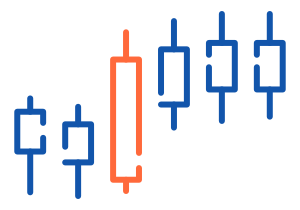 As mentioned earlier, during a stairs pattern, if the market begins to form smaller successive breakouts, this signals slowing momentum and precedes a larger correction or even a trend reversal. It closely resembles a successful wedge. Some traders call this pattern ‘shrinking stairs’. Take a look at the following example.
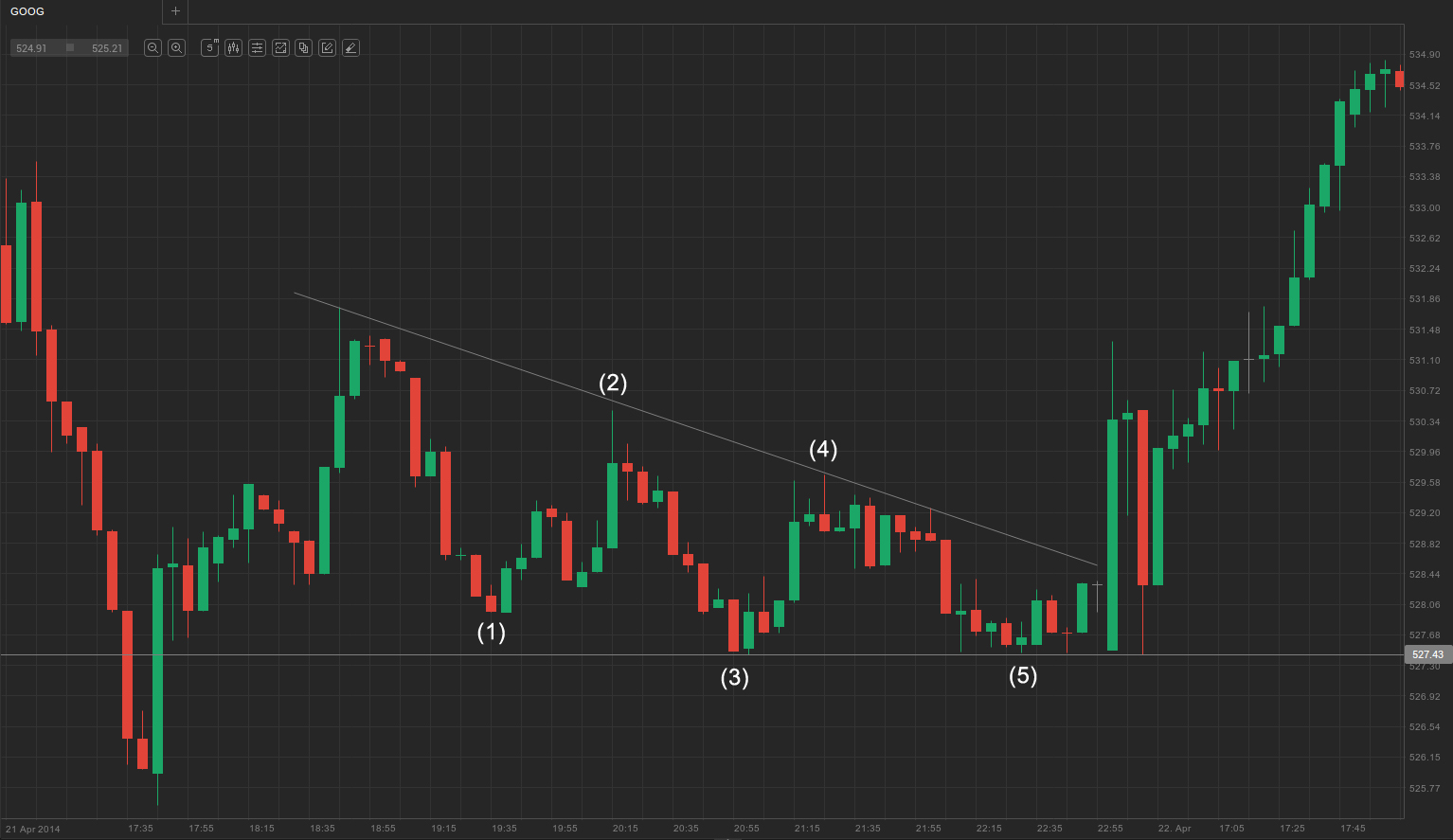
As you can see, the market made a correction after a significant sell-off, which was the beginning of a bear stairs pattern. The first stair made a lower low at bar (1), after which the pullback to bar (2) fell short of the high of the first stair. The leg to bar (3) marked a lower low and the pullback to bar (4) exceeded the breakout point. However, the next stair of the pattern, down to bar (5), not only failed to maintain the declining pace from bar (1) to bar (3) but also failed to penetrate the support level of bar (3), thus turning the pattern into shrinking stairs and hinting that an upward breakout might be on the way.
Although the stairs pattern is a variation of the trending trading range – that is, essentially a weak trend – it can sometimes precede the formation of a strong trend in the same direction, i.e. an acceleration. This is a typical scenario when a wedge fails.