
Trending trading ranges
This lesson will cover the following
- What trending trading ranges are
- What are their primary characteristics
- What should traders aim to do
- What should traders avoid doing
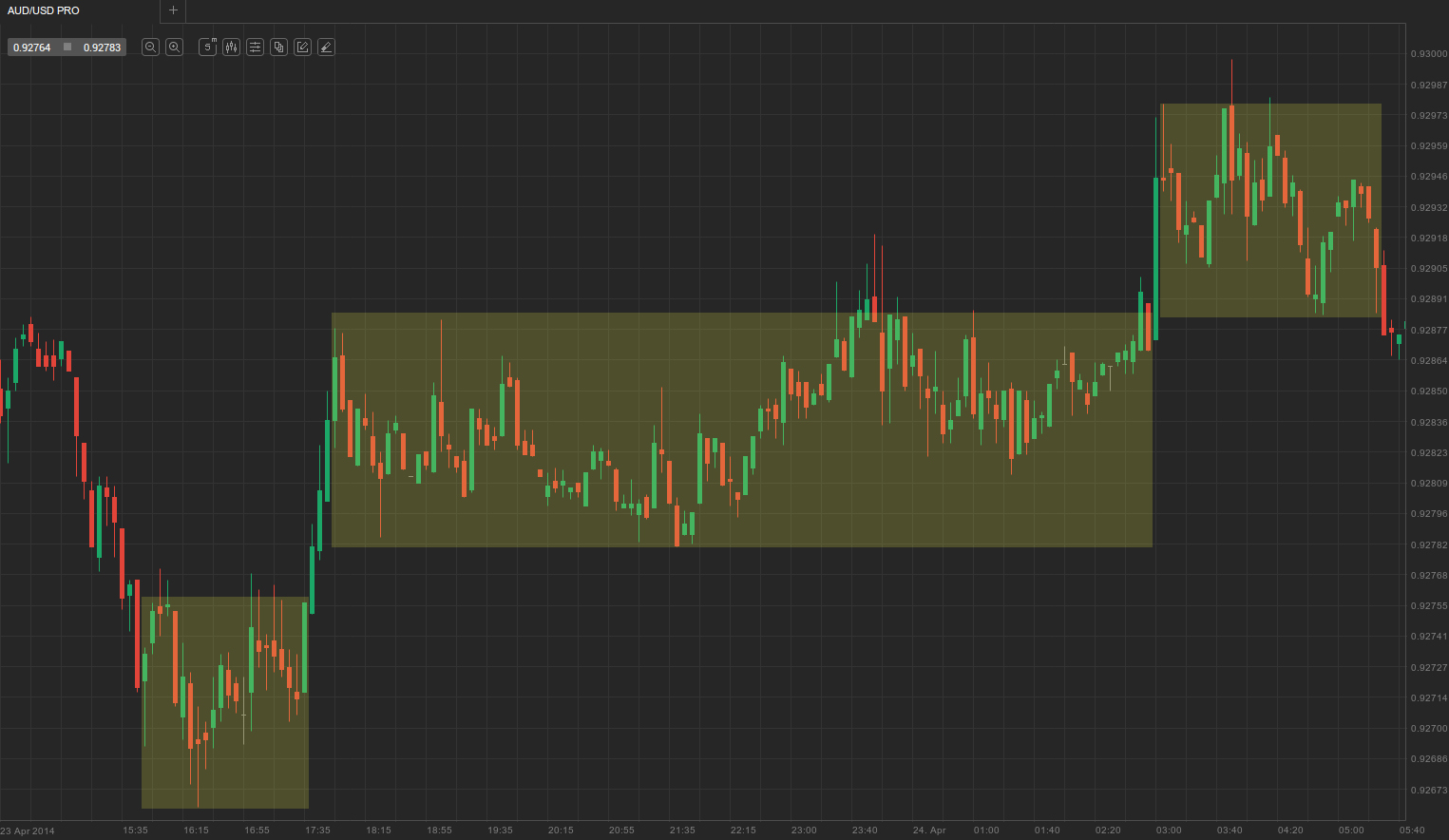
As you know, the market is either trending up or down, or its movement is range-bound. However, you will often see a scenario in which the market has formed trading ranges, yet the succession of these periods of sideways trading actually constitutes a trend: these are trending trading ranges. This means that, although the market is moving sideways for more than 50% of the time, if the price breaks out of a trading range, edges higher, enters a new trading range and then repeats the process, we effectively have a trend. Here is an example of three trending trading ranges.
However, a spike plus channel trend must be distinguished from trending trading ranges for a good reason – they are traded differently. A spike plus channel trend has much more strength, which implies you should refrain from entering counter trend positions and only trade with the trend, mostly swing trades. Once the market movement stalls and reverses, or enters a trading range, you can safely switch to counter trend positions.
Unlike channel trends, trending trading ranges provide you with the opportunity to go both long and short and also look for more scalps. As you already know, trading ranges are more common than strong trends, which logically leads to the conclusion that trending trading ranges can be seen more often than spike plus channel trends – in fact, twice as often.
In some cases, there will be not only a few but multiple breakouts and trading ranges. When that happens, market behaviour more closely resembles a stronger type of trend, meaning you should stick to with-trend trading.
Tests of successive trending ranges
 After the second trading range begins to form, a pullback usually tests the earlier trading range. The test often ends with the price entering the previous trading range, but if it does not, the trend is considered stronger. In some cases the test leads to a breakout beyond the previous range; the market has then reversed.

- Trade Forex
- Trade Crypto
- Trade Stocks
- Regulation: NFA
- Leverage: Day Margin
- Min Deposit: $100
Generally, because entering on the breakout from a trading range is a low-probability trade, it is much better to enter on a breakout pullback or on a reversal from the opposite side of the trading range. However, if the trader is certain that the market is forming trending trading ranges and the breakout seems highly probable, he can enter during the formation of the breakout – at the close of the breakout bar or at the close of the next bar if it is also strong and confirms the breakout.
Usually breakouts start with a spike that is followed by trending market movement contained within a channel. However, you can often see the price stopping around the measured move area and then beginning to move sideways (the market is effectively moving from one trading range to another). Much less frequent, but still observed, is a scenario in which the market forms a succession of three or more small trading ranges (multiple) that display trending behaviour – these should be treated and traded as strong trends and therefore be subject to with-trend entries only.
Difficulties
 One of the difficulties traders encounter with this type of market behaviour is properly adjusting to the shifts. Usually, after a breakout from a trading range, market players expect the beginning of a new trend and so they enter swing trades. However, if the price consolidates at a certain level after the breakout, it indicates that more sideways trading will follow as the market tests the support and resistance levels of the newly formed range. At this point, traders should move from trend trading style to range-trading style (basically you have range trading, followed by trend trading, followed by range trading, etc.).
If the market finds itself in a trending trading range, traders should not trail their protective stops below the most recent swing low, because they will often be hit by retracements. During trading ranges you should aim to buy low and sell high, and therefore it would be wiser to exit when the market forms a higher trading range than to exit when it is falling back to lower levels.
Formation of successive trading ranges
 But what causes the formation of a higher trading range after a breakout? Basically, aggressive traders will bet against large trend bars in the area of the measured move target and will scale in further as the price continues to rise. These traders expect that the large trend bars are preceding a climactic exhaustion, which will be followed by a pullback to the top of the previous lower range. Because they anticipate the bull spike to mark the top of the higher trading range, shorting at the spike makes for a good entry point. Even if the market edges higher, it will eventually retrace at least to the entry price. If the trader scales in as the price continues to gain, he can exit his first entry as it later drops to the break-even point and then move his stop to the higher entry’s break-even point. Here is an example of clearly successive trading ranges with distinctive breakouts.
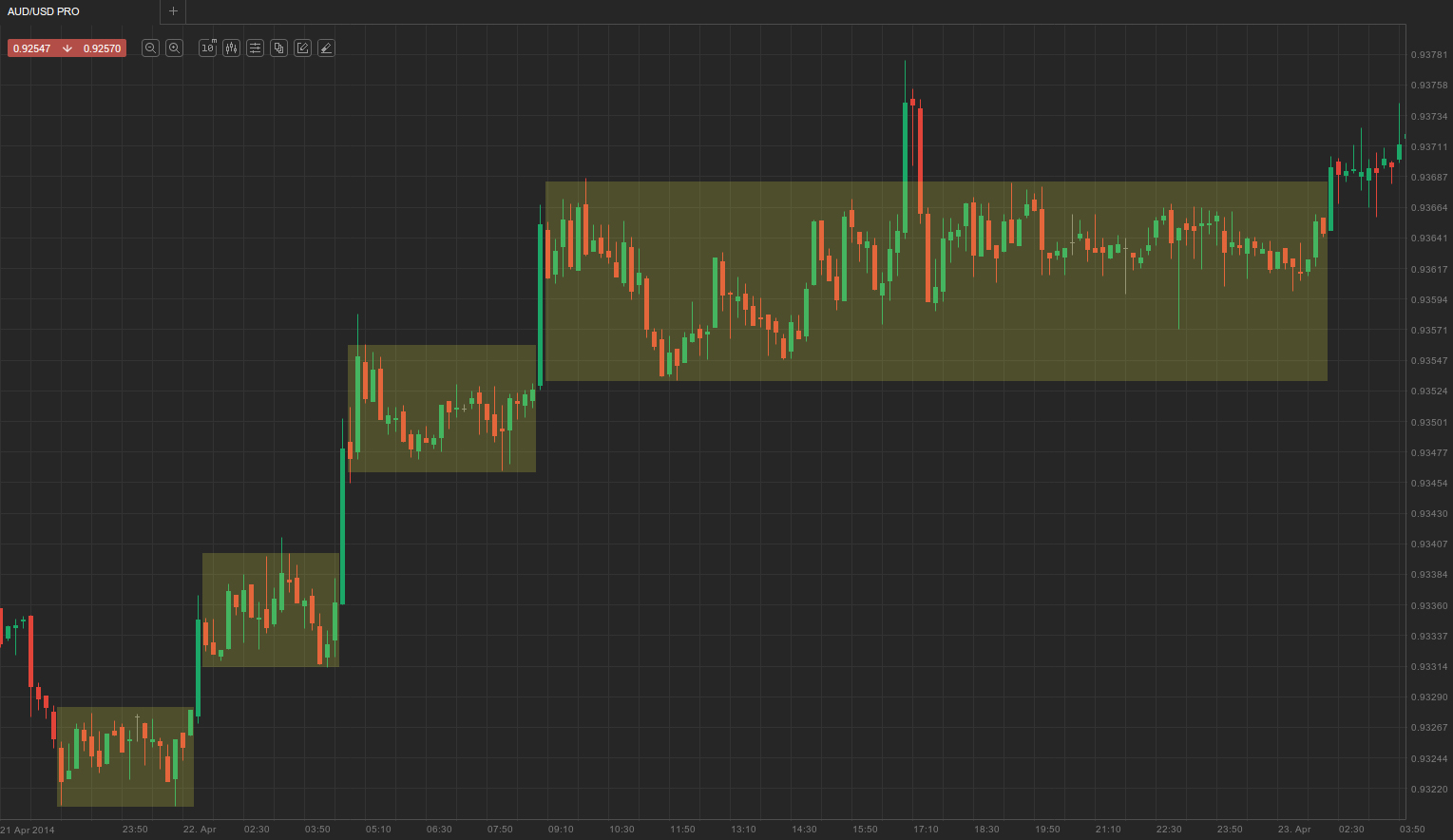
Like any other trend, weak trends such as trending trading ranges also have pullbacks, which means that a trading range can overlap a previous one or even retrace further beyond it.
As we said earlier in the article, trending trading ranges allow traders to place counter-trend orders with more confidence because the market usually tests the breakout from the previous trading range. Once they’ve determined that the market is forming trending trading ranges, market players will want to short at around 50% of the session’s average range above the breakout (if a currency pair has fluctuated in a daily range of 50 pips, then traders will look to go short at 20-30 pips above the upward breakout). Their profit target will be a move down to the breakout area or even lower – the top of the lower trading range.