
 | Updated:
 Trading the channel phase of spike plus channel trends
This lesson will cover the following
- Projecting a channel
- Different trading approaches
- Signs of weakness in a channel
If there is a huge move, followed by even a single-bar pullback and then a resumption of the trend, there is a good probability of a spike plus channel trend. Let us explain such a situation. A trader sees a sudden move to the upside, which breaches a trading range. Next, an inside bar forms, followed by a bar that moves below this inside bar. Eventually, the second bar reverses up (becoming a bull reversal bar), as many traders wait to enter long above the high of this bar because they expect a bull channel. With prices moving above this bar’s high, the bull channel is already apparent.
If this bull channel extends to an area where a possible reversal can occur (the top of a trading range), it may indeed reverse after several legs up.
If the bull channel develops in an area where an uptrend is possible (an upward reversal after a clear bottom pattern), the channel may form at least three swing highs.
Projecting the channel
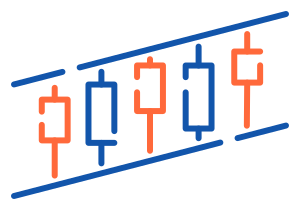
During a strong trend, a channel may extend much further than most traders anticipate. If there is a huge spike, a possible measured target is the distance from the open or low of the first bar of the spike to the close or high of the last bar of the spike. That distance needs to be projected up. Then, a trader should determine whether a reversal is setting up after the channel has reached the measured target.
A trader may spot other measured-target projections, but most of them will likely fail if the trend is particularly strong. These targets are important because when a reversal eventually sets up it will occur at one of these resistances, which give a trader the confidence to take the reversal trade. However, as we said in our previous guide, measured targets are more appropriate for locking in gains than for looking for entry points in reversal trades. Usually, traders will consider a reversal trade only when they see a strong setup. Traders with considerable experience may consider scalping against the underlying trend at measured targets and may even scale in if prices move against them. However, it is a risky move and there is no guarantee that it will be profitable.
Countertrend trades are good with-trend setups
 After identifying the spike plus channel trend, it is not advisable to enter against the trend in anticipation that the ABC pullback will reach far enough to ensure a scalper’s gain. There may not yet have been a breach of the prior trend line, and the channel may be too tight, which would render a trade against the trend unsuccessful. We can say that these countertrend scalps offer good with-trend opportunities. The entry should be on a stop where countertrend traders exit the market with their protective stops.
Another approach
 Traders using a more aggressive approach may enter channels with limit orders in the direction of the trend until indications of two-sided trading appear. When this happens, most of these traders may begin entering against the trend.

- Trade Forex
- Trade Crypto
- Trade Stocks
- Regulation: NFA
- Leverage: Day Margin
- Min Deposit: $100
Example
 Consider the following situation. A huge bearish move occurs, followed by a channel. Sellers will probably enter the market on limit orders at or above the high prices of previous bars. As the bear channel moves closer to support levels, sellers will probably examine whether there is a large overlap between bars, whether more substantial bull trend bars and more doji bars appear, and whether larger pullbacks are present. If more of these indications of two-sided trading are evident, buyers will probably become more eager to go long on limit orders at or below the low prices of previous bars and swing lows. Sellers, on the other hand, will probably scale out of profitable trades after the trend has continued for some time, especially if it is in the area of support levels and measured targets. Buyers will probably consider scaling in their long positions in that same area. As a result of this increased buying and diminished selling, a breakout from the bear trend line finally occurs.
Institutional traders and individual traders with large capacity can afford to scale into a position against the trend, anticipating that prices may test the beginning of the channel. However, most traders prefer to trade in the direction of the trend until they detect clear indications that a reversal is imminent.
Sometimes channels tend to be parabolic
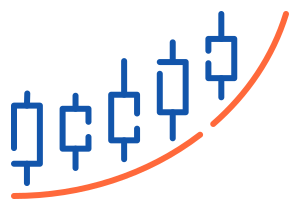 At times, channels appear to be quite vertical and, as they accelerate, they take on a more parabolic shape. In this case, there is little overlap between successive bars and the channel no longer appears typical. The parabolic move actually represents the channel phase of the trend. The move itself may, in many cases, include a huge trend bar.
Example
Consider the following situation. A sudden bearish move of one or more huge bear trend bars occurs, followed by a pause, after which another bear spike appears. This is a situation of two successive sell climaxes. If two successive climaxes, separated by a pause or a pullback, occur, they are usually followed by a two-legged retracement. The latter usually tests the pause that comes after the first climax. The second climax may be regarded as the channel phase of the spike plus channel formation, even though it is simply another sudden move (a spike) and not a channel in which prices demonstrate lower momentum. Thus, successive climaxes can be considered a version of traditional spike plus channel trends. In rare cases, a third successive climax can be observed.
Signs of weakness in a channel
 If there is a large overlap between adjacent bars, a large number of trend bars in the opposite direction, and a few pullbacks comprising several bars, this all points to weakness in the channel itself. The weaker a channel is, the more aggressive institutional countertrend traders are likely to be.
Example
In a weak bear channel following a bearish spike, institutional bulls will probably be more eager to scale into their longs as the price continues to fall. This includes going long below the low of every bar, below the previous swing low, or on every test of the trend channel line. If the price sharply breaks out from the bottom of the channel, rather than the top, and a huge bear spike of several bars appears, these strong bulls will need to close their positions. They sell their longs, which contributes to the strength of the bearish move. Since most of them are momentum traders, they will probably switch to short positions.
This breakout to the downside, however, may not extend very far. As soon as the most unsuccessful bulls have sold their long positions, there will probably be no one willing to go short at such low levels. Therefore, the market will likely stage a rally of at least two legs and over ten bars, seeking a higher price level where bears may consider going short again.