
 | Updated:
 Gaps and pullbacks to the exponential moving average (EMA)
This lesson will cover the following
- What is a gap?
- Pullbacks to the moving average
Gaps
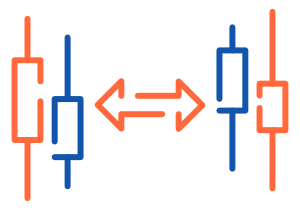 A gap signifies a space between two points on the price chart. If today’s opening price is above yesterday’s close, a gap is formed. If today’s opening price exceeds yesterday’s high, the gap is likely to be visible even on a daily chart. If a bar’s high price remains below the exponential moving average (EMA), a gap is created between that bar and the EMA.
During an uptrend or within a trading range, the market may attempt to fill a gap above a bar that formed below the EMA.
At times, a bar may exceed the previous bar’s high, after which, within 1-2 bars, the pullback to the downside continues. If the market again moves above the previous bar’s high, an EMA Gap 2 bar forms. This represents the market’s second attempt to fill the gap to the EMA in an uptrend and, as a result, increases the likelihood of a rally. Such a setup provides good opportunities to enter the market.

- Trade Forex
- Trade Crypto
- Trade Stocks
- Regulation: NFA
- Leverage: Day Margin
- Min Deposit: $100
During a downtrend or within a trading range, if a gap occurs above the exponential moving average, the market will probably attempt to fill it.
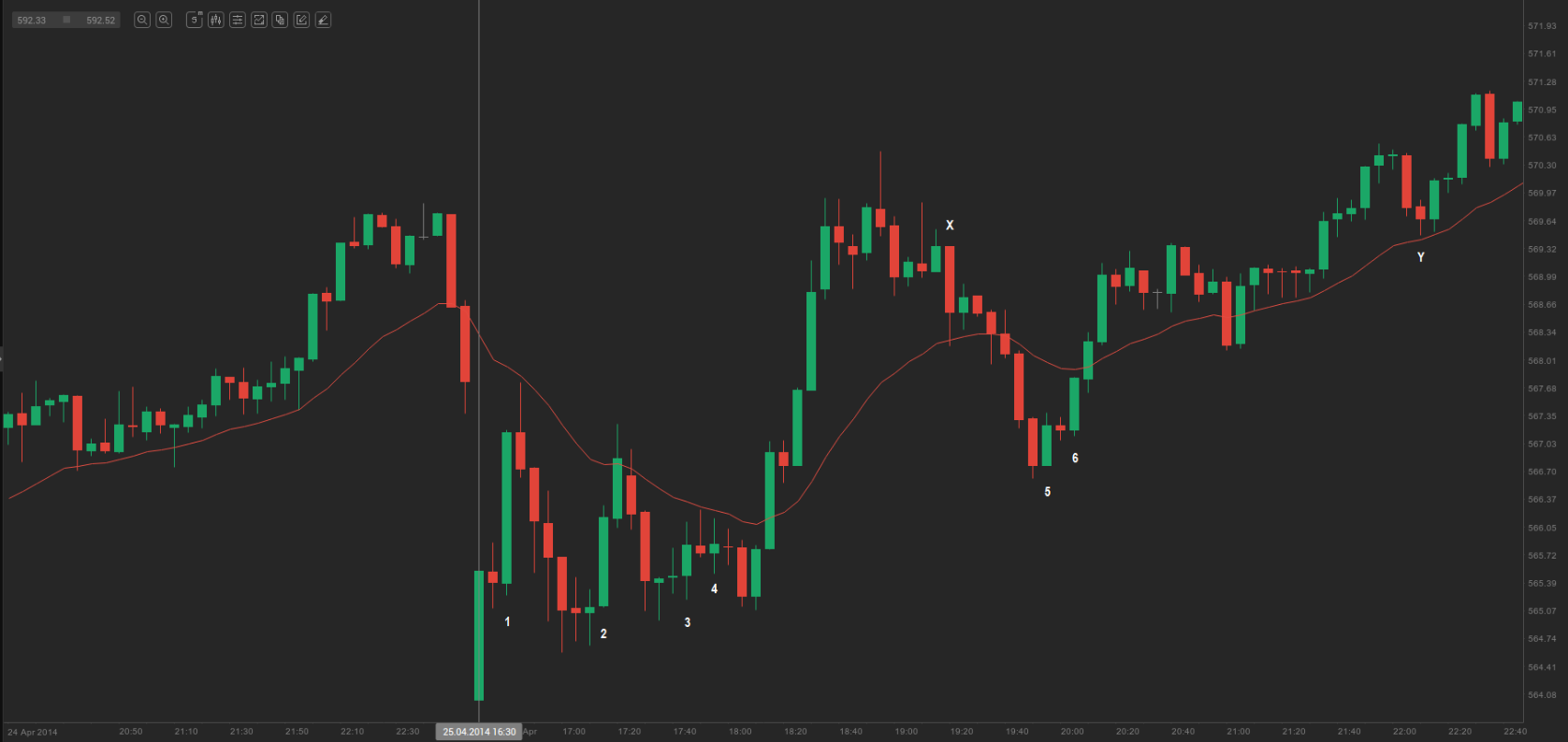
On the 5-minute chart of AAPL above, bar 2, bar 4 and bar 6 were second attempts to fill the gap below the 20-day exponential moving average within a trading range. Bars X and Y were EMA Gap 2 Bar shorts. The price broke above bar Y and an uptrend developed because there had already been two failed attempts to move lower. Bar Y was the second attempt.