Pullbacks in a strong trend – one of the most profitable trades
This lesson will cover the following
- Why a trader must always look for pullbacks in strong trends
- Other suitable entry signals
Pullbacks can be extremely profitable when they form within a strong trend; therefore, you will want to tap that potential as soon as you notice the market is moving decisively in one direction.
Of course, identifying a strong trend is not easy at the very beginning, before a sufficient number of bars have shown trending highs and lows. Moreover, because you need a relatively strong move for pullbacks to occur, you probably won’t see the profitable pullbacks in question for at least one or two hours after the trend has begun.
The most profitable set-up is a two-legged pullback to the moving average. At first, many traders think that a pullback to the MA might not trigger a large move afterwards, but it usually results in a with-trend acceleration towards the trend’s extreme, which it often breaks before continuing further. Here is an example.
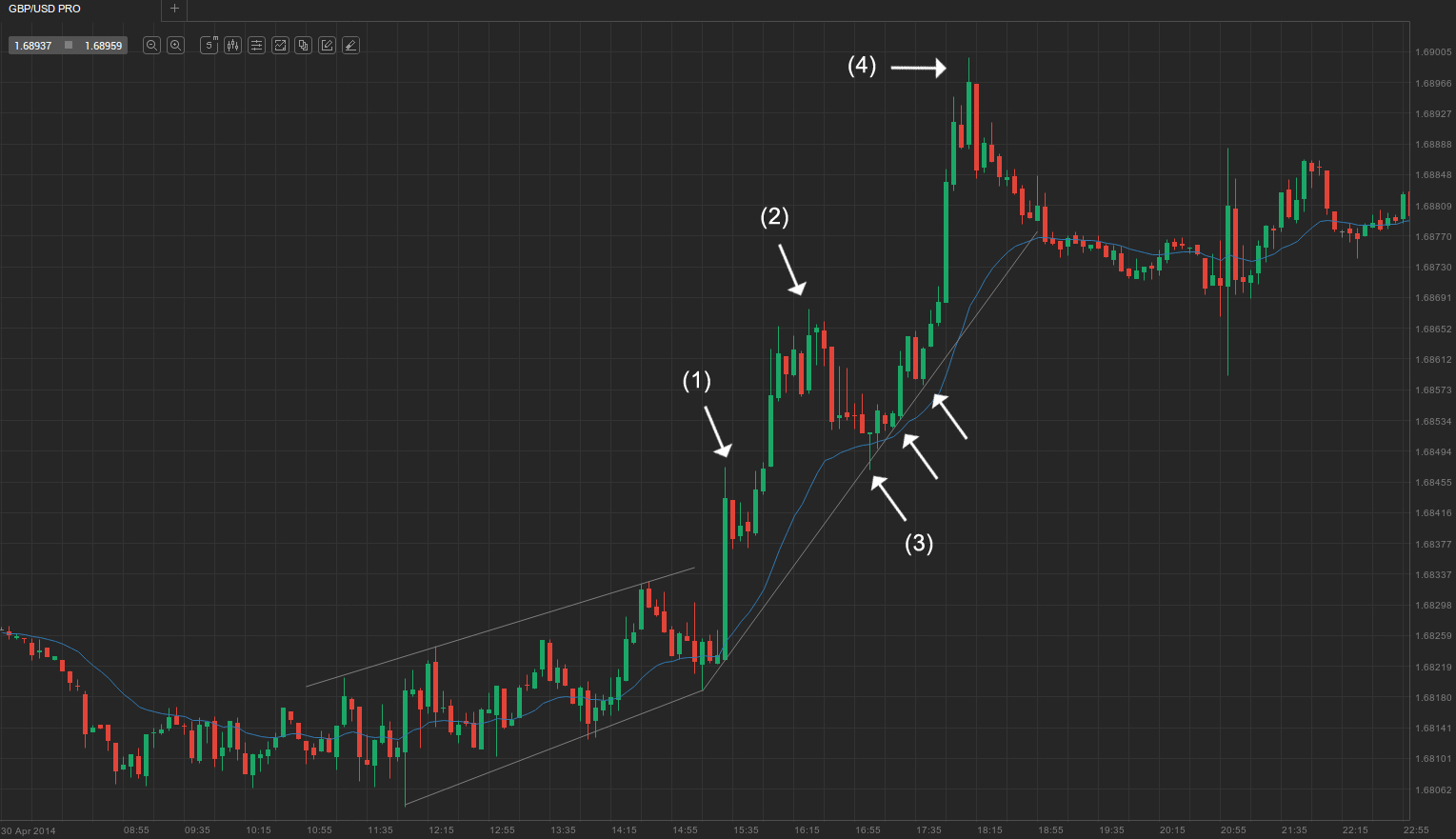
As you can see on the screenshot, the market was confined to a range before it formed bullish ‘stairs’, creating a rising channel. Although the second-to-last stair failed to maintain the pace of the previous ones and even produced a deeper pullback, the final move up stayed in line. As you already know from our article “Wide Channel Trends“, the stairs pattern signifies a modest trend that can occasionally accelerate – as it did here.
The market accelerated to a new session high at (1), followed by a small pullback that formed an inside-inside pattern. Although such patterns usually lead to reversals, there was no follow-through on the small bear bar after the pattern and the market broke to a new session high at (2). The price then pulled back to the moving average and even overshot the trend line at (3), which many traders had been waiting for. Several retests of the trend line were followed by an acceleration to a new extreme at (4) and, later, a period of consolidation.

- Trade Forex
- Trade Crypto
- Trade Stocks
- Regulation: NFA
- Leverage: Day Margin
- Min Deposit: $100
Join the party
 As we’ve said in the article “Trend Trading Guidelines“, when a strong trend is in motion, traders don’t need to wait for a special set-up to enter the market – doing so costs time and opportunities – and should instead hop on at any point, especially on pullbacks. We also know that during strong trends, traders should scalp a portion of their position and swing the remainder, holding it until a major reversal occurs or the market enters a trading range.
Keeping part of your position in the market throughout the strong trend is key to capitalising on the opportunities it offers. This, however, introduces the risk of losing your swing portion if a deeper pullback triggers your break-even stop-loss. In most cases, though, the strong with-trend runs will earn you far more than any losses caused by occasional hits on break-even stops.
At each new pullback set-up, traders add back the scalp portion of their position, which they had previously locked in, and keep it until their next profit target is reached. Some more aggressive traders re-enter with not only the scalp but a full position. Later, when the scalp profit is taken, they remove the scalp portion and are left with two swing portions. This tactic is suitable only for experienced traders who are comfortable managing larger positions because scaling in risks unintentionally growing your exposure to an uncomfortable size, which can make novice traders nervous and cloud their judgement.
Alternatively…
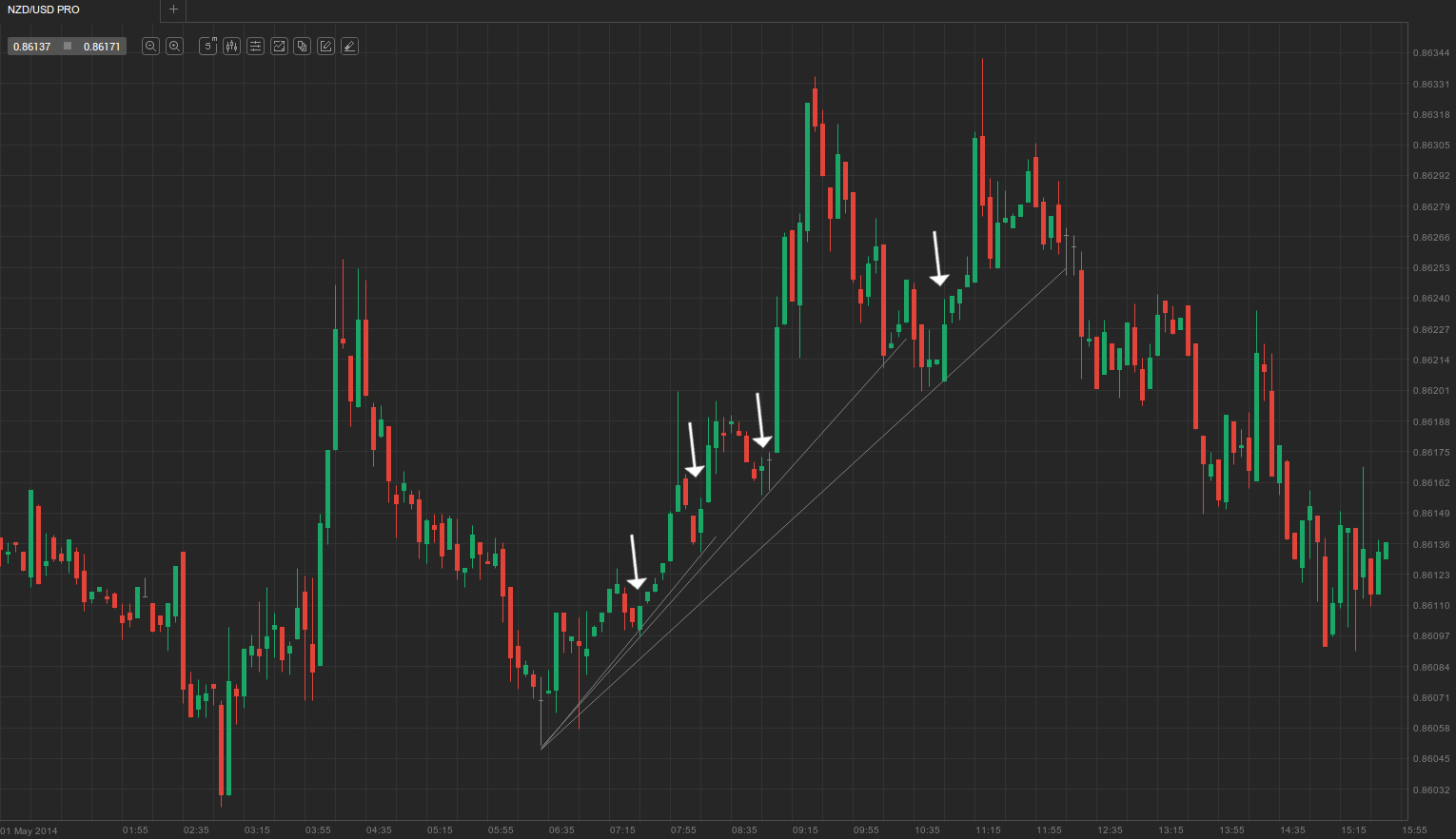
 Apart from moving-average pullbacks, another suitable with-trend entry signal appears when the price tries to break through micro trend lines but fails, marking a High 1 in a bull trend or a Low 1 in a bear trend. As explained in the article ‘Counting bars in order to detect end of corrections’, a High 1 is the first bar whose high is above the previous bar’s high during a downward move in a bull trend.
Logically, a Low 1 is the first bar with a low below the previous bar’s low during an upward move in a bear trend. The formation of a High 1 or Low 1 therefore signals the end of a counter-trend move and generates a with-trend entry signal. You can see several such entry bars in the example below, with the last one suggesting a pullback entry off the major trend line.