
 | Updated:
 Pattern transformation
This lesson will cover the following
- Patterns have the ability to:
- Patterns’ ability to evolve
- Some common transformations
Having covered the basics of price action, you should now be aware that every bar that forms at present can mark the beginning of a huge price move in either direction. Moreover, you need to examine very closely how price action develops in order to detect whether a current setup is changing and progressing into something more complex, which could have the potential to reverse the market’s direction, thus leading to a position in the opposite direction.
 Patterns have the ability to transform into other patterns, or to progress into larger patterns. In both cases, price action may lead to trades in either direction. If a trader analyses price action correctly, this will, most of the time, enable him to obtain at least a scalper’s gain (the amount a scalper usually sets as his or her profit target). A larger and more complex pattern can also ensure this. As we have already said, labelling patterns is not important. Correctly analysing price movement and making an entry based on this analysis is what matters.
 As an example of a transformed pattern, consider a situation where the pattern does not deliver a scalper’s gain and, moreover, produces a signal for a trade in the opposite direction. In this case, some traders will find themselves trapped and forced to exit the market at a loss. Their exit will push prices further, so that a scalper’s gain can be obtained in the opposite direction. Such a scenario is possible with any pattern.
Some common transformations
 A breakout from a micro trend line (a line drawn across two to ten bars that touch, or are close to, the line itself) can fail, and a pullback can then occur.

- Trade Forex
- Trade Crypto
- Trade Stocks
- Regulation: NFA
- Leverage: Day Margin
- Min Deposit: $100
In stock trading practice, during the first hour of a trading day, it is common to observe a situation where a double-bottom bull flag (a bull flag in an uptrend that has two distinct moves down to approximately the same price and then reverses back into the uptrend) can transform into a double-top bear flag (a bear flag in a downtrend that has two distinct moves up to approximately the same price and then reverses back into the downtrend).
A bull spike-and-channel trend (a breakout to the upside in a trend, followed by price action with less momentum, or in the form of a channel) can transform into a trading range, which may then transform into a double-bottom bull flag.
Example from stock trading practice
Now let us look at the 10-minute chart of BASF SE (BAS). Here we can see a double-top pattern that transformed into a double-bottom bull flag. In this situation, entries in both directions can be taken. It is possible to go short below bar 4 and then go long above bar 5.
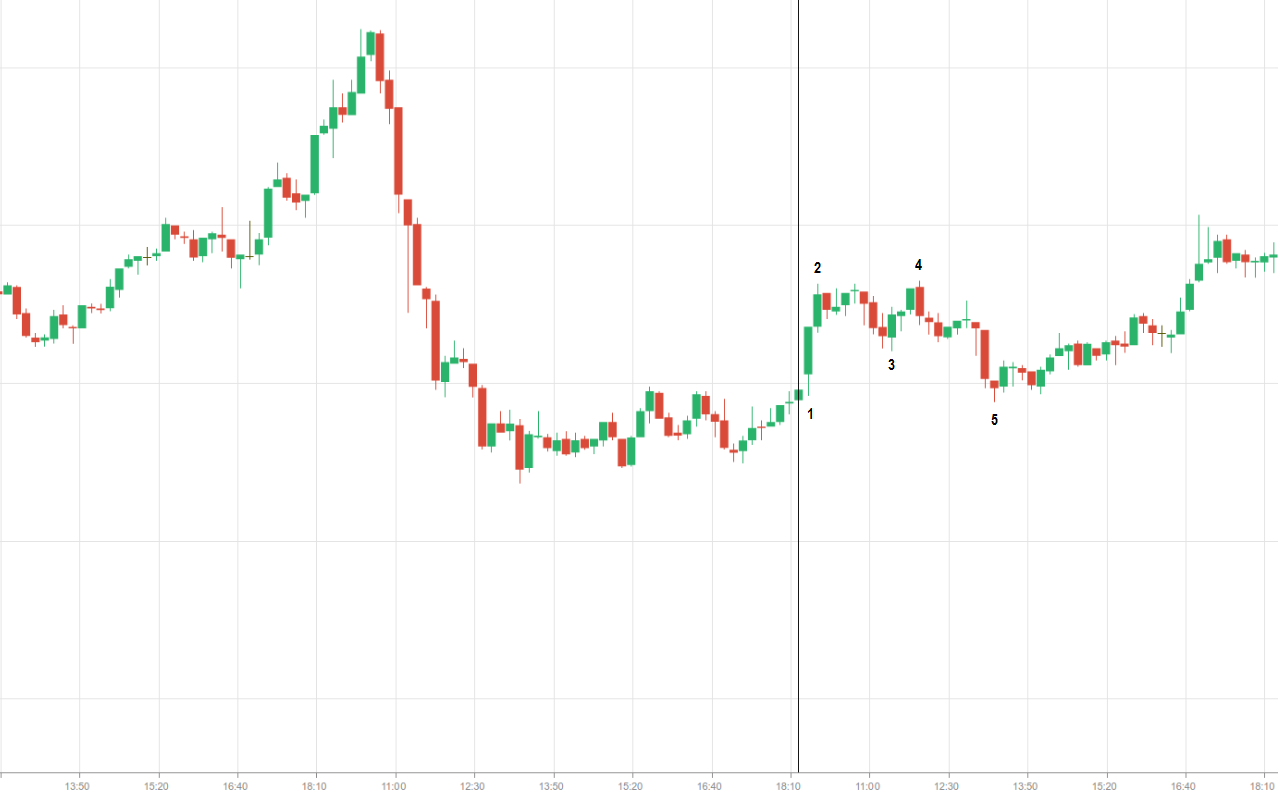
One of the extremes usually occurs during the first hour of the trading day, suggesting that prices may move away from this extreme level during the next few hours, sometimes even throughout the entire day (in this case, the trading day becomes a trend day).