
 | Updated:
 Trend reversals – general explanation and requirements
This lesson will cover the following
- What do we mean by a ‘reversal’?
- Requirements for a reversal
Beginners should remember that trading against the underlying trend should not be attempted until a key trend line has been breached. However, even then, a trader must remain cautious because, after the initial move against the trend, the market often continues to trend and attempts to retest the previous extreme level. As we have already noted, if the price fails to surpass that prior extreme, it will have made two unsuccessful attempts, and the market is therefore more likely to reverse. Consequently, a trader should look for entries against the trend only after the old extreme level has been tested.
What do we mean by a ‘reversal’?
 A reversal within a trend may not necessarily represent a genuine change in direction. It may denote a transition from an uptrend to a downtrend or vice versa. It can also signal a shift between an uptrend or downtrend and a trading range, a transition between a trading range and an uptrend or downtrend, or simply a breach of a trend line. The ‘new trend’ may be limited to a single bar. The price may move sideways for a few bars and then resume trending either upwards or downwards.
Technical analysis experts will usually not use the term ‘reversal’ until a series of trending highs and lows has formed. However, if a trader starts placing orders against the underlying trend, they are effectively assuming that a reversal has occurred. If a trader goes long during a downtrend, they believe the price is unlikely to fall even one pip or tick lower; otherwise, they would refrain from buying. By entering long positions on the assumption that the price will rise, the trader is treating the market as bullish and, therefore, presuming a reversal. Experts, however, would not endorse this view because it ignores some basic elements required to confirm a trend.

- Trade Forex
- Trade Crypto
- Trade Stocks
- Regulation: NFA
- Leverage: Day Margin
- Min Deposit: $100
Requirements for a reversal
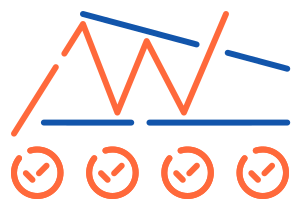
First, price movement needs to breach a key trend line from the previous trend; this is a strict requirement. Second, although not strictly required, it is often observed that following the key trend line breach, the price returns and tests the extreme level of the prior trend.
A new trend is considered to have begun when a series of higher highs and higher lows (in an uptrend) or lower highs and lower lows (in a downtrend) is already in place. The first move will breach the key trend line and produce a pullback that tests the end of the prior trend; after this test, traders will probably enter against the prior trend (that is, in the direction of the new one). Sometimes this test may not reach the old extreme exactly; in other cases it may overshoot slightly.
 Let’s elaborate. If, during a downtrend, a sudden move to the upside occurs that extends well beyond the bear trend line, most traders will look for long entries on the first pullback, anticipating that it will mark the first of many higher lows. At times, the pullback may dip below the downtrend’s low and trigger protective stops on the new long positions. If this lower low reverses within several bars, it may lead to a substantial move to the upside. Should the lower low be well below the previous low, it is preferable for a trader to wait for another trend line breach, a strong rally, and a pullback to a higher low (or at least a less pronounced lower low) before initiating another long trade.
Despite most traders preferring to buy the first higher low in a new uptrend and sell the first lower high in a new downtrend, a strong trend will produce several pullbacks and a sequence of higher highs and higher lows (uptrend) or lower highs and lower lows (downtrend). Each pullback can offer a valid entry. The first higher low in a new uptrend may test the low of the prior trend (downtrend) or retest a breakout from a previous swing point, trend line, trading range, or exponential moving average. In the latter case, the pullback may not come very close to the low of the prior trend (downtrend).