
 | Updated:
 Overview of channels – explanation and creation
This lesson will cover the following
- What do they represent?
- Variations of channels
- How to draw a channel
When price action is contained between two lines, a channel is usually formed. A trend channel represents a diagonal channel in which prices oscillate between one trend line and one trend channel line. In the case of a bull channel, it usually has an ascending trend line below (bull trend line) and an ascending trend channel line above (bull trend channel line).
Triangles and wedges as channels
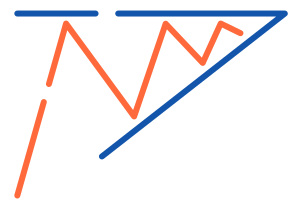 Different types of triangles can also be considered a type of channel, as they represent areas where prices oscillate between two lines. Because triangles demonstrate lower highs (descending triangles), higher lows (ascending triangles) or higher highs and lower lows (symmetrical triangles), we can say they provide trending clues in addition to their behaviour as trading ranges.
A symmetrical triangle is an area of price action contained between two diverging lines (trend channel lines). The lower line is drawn across lower lows (thus it is a bear trend channel line), while the upper line is drawn across higher highs (thus it is a bull trend channel line).
Symmetrical triangle with upward breakout
An ascending triangle usually has an upper line acting as a resistance line and a lower line acting as a bull trend line.
Ascending triangle with downward breakout
A descending triangle usually has a lower line acting as a support line and an upper line acting as a bear trend line.
Descending triangle with downward breakout
A rising wedge (bull channel) and a falling wedge (bear channel) both have a trend line and a trend channel line that eventually converge.
Wedge trend continuation
Drawing a channel
While a channel is forming on the chart, traders cannot be sure whether it will indeed develop or whether it is more likely a two-legged price move followed by a reversal. If prices begin to reverse from a two-legged move but the reversal eventually fails and a third leg of movement begins, channel lines can then be drawn.

- Trade Forex
- Trade Crypto
- Trade Stocks
- Regulation: NFA
- Leverage: Day Margin
- Min Deposit: $100
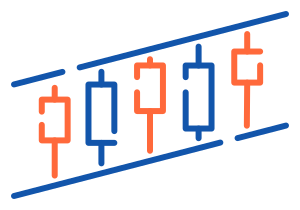 Let us imagine the following situation. Prices have just demonstrated two legs to the upside and have begun to reverse, while many traders probably went short at the reversal. If this second leg to the downside ends and appears to be almost the same size as the first leg down (the one that follows the first leg up) and a third leg up now begins, traders may suppose that a bull channel is forming rather than a reversal to the downside. When the second leg down is completed, a trader will place a trend line from the low of the first leg down to the low of this second leg and project it to the right. He or she will then attempt to go long once the price returns to the trend line. The trader will also draw a parallel line to the first one and drag it to the peak of the first leg up, thus forming a channel. Every time the price surges to this trend channel line, the trader will look to take profit on his or her long position and go short.
In the image below we can see what a bull trend channel should look like.
![trend channel bullish[1]](https://www.tradingpedia.com/wp-content/uploads/2020/10/trend-channel-bullish1.svg)
Because a bull channel requires at least the first two legs down for the channel to be confirmed, and because the price will usually test the area above the peak of the second leg up, bull channels display at least three swing highs, each higher than the previous one. A trader will not look for a reversal and a breakout from the channel to the downside until the third leg up is complete.
When the trend channel line is overshot (one or more bars penetrate this line) and a huge bear reversal bar appears on the chart, most traders will begin to short heavily. They do so because they see a greater probability that a breakout to the downside may occur. This is also a possible reason why many bull channels end after the third swing high is reached. Conversely, many bear channels end after the third swing low is reached.