
 | Updated:
 Overview of breakouts
This lesson will cover the following
- Any key price level or formation may have a breakout
- Positioning during a strong trend
Breakouts represent price moves beyond a given previous level of relevance (a trend line, a previous high or low, the high or low of the prior bar and so on). From a trader’s perspective, a breakout signifies strength, which may result in a new trend. If a bullish breakout bar shows a strong close and the following few bars also have strong closes and higher highs and lows, then, at some point in the future, the price will probably move to levels higher than those at present. After that, the market usually retreats back beyond the starting point of the breakout.
Any key price level or formation may have a breakout
 Breakouts may occur from trading ranges, from key trend lines, from the daily high or daily low, or from yesterday’s close. In all these cases, a trader should use the same trading approach. He/she would fade the move if the breakout failed, and enter in the direction of the breakout if there was a pullback after the breakout. In rare cases, a trader should make his/her entry on the breakout itself.
 During most trading days, traders view swing highs and swing lows as setups to fade. During a strong trend day, however, breakouts are accompanied by increased volume, while the market shows only minimal pullbacks. This implies that with-trend traders dominate market sentiment. In such a strong trend, a trader relying on price action should make entries in the direction of the trend on pullbacks after the breakout, not on the breakout itself, as he/she is constantly striving to minimise risk. At times, however, once a trader determines that a large move is imminent, he/she may enter in the direction of the move for any reason and still be successful. During a very strong trend, every single pip or tick is a potential entry in the trend’s direction; thus, a trader can enter with a market order at any point, using an appropriate protective stop.
Making entries during a strong trend
 In a strong trend, every single breakout beyond the previous extreme level can be considered an entry in the direction of the trend. This is usually supported by increased volume, large trend bars and further price action in that direction (usually within the next several bars). This means that entries are made on the breakout itself. But, as noted above, a trader should make such decisions only in rare cases. A price action trader can often spot an earlier entry during a strong trend.

- Trade Forex
- Trade Crypto
- Trade Stocks
- Regulation: NFA
- Leverage: Day Margin
- Min Deposit: $100
Even if a trader misses the earliest entry point during a breakout and decides to wait for a pullback, he/she can enter with a market order or on a one-minute pullback. It would be better, however, if he/she waited for at least two large trend bars (or four-five medium-sized bars) to appear and made his/her entry on a one-minute pullback with about 50% of his/her normal position size. The trader may wait for a pullback test of the breakout and use the protective stop he/she would have used if he/she had entered earlier. He/she may scalp out half of the position and move the protective stop to breakeven. As the strong trend develops, the trader may add to his/her position or make new entries on each subsequent pullback.
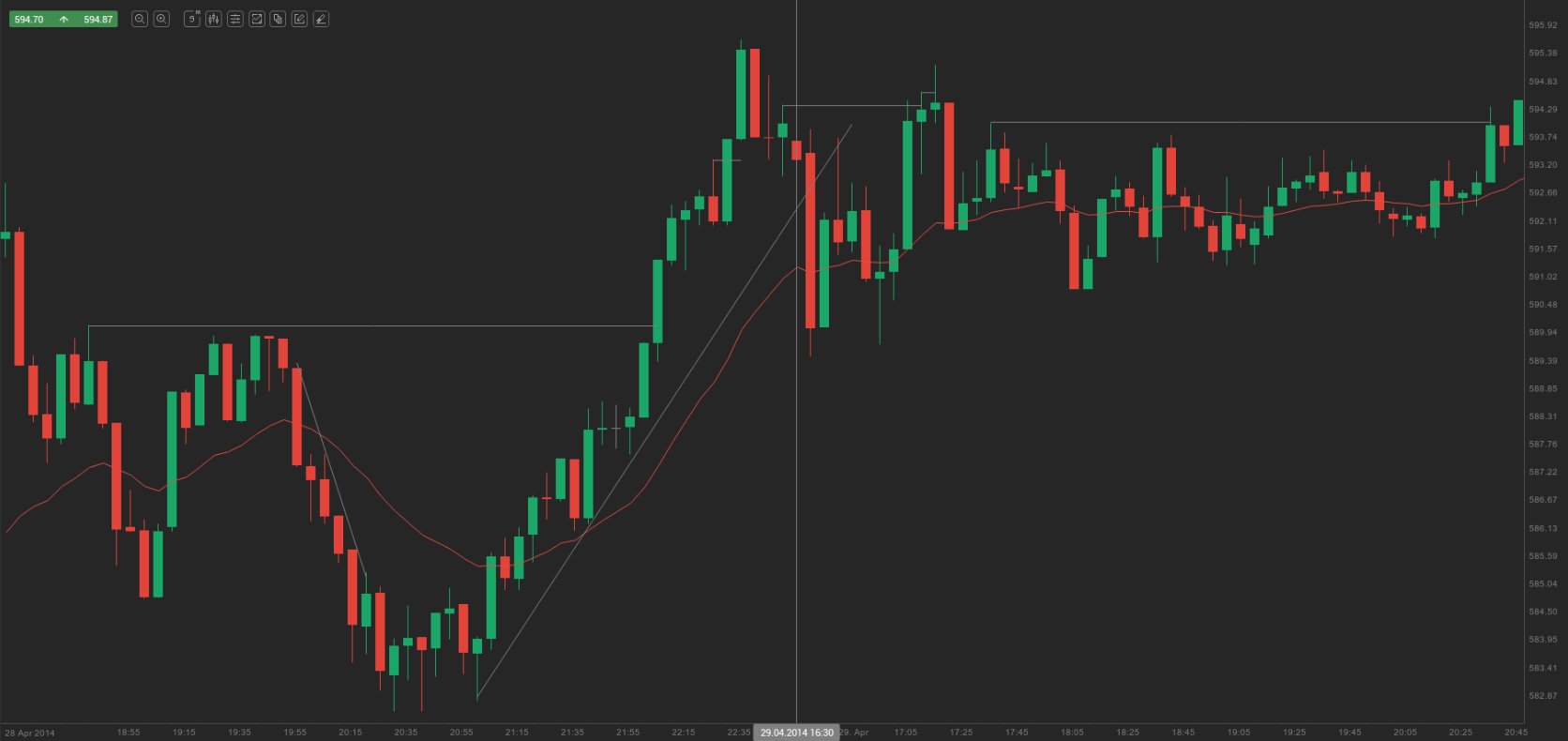
Breakout traders would have gone long above every previous swing high (as marked on the 5-minute chart of AAPL above). Price action traders would have entered earlier, on every breakout pullback, which can be viewed as a bull flag. Breakout traders, in fact, would have entered the market exactly where price action traders would have sold their long positions for a profit.
Generally, if the market is in a strong uptrend, one can buy at any level and still be profitable. What is worth noting, however, is that his/her risk-to-reward ratio will likely be far better if he/she enters on pullbacks than it would be if he/she entered on breakouts.