
Missing entries, entering trades late
This lesson will cover the following
- What to do when you’ve missed an entry
- What late entries are
- Why you shouldn’t hesitate to enter late
There will be many occasions when a trader either hesitates to enter the market at a certain time or sits at their computer and joins the market well after a strong trend has formed, thus missing out on a large part of its duration. At this point, the trader will wonder whether to wait for a trend reversal that can be captured or to enter the market, even though the current trend might be close to exhaustion.
 Well, the answer is simple. If you believe that, had you taken the initial entry, you would still be holding a portion of your position after scaling out, protected by a stop, then you should enter the market with exactly that portion and the same stop-loss. Of course, such a decision must be based on sound analysis, not merely on eagerness to hop on because the market is trending.
Insert links below.
Day traders who use small time frames such as 5 minutes commonly enter swing trades. These are positions that last longer than a scalp and persist through at least one pullback. Such trades involve the use of the scaling out technique. At least part of the position is held without a profit target, in expectation of a strong, prolonged market movement, aiming for a risk-to-reward ratio of at least 1:1. Once that ratio is achieved, the trader locks in some profit, thereby scaling out of the trade, and remains with a portion of the position in the market.
This is exactly where the late entry discussed here comes into play. It should be of the same size and have the same protective stop as the remaining portion after the scale-out.
 For example, imagine that you bought 1 standard lot of EUR/USD at 1.3000 with a trailing stop 20 pips away. The market subsequently jumped to 1.3020, where you sold 7 mini lots, thereby completing your scalp. You are now left with 3 mini lots at the current price of 1.3020 and choose a wider stop-loss, for instance at 1.2990, which you will use to milk the uptrend for additional profit. If you had not entered the market at 1.3000 and now want to join, you should buy 3 mini lots of EUR/USD at 1.3020 while placing a stop-loss at 1.2990.

- Trade Forex
- Trade Crypto
- Trade Stocks
- Regulation: NFA
- Leverage: Day Margin
- Min Deposit: $100
Emotionally, some traders perceive a difference between these two situations. They may believe that entering at 1.3000 and aiming for an open profit carries less risk because every pip they gain is someone else’s money, and therefore the risk is smaller. This is not true: as soon as the market moves to 1.3005 and you’ve earned 5 pips, that profit is yours – provided you lock it in. Consequently, it is no different from entering at 1.3200 with the same protective stop you would otherwise have used.
An experienced trader knows this and will not hesitate to enter such trades, because the probability of making a profit is high. This is especially true when the market has formed three, four or more consecutive trend bars that do not show climactic behaviour (are not too big), suggesting that a strong and possibly prolonged trend is in motion. When a trader sees such a scenario, they should enter the market with at least a small with-trend position instead of waiting for pullbacks.
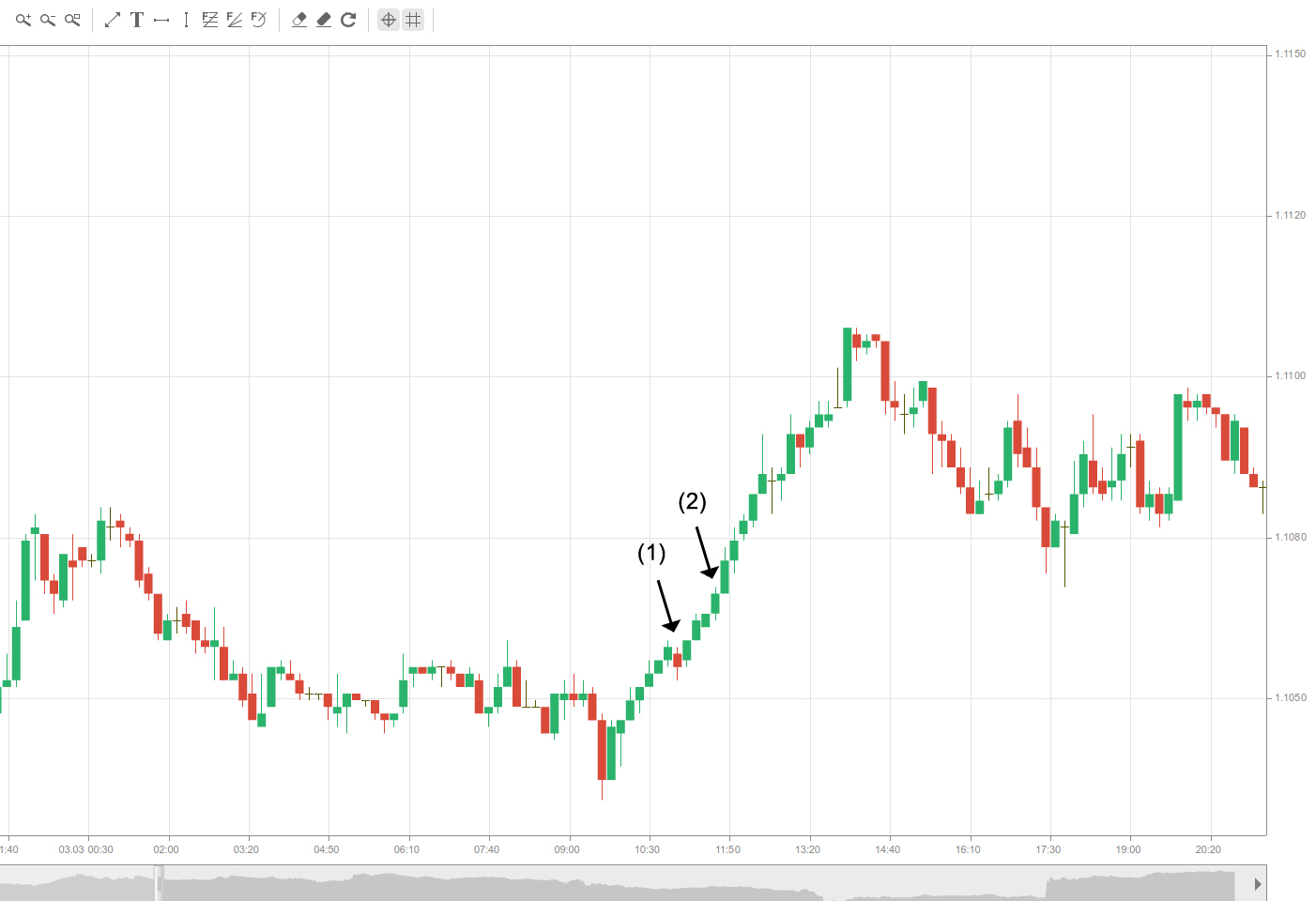
In the screenshot above, you can see a suitable example. The market formed a bullish two-bar reversal and entered a very strong bullish trend, consisting of many small successive bullish trend bars that do not show any climactic behaviour. Let us assume that you would usually enter a long position above the high of bar (1) and place a protective stop beneath its low. If for some reason you missed that entry point and began observing the market at, say, bar (2), you might wish you had at least the swing portion of the original order in the market. In that case, you can safely go long above bar (2) with that portion and use the same stop as you would have below bar 3. You can also use a breakeven stop. If the market continues to rise in your favour, you can add to your position, but that must always be accompanied by moving the stop of the entire position up in line with the addition.