
 | Updated:
 Making secondary entries in the market
This lesson will cover the following
- What do we mean by secondary entries?
- Why are they more specific than the first entries?
Very often, a peak that appears on the price chart requires a second reversal from this peak to convince enough market participants that prices have probably begun a new bear trend. In fact, the same is also true for a bottom.
Secondary entries have their specific features
 A secondary entry in the market is often considered more likely to lead to a successful trade than the first entry. A trader looking to make a secondary entry is one who enters later, strives to minimise his/her risk exposure and usually pays a little bit more for the additional information he/she has obtained.
However, if this secondary entry gives a trader access to the market at a better price than the first entry, there is a chance that the trader could find himself/herself trapped. If the trader pays less for his/her entry into the market, the market itself may be providing a false signal, which can result in a loss. In many cases, ‘good’ secondary entries occur at the same or a worse price.
Traders who look for secondary entries usually adopt a more aggressive approach and examine smaller time frames. This means that, for instance, on the 5-minute chart they will enter the market after many other traders have already made their entries. This way second-entry traders actually make a slightly worse entry compared with others.
Once again, note that if the market is allowing you to enter at a better price, you are probably missing something and should therefore refrain from taking this trade.
Another crucial point to note is when a trader intends to go short on the first reversal that occurs during a strong uptrend. If this reversal consists of four-five successive bull trend bars or two-three huge bull trend bars, the trader should reconsider whether to enter against the underlying trend. This is because the momentum appears to be quite strong. A better decision may be to wait for the major trend to resume for one-two bars and then enter as prices attempt to reverse for a second time.

- Trade Forex
- Trade Crypto
- Trade Stocks
- Regulation: NFA
- Leverage: Day Margin
- Min Deposit: $100
Examples
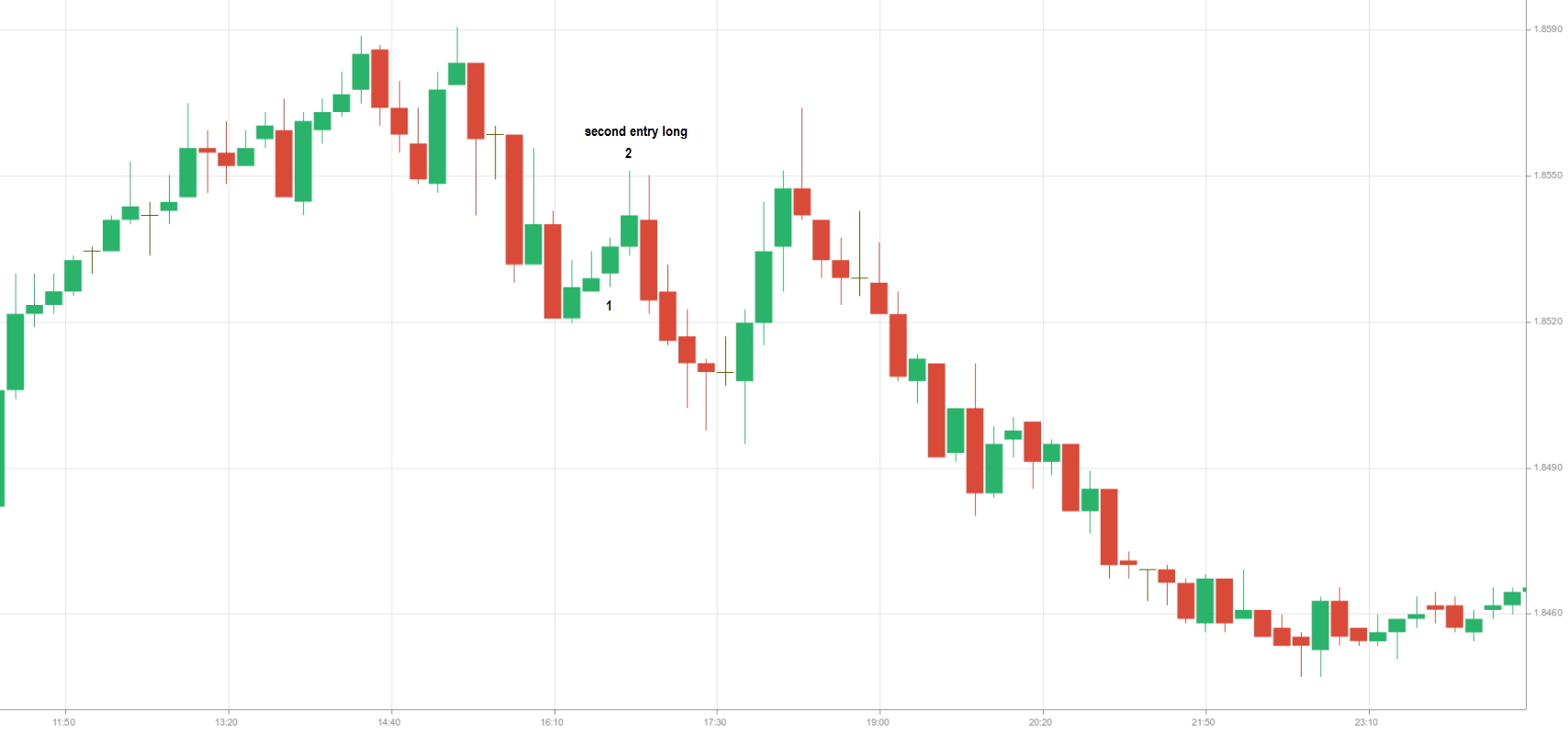
On the 10-minute chart of GBP/CAD above, we can see an example of a secondary entry made at a better price than the first entry. The market allowed traders to buy a few pips lower (bar 2) than those who went long at bar 1. The entry was good, but the trade itself was obviously unsuccessful. Bar 2 was a second entry; however, the downward momentum was strong.
If the market is offering you a ‘bargain’, you would be better off not entering a trade. So, whenever you consider entering against the underlying trend, it is better to look for further proof in the previous several bars that the buyers have indeed moved more than just a few pips above the preceding bar.
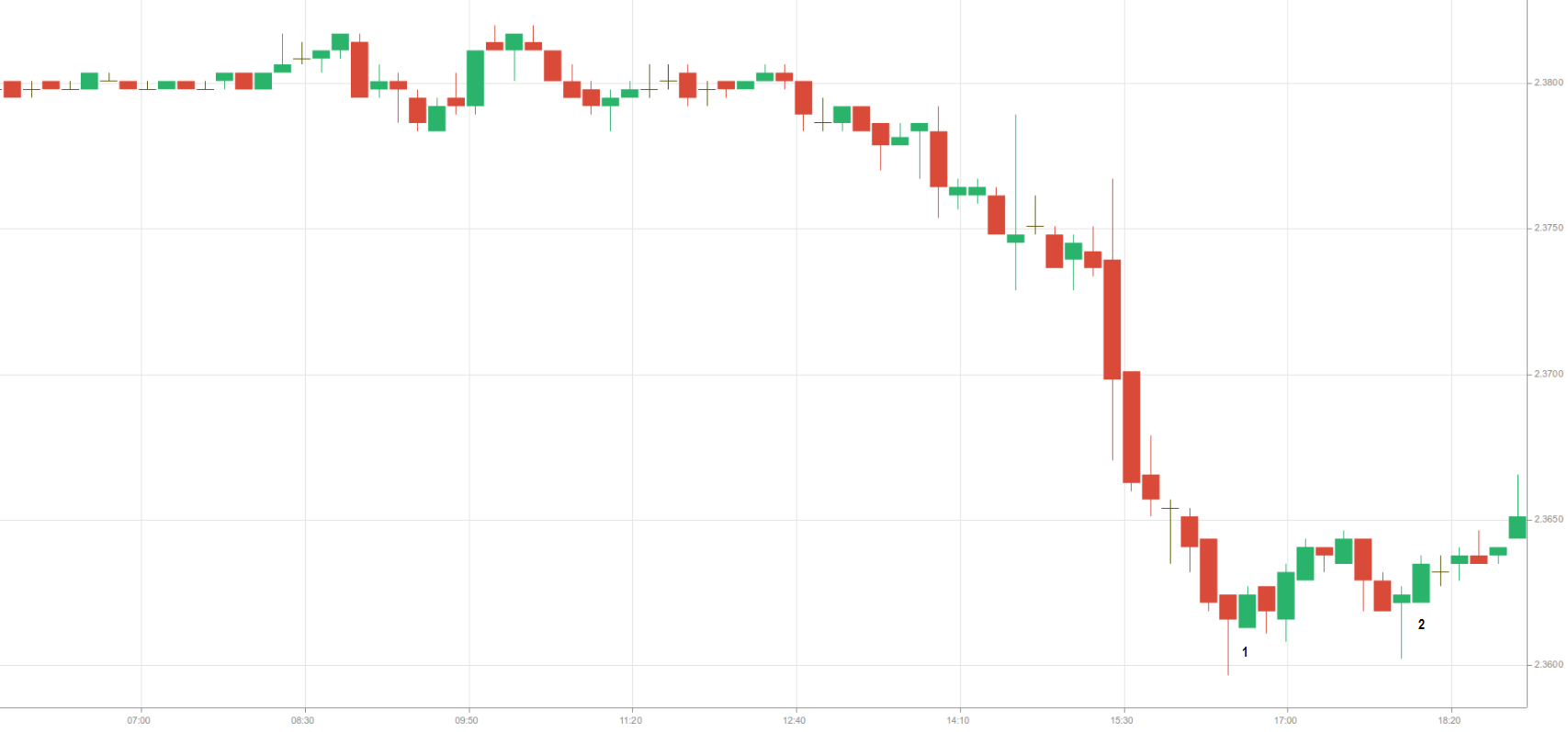
On the 10-minute chart of GBP/BGN above, bar 1 formed after seven bars with bearish closes, which implied too much downward momentum. Thus, a long entry on bar 1 would have been a risky move. Astute traders would instead wait to see whether the bears would succeed in dragging the price to the daily low for a second time. As they failed to do so, a secondary entry could have been made on bar 2.
The same remains valid in the opposite situation. If we see a bear bar forming after seven bars with bull closes (too much upward momentum), our short entry should not be on this first bear bar. We should wait to see whether the bulls manage to lift the price to the daily high for a second time and, if they fail, look for a suitable bear bar to make our secondary entry.