
Major trend reversals
This lesson will cover the following
- General thoughts on major trend reversals
- How to know when one occurs
- Different entry points
Previously in our guide, we’ve repeatedly underscored the importance of a trader’s ability to choose the best trades and avoid losers as much as possible in order to become consistently profitable. Gaining that ability, of course, requires a great deal of practice – sometimes even years of trading – but it is a goal every trader should strive to achieve.
We have previously said that one of the most successful ways to profit from trading is to bet in the direction of the market during strong trends, especially on pullbacks to the moving average. Moreover, we expressly emphasised that traders (especially less-experienced ones) should avoid going against the market until it has entered a definite trading range or a major trend reversal has occurred. If you would like to learn more about major trend reversals, please read on.
Turnarounds
 Major reversals signify a complete shift in market momentum, which may have continued for at least a couple of hours and sometimes even for days. The best trend reversal patterns unfold after a major trend line is broken, which indicates that counter-trend traders have established partial control over the market and are growing in strength.
In the article ‘Pullbacks in a Strong Trend – One of the Most Profitable Trades’, we said that, often, when the market breaks the trend line and the moving average after a protracted trend, and especially when it forms a gap bar, it usually reverses and tests the trend’s extreme. This is the strongest type of pullback and usually precedes a trend reversal.
After the trend-line break, the price usually reverses with a two-legged move that undershoots or overshoots the previous trend extreme, and it is very likely that the trend will reverse, making it a suitable entry point for a counter-trend bet. The two pushes to the new extreme attempt to re-establish the old trend, and that potentially failed second attempt to penetrate the previous resistance (the current trend extreme) carries a strong chance of producing a reversal move with at least two legs, which often develops into a new trend. However, if the market penetrates the trend’s extreme and continues beyond it, the trend is likely resuming and you must wait for a new trend line and moving-average break.
Different scenarios
In the screenshot below you can see a suitable Higher High counter-trend entry after a major trend-line break (or a Lower Low entry during a bearish trend).
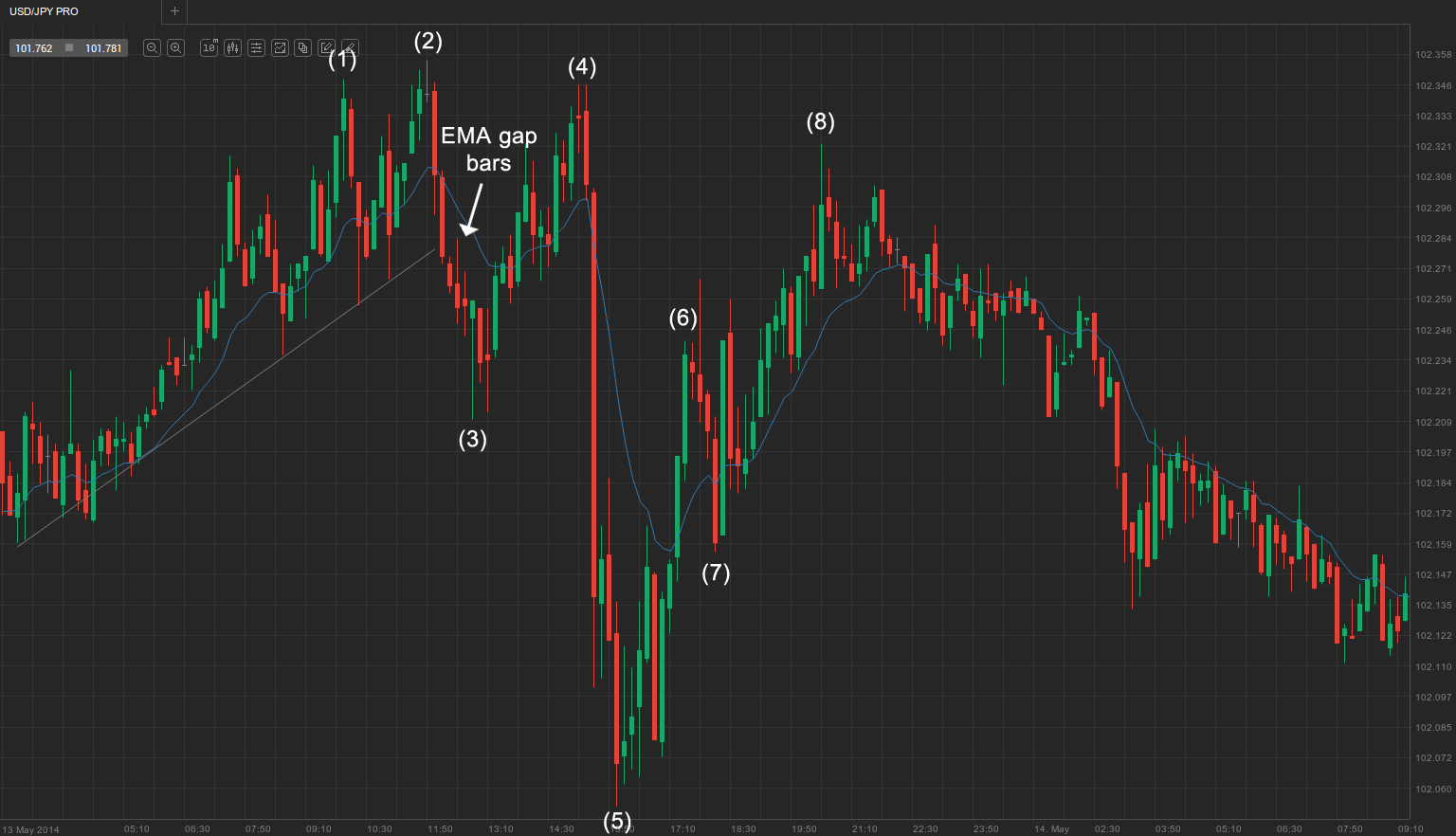
The market recorded two consecutive session highs at bars (1) and (2) before breaking both the trend line and the EMA, forming six gap bars. It then pulled back and undershot the trend extreme at bar (4), also forming a double-top bear flag with the bar following bar 2, thereby generating a reliable short entry signal. A sell climax followed, which was paused by a bull trend bar, and the price fell further to bar (5). The sell climax was then reversed with a two-legged move up (to bar 6 and then to bar 8), marking the end of the pullback and the continuation of the bear trend.
Two-legged pullback to lower high in a bull trend
The screenshot below illustrates a bear trend reversal followed by a two-legged pullback to a lower high, providing a high-probability second-entry short.
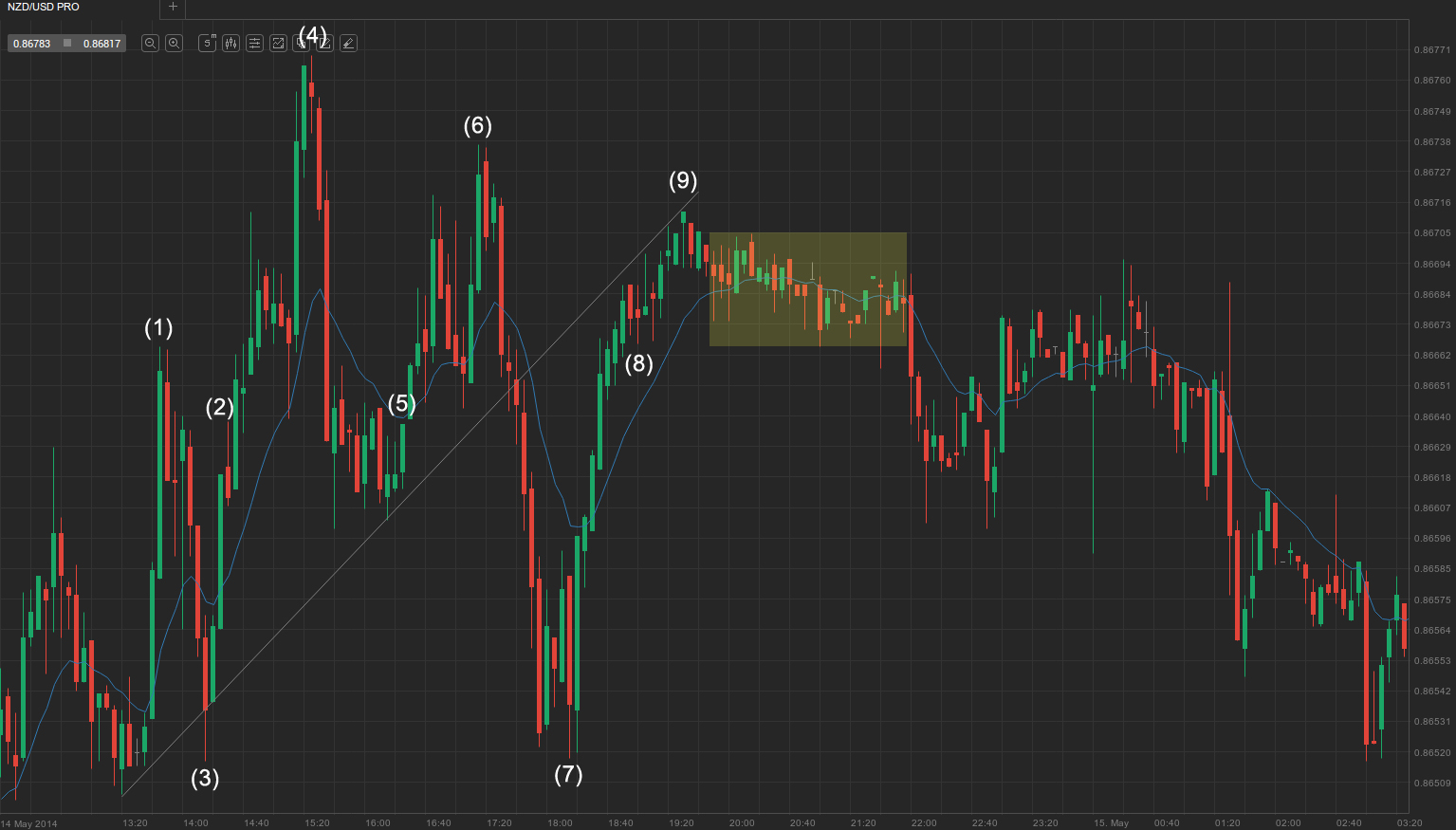
The trend accelerated to a new session high at bar (1), followed by a pullback to the trend line and the formation of two EMA gap bars. As expected, the market then rebounded to a fresh session high with a strong move up. Bar (2) was a huge double-shaved bull trend bar, and market participants who were still not in the market entered with a limit order above it, adding to buying pressure. Another session high was reached, followed by a pullback to the moving average and then an acceleration to a new session high at bar (4). A pullback to the trend line followed a sell climax, which formed ten EMA gap bars. The rebound from the trend line was fuelled by strong buying pressure, as evidenced by the top-shaved bull trend bar (5) and by the next bull trend bar, which gapped up.
At bar (6) the market formed a double top and an inside-inside pattern, providing a suitable short entry with a limit order below the low of the bear trend bar (for extra certainty, below the low of bar 6). When the short limit orders were triggered, the market plummeted, breaking both the trend line and the moving average. The swing low at bar (7) created a double bottom with bar (3), and the market ended the correction with a two-bar reversal up. Market participants now expected at least a two-legged move up to either a higher high or a lower high. The first leg of the pullback ended at bar (8), followed by a second rally to bar (9) – a lower high that was likely the end of the previous bull trend and, therefore, a suitable short entry. The end of the bull trend was also supported by the ‘barbed wire’ trading range, which had lasted for more than 25 bars, making a downward breakout more probable. Nevertheless, traders should have waited for the breakout to occur before positioning themselves.
Three-push pullbacks
In some cases, pullbacks do not consist of a single or two-legged move but of more legs, and will require further analysis to determine where the Lower High or Higher Low will form in order to obtain a reliable second-entry signal. See the screenshot below.
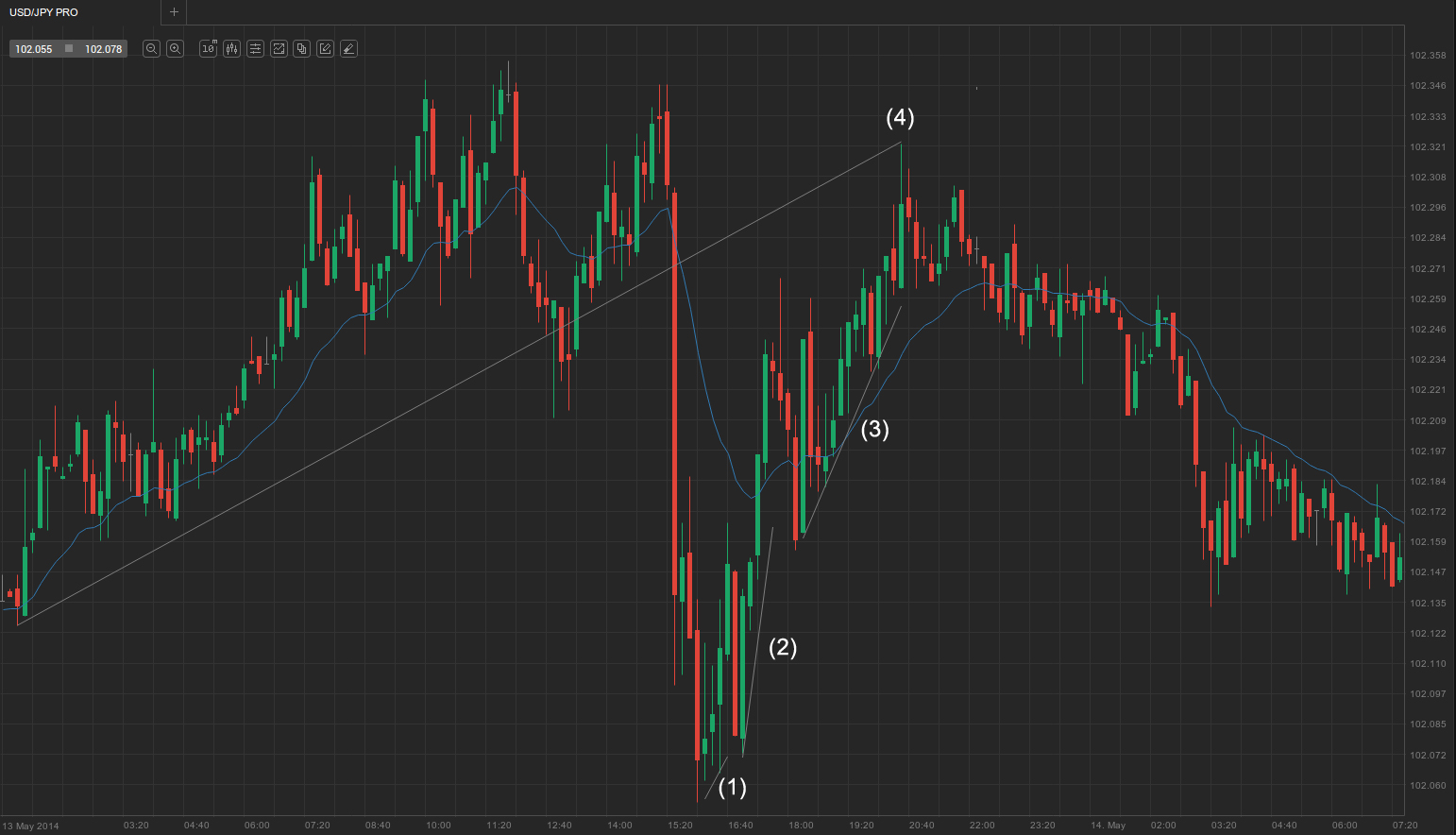
As you can see in the example above, the market pulled back and broke both the trend line and the moving average, forming seven EMA gap bars. The subsequent rally ended with a double top close to the session high, and the trend reversed with a huge climactic bear trend bar. The sell-off climax was paused by a bull trend bar before the price fell further to a new session low. The ensuing pullback consisted of three pushes up ((1), (2), (3)) instead of the usual two, and extended to bar (4).
Higher low after a lower low in a bear trend
The same scenario as the lower high in a bull trend is shown below, but this time in a bear trend.
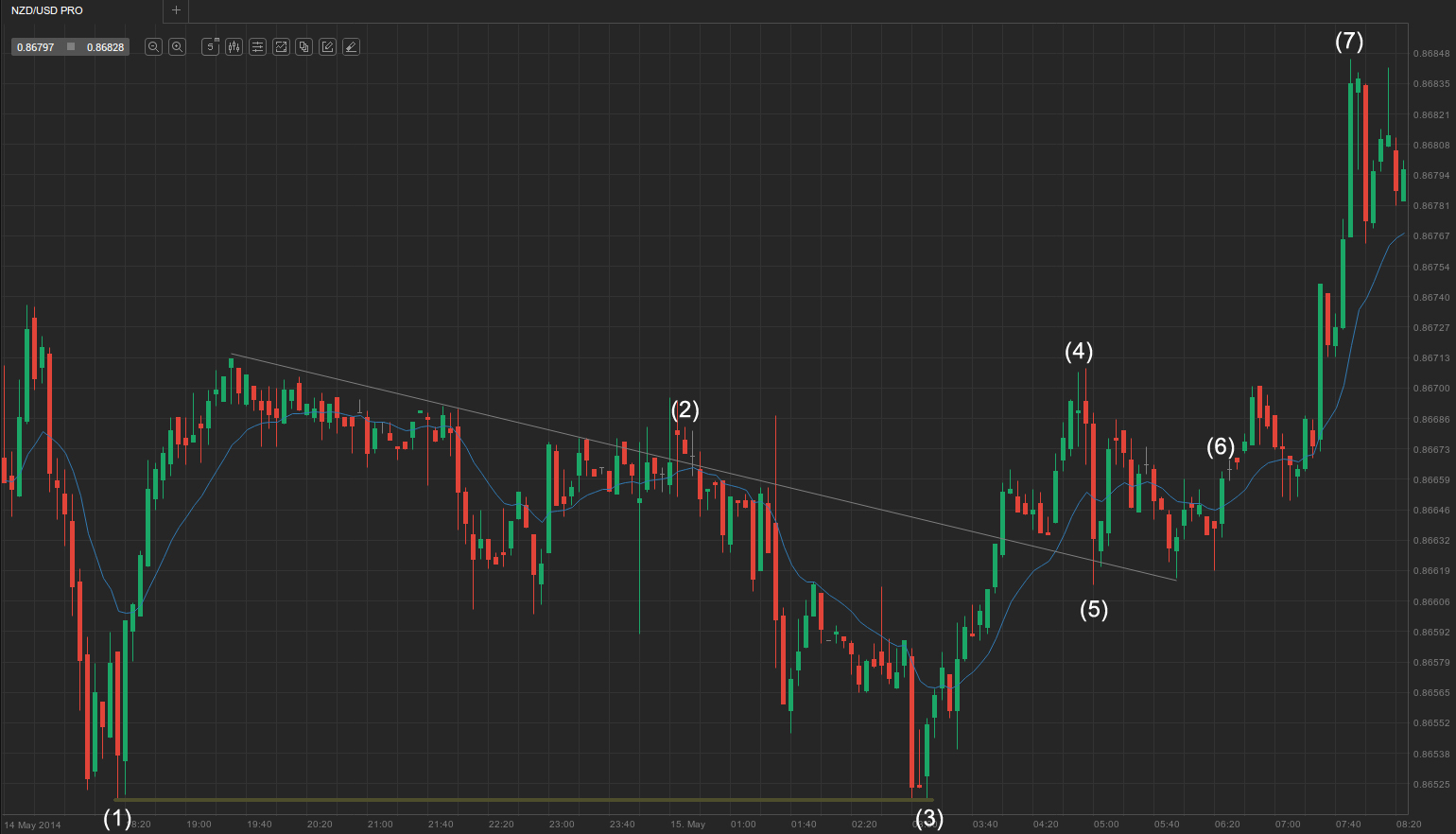
The trend illustrated above was weak at the beginning, briefly resembling a ‘barbed wire’ pattern, but then accelerated. The price rebounded and broke both the trend line and the moving average, forming a gap bar at (2). It then accelerated to a swing low at bar (3), which was both a double-bottom bear flag and a double bottom with bar (1), generating a reliable long entry. Moreover, it was a strong bull trend bar after a doji that appeared immediately after a sell climax, enhancing the reliability of the long entry and warranting at least a two-legged move up, in our case to bar (4). The price then pulled back to bar (5), testing the trend line; this was a higher low below the moving average and a reliable second bull entry – at least a scalp. You should always consider buying the first higher low after a major lower low, which was the weakest price level of the day. The market then entered a descending triangle, which could also be viewed as a falling wedge (not drawn), and broke out of it at bar (6) – a continuation pattern – followed by a three-push acceleration to the session high at bar (7).