
 | Updated:
 Further talk on reversal bars
This lesson will cover the following
- Waiting for a signal
- Following the trend
- Overlapping cases
As any market has the potential to trend upwards or downwards after any bar appearing on the price chart, any bar may be considered a setup, allowing a trader to enter either a long or a short position. A setup bar may become a signal bar only if a trader enters a position on the next bar (which then becomes the entry bar). A setup bar, viewed in isolation, does not provide a reason for a trade to be initiated. A setup bar must be examined in relation to the bars preceding it. If this bar is part of a reversal or continuation pattern, it may give a reason to enter a trade.
Lying in wait for a signal
 Beginner traders should note that a key aspect of price action trading is the expectation that the market can begin swinging up or swinging down on the next bar. There is a reason why some traders become extremely successful: they do not stop to ponder why the price might rise or fall on the next bar. Instead, they always expect a signal bar to appear and are prepared to open a position as soon as a suitable setup occurs.
Following the trend
 We have already noted in our previous guide that every trader strives to detect early and ride a developing trend. A successful trade is likely to follow a signal bar that is actually a strong trend bar confirming the direction of the trade.
Price action traders usually look for an imbalance between the bulls and the bears above or below the previous bar. A reversal bar reflects such an imbalance. A trader can enter the market after a trend consisting of only one bar if they expect further movement in their direction.
It is worth noting that if a strong uptrend is developing, you can go long for almost any reason. You can even go long above the high of a strong bear trend bar provided you place a sufficiently wide stop-loss. The more resilient the uptrend, the less important it is to wait for a strong signal bar to enter with the trend. However, it becomes more important to look for a strong signal bar if you wish to take a counter-trend trade. It is vital to enter the market only after the correct side (buyers or sellers) has at least taken control of the signal bar.
 When you intend to enter a counter-trend trade during a strong trend, you must first see the trend line breached and, second, see a strong reversal bar appear as the extreme level is tested. Consider the following example. A downtrend ends, the bulls overpower the bears and prices surge. When the price returns to the area of the prior low, a test is under way to determine whether the bulls will buy again at that level or the bears will manage to push the price below it. If the bears fail in their second attempt to break the low, the market is likely to move up for a while. When the market tries the same move twice and fails, it usually attempts the opposite move. Traders are often not convinced that a reversal is at hand until the market tests the extreme level of the old trend.
Overlap cases
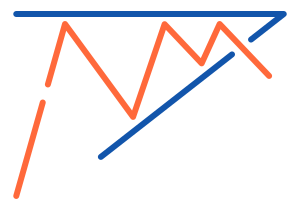 If a reversal bar overlaps one or more of the preceding bars, or its wick extends beyond those bars by a few pips, the reversal bar may be part of a trading range. If that is the case, a reversal is highly unlikely because prices are moving within a range rather than trending. The bar in question should not be treated as a signal bar.

- Trade Forex
- Trade Crypto
- Trade Stocks
- Regulation: NFA
- Leverage: Day Margin
- Min Deposit: $100
If a signal bar is large and overlaps the preceding two or three bars, this suggests that the bar belongs to a trading range. This is often the case with bull and bear flags, which may trap anxious traders positioned in the trend direction.
Imagine a market that has been in consolidation (a trading range) throughout the day. A sudden upward move carries the price a few pips above the exponential moving average. The market then moves sideways for a few bars until a strong bull reversal bar appears. A bull flag has formed. Some traders may be tempted to enter long a few pips below the top of the bull flag. However, in many cases this proves to be a bull trap because the market moves in the opposite direction soon after the entry is opened.
If the midpoint of a bull reversal bar is above the low of the previous bar in a probable reversal up (and, conversely, the midpoint of a bear reversal bar is below the high of the previous bar in a probable reversal down), this implies significant overlap; therefore, a trading range is more likely than a reversal.
If the body of the bar is small but the bar itself is large, indicating a doji, it is better not to use it as a reversal signal. A pronounced doji represents a one-bar trading range, so going long at the top of a range in a downtrend, or short at the bottom of a range in an uptrend, is unlikely to succeed.
If a bull reversal bar has a large upper wick, or a bear reversal bar has a large lower wick, counter-trend traders are not convinced they should hold into the close of the bar. A trade against the trend should be taken only if the body of the bar looks reasonably strong.
If a reversal bar is considerably smaller than the previous several bars, and its body is also small, it should not be used as a counter-trend signal.
During a strong trend a reversal bar may appear, but moments before it closes no reversal materialises. For example, in a strong downtrend a large bull reversal bar with a long lower wick forms: its last price is far above its open and above the close of the preceding bar, while its low reaches below the bear channel line. However, just before the bar closes, prices fall and it closes on its low. No bull reversal bar has formed where the trend channel line was breached; instead, a strong bear trend bar appears. Traders who went long early, expecting a sharp reversal, now find themselves trapped and must close at a loss, accelerating the move downwards.
A large bull reversal bar with a small body must be assessed in relation to previous price action. The long lower wick signals that sellers were overpowered by buyers, but if the bar significantly overlaps the previous bar or bars, it may represent a trading range on smaller time frames. The close at the top of the bar is therefore a close at the top of that range. As traders on smaller time frames take profits, their selling pushes the price down. Additional price action is required before entering against the trend. Going long at the top of a flag in a downtrend, or short at the bottom of a flag in an uptrend, will not lead to a successful trade.
Final words
 Beginner traders should also remember that any reversal on one time frame may appear to be an ideal reversal on another. If you detect a potential reversal but do not see a reversal bar on your chart, do not waste time scanning dozens of other charts for the perfect example. Your objective is to understand what is actually happening in the market, not to find an ideal formation. If prices are attempting to reverse, focus on finding a way into the market rather than expending energy looking for a perfect reversal bar.