
 | Updated:
 Breakouts, tests and reversals in general
This lesson will cover the following
- Basics of breakouts
- Basics of tests
- Basics of reversals
Breakouts
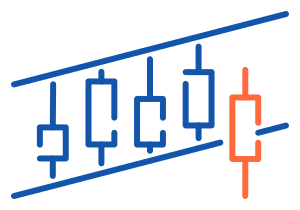 Every single bar has the potential to signal either a trend or a trading range. Put another way, every bar can indicate a situation in which either long-positioned or short-positioned traders dominate the market, or one in which both groups alternate in taking temporary control.
When a trend begins to develop, a small or large trend bar appears on the price chart, followed by other trending bars, while the market gradually moves away from the trading range. It is valuable for every trader to be able to identify whether a breakout is real or merely a fake-out.
At times, when trading volume is thin, a breakout may appear as a gap on the chart rather than as a trend-signalling bar.
At some point, prices may begin to pull back; the trend then loses strength and its slope becomes less steep. The trend forms a channel, so a trend line and a trend channel line can be plotted on the chart. These lines will need to be redrawn as the trend continues so that price action remains contained.
Tests
 The beginning of a channel usually implies the inception of a trading range. If an upside breakout occurs and lasts for several bars, a pullback is expected to follow. After this pullback ends, the trend resumes its upward movement, but now in the form of a channel rather than an almost vertical climb. Bars begin to overlap more, and there are more bars with wicks and more small pullbacks.
After the pullback starts and prices tend to approach the beginning of the channel, many traders will likely identify the formation of a trading range. Price-action traders will probably anticipate this trading range immediately after the sudden move (spike) ends and as the channel starts to form. Some may begin to scale into short positions on the first pullback after the spike. Expecting prices to test the bottom of the channel, they may even add to their shorts on subsequent pullbacks.
As soon as a larger pullback tests the bottom of the channel, bears begin to exit the later short positions at a profit. Many traders may cover their shorts at the bottom of the channel (they buy there), while others (bulls) enter at the same level where they bought earlier, that is, at the low of the first pullback that followed the spike up. This activity lifts prices and the trading range widens.

- Trade Forex
- Trade Crypto
- Trade Stocks
- Regulation: NFA
- Leverage: Day Margin
- Min Deposit: $100
Channels are eventually retraced, which prompts some traders to regard all bull channels as bear flags and all bear channels as bull flags. In rare cases, a breakout occurs in the direction of the trend, leading to an acceleration of that trend. If a sudden move up is followed by the formation of a bull channel, the price may, on rare occasions, break out above the trend channel line and thus accelerate the uptrend. However, such a breakout may prove to be a fake-out, and a price reversal will probably follow.
By a ‘test’ we mean a situation where prices return to a support or resistance level or zone. This may include trend lines, trend channel lines, previous swing highs or swing lows, the high of a bull signal bar, the low of a bear signal bar, or yesterday’s high, low, open or close.
 Traders often make decisions based on price behaviour at a test. Consider the following example. If prices reach a high, pull back, and then return to that high, this may suggest that bulls expect a strong breakout. If a breakout appears to be starting, bulls may go long a few pips above the previous (old) high. Alternatively, they may wait for a pullback after the breakout and then go long a few pips above the high of the prior bar in anticipation of a continuing breakout. In this scenario, bears may be waiting for a reversal. If the move up to the old high is not strong enough and a reversal bar appears at that level, bears may go short just below the reversal bar. They will wait for confirmation that the market is rejecting prices in this zone, thereby validating their view that the instrument is overvalued.
Reversals
 A reversal is a sudden change in sentiment, i.e., a shift from an uptrend to a downtrend or vice versa. Some traders consider price behaviour in a trading range to be the opposite of price behaviour in a trend. Therefore, when a trend is followed by a trading range, it implies a reversal in price behaviour. When a trading range is followed by a trend, it also implies a reversal in behaviour, but this scenario is simply called a breakout.
However, novice traders should note that most reversals do not lead to the opposite trend; they are usually transitions from an uptrend or downtrend into a trading range. Once a market has gained momentum, it is not easily changed. A strong uptrend will likely resist reversal. Thus, each attempted reversal is more likely to result in a bull flag, after which the trend continues. Each successive bull flag may appear larger on the chart because bulls become increasingly eager to take profits at new highs and may refrain from aggressive buying. At the same time, bears become more aggressive. Eventually, they may succeed in wresting control from the bulls, causing the range to break to the downside and a downtrend to develop. This usually happens after several failed reversal attempts.
Although most reversals lead to trading ranges, the resulting price movement is usually large enough to allow a swing trade and, consequently, a considerable profit.
 Another point worth noting is that reversals may look different on different time frames. A large bear reversal bar on a monthly chart may appear as a two-bar reversal on a weekly chart. Regardless of the time frame, the key is simply to recognise that a given pattern may lead to a reversal.