
 | Updated:
 Breakouts from trend lines
This lesson will cover the following
- Trading with the trend until a trend line breach
- What determines the strength of a trend line breach?
It is vital to emphasise that a trader should place entries only in the direction of the trend. Only after spotting a breach of a key trend line may it be appropriate to look for entries against the trend.
As mentioned earlier, trend reversals begin with, first, a breach of a trend line and, second, an overshoot of a trend channel line, followed by a reversal. In both cases, a breakout from a trend line is present. Until this occurs, there is very little justification for trading against the trend. When there is no trend line breach, the strong trend remains intact; therefore, a trader should ensure they have taken every suitable entry in the direction of the trend, regardless of whether they may have missed a scalp or two against the trend.
Actual V-bottoms and V-tops, especially when there is no trend channel line overshoot followed by a reversal, are rare. Therefore, a trader should focus on more common setups. If they miss a rare pattern, there will eventually be a pullback that may provide an opportunity to enter in the direction of the new trend.
Formidable trend channel line reversals arise from overextended trends and usually travel quite far after breaking the trend line. The first pullback following the reversal is typically brief because both sides of the market agree that the trend has reversed. This confidence prompts most traders to adopt an even more aggressive approach – adding to their positions at the shortest pause while refraining from locking in gains. This leads to shallow pullbacks.

- Trade Forex
- Trade Crypto
- Trade Stocks
- Regulation: NFA
- Leverage: Day Margin
- Min Deposit: $100
What determines the strength of a trend line breach?
 If the move through the trend line is exceptionally strong, a second leg after the pullback is usually present. The stronger the breach, the higher the likelihood of a second leg. The pullback may test the extreme of the trend and may overshoot the trend channel line (a higher high at the end of an uptrend and a lower low at the end of a downtrend), or undershoot it (a lower high in a new downtrend and a higher low in a new uptrend).
Sometimes the trend channel line may be overshot beyond the old extreme. In this case, the reversal is neutralised while the original trend continues. If a trader is looking for an entry against the trend, they need to wait for another breach of a trend line or an overshoot of a trend channel line.
There are several indications of how strong a breach of a trend line (the first leg of a potential reversal) is.
First, the move encompasses many points/pips and many bars (ten or more);
Second, the move goes far beyond the exponential moving average (EMA);
Third, other strong previous trend line breaches were present;
Fourth, in a reversal to the downside, the move reaches below the final higher low in the uptrend. In a reversal to the upside, the move reaches above the final lower high in the downtrend;
Fifth, the reversal back, which tests the extreme of the old trend, stops at the exponential moving average (EMA) or the old trend line and does not come very close to the extreme itself;
Sixth, the reversal back, which tests the extreme of the old trend, lacks momentum (the move has a lot of bars with considerable overlap and many of them are bars in the direction of the new trend).
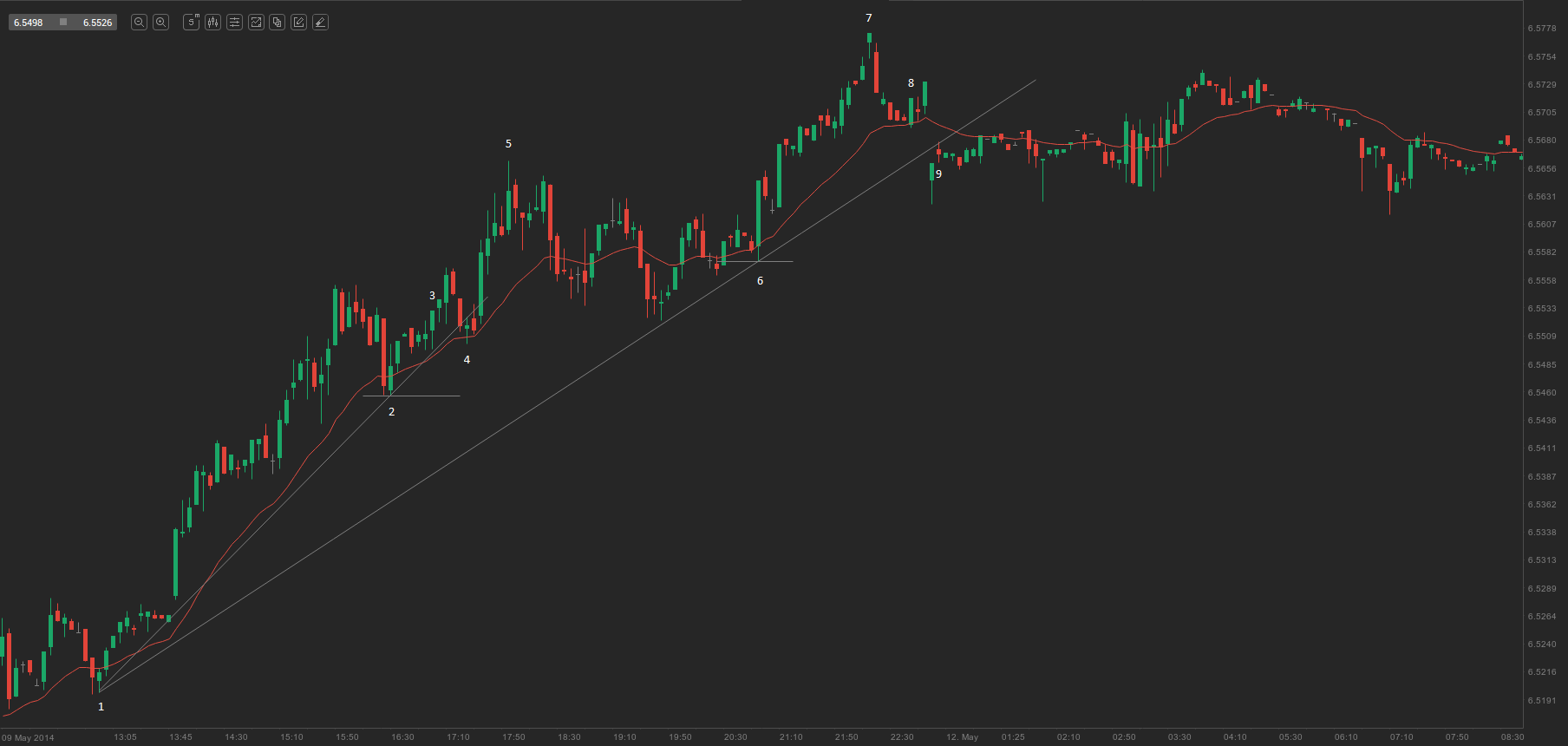
On the 5-minute chart of USD/SEK above, there was a weak bear leg to bar 4 that barely breached the bull trend line, failed to fall below the last higher low in the uptrend (bar 2) and could not break through the exponential moving average. The down leg to bar 9, however, breached a longer bull trend line and the exponential moving average. These factors indicate a degree of strength behind the trend-line breach, which increases the probability of at least another leg to the downside and even a successful reversal. Remember: counter-trend positions should not be taken until after there has been a break of a key trend line!
After a key bull trend line has been broken, many traders begin drawing bear trend lines, which can prove vital, especially if the price reverses and starts forming lower highs and lower lows.