
 | Updated:
 Breakouts from a channel
This lesson will cover the following
- Most breakouts to the upside from bull channels fail
- Channels act in a similar way to flags
- Signs of channel strength
As we have already said, channels can be viewed as sloping trading ranges. As such, many of the attempts by prices to break out either from the upper area or from the lower area of the channel usually fail.
In a bull channel, both buyers and sellers are active, but buyers appear more tenacious, which explains why the channel slopes upwards. Both sides consider it appropriate to enter into trades in the middle of the channel, but as soon as prices approach the upper area of the channel, buyers grow more concerned that a breakout to the upside is unlikely to occur. Consequently, they will exit some of their long positions. Sellers, on the other hand, will go short with even greater impetus close to the upper area of the channel, because the prices at which to short are better.
As the price approaches the lower area of the channel, sellers will be less likely to go short at these levels, while buyers will enter long positions aggressively. A bounce off the trend line will usually occur.
As the bull channel develops, the price will usually dip below the channel a few times, so the trend line needs to be redrawn. This way, the channel will broaden.
The eventual result is usually a breakout to the downside, sufficiently strong to be followed by a lower high and a lower low. As these two patterns appear on the chart, some traders will begin to construct a bear channel.
Most breakouts to the upside from bull channels fail
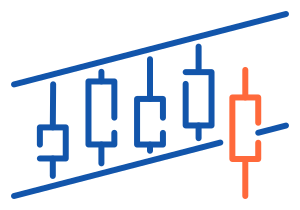 If buyers eventually overpower sellers in the market and manage to produce a breakout to the upside, it may last for several bars. Buyers are likely to consider the market overbought, so they may exit and lock in gains. They will probably not look to go long again until the price retraces a little.
The magnetic pull of the middle area of the channel, which we have already mentioned, will usually drag prices back inside the channel; thus, this will not be an actual breakout but rather a buy climax. This climax may trigger a two-legged retracement (lasting for about 10 bars) that will eventually move below the channel. When the price breaks out to the downside and selling pressure persists, the move downwards may be approximately equal to the height of the channel.
Sellers are probably aware that the buy climax may be followed by a retracement, so they will begin to short heavily. In addition, buyers will exit their long positions, which is also likely to create selling pressure. If this pressure proves strong, the retracement may even turn into a downtrend.
Channels act in a similar way to flags
 As every trend channel is a trading range with a slope, a bull channel, regardless of its steepness, will eventually produce a breakout to the downside. Therefore, it can be viewed as a bear flag, even if no downtrend was detected beforehand. Institutional bulls will probably take their profits and look to go long again only after a substantial pullback has occurred. Moreover, this pullback needs to extend to the start of the channel, where these bulls bought earlier. This, to some extent, explains why channels often cause a retracement that touches the lower area of these channels.

- Trade Forex
- Trade Crypto
- Trade Stocks
- Regulation: NFA
- Leverage: Day Margin
- Min Deposit: $100
Institutional bears, on the other hand, will begin to sell heavily just when institutional bulls cease buying. These bears will probably take their profits near the very bottom of the channel, where institutional bulls will look to renew their buying.
As a bull channel acts as a bear flag, it is logical to trade it as such. Likewise, every bear channel can be considered to act as a bull flag and traded accordingly. An uptrend may or may not be present beforehand, but that is of little importance.
A breakout to the downside from a bear channel may be just a sell climax, which will lead to a two-legged retracement back inside the channel that will eventually break above it.
Signs of channel strength
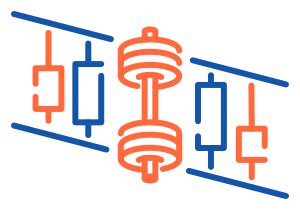 A channel is usually stronger if both lines are close to one another and the slope is steeper (the so-called tight channel). This implies greater momentum.
 It is risky to trade the first breakout against the trend if the channel appears to be strong. Viewed on a higher time frame, the whole channel may appear as a spike. In a steep bear channel that has pullbacks consisting of only one bar, a trader would be better off not buying breakouts above the preceding bar. It is more appropriate to wait for a breakout pullback. If such a pullback occurs and the reversal appears strong (2-3 large bull trend bars among the past several bars), the pullback may be bought. If a rally follows, the likelihood of even higher prices increases.
The likelihood of a long position generating gains is higher if the price rally moves above the Exponential Moving Average (EMA) while the first pullback remains above it. In case the pullback occurs below the EMA, this suggests that buyers are not that strong, while the odds of another leg up decrease.
If the price continues to fall after the breakout to the upside, it was obviously a false breakout and the downtrend may be resuming.