
Basics of trends and trend lines
This lesson will cover the following
- A basic outline of trends
- Types of trends
- Trend lines and trend channel lines
- Trend channels
As we’ve already said in previous articles, there are two states a market can be in – it is either trending or trading sideways. A beginner trader should be very cautious when trading in ranging markets because they carry a much higher risk of loss, and experienced market players are very good at reading them and trapping newbies. We’ve mentioned several times that novice traders should stick to trending markets and enter with-trend positions because going against the market can be very destructive for your account if you lack the required experience.
So, let us begin with some basics regarding trends. A trend defines a direction in market prices. When we refer to a trend, we mean a directional movement (formed by rising or declining prices) from which a trader can generate a profit, provided they have the required skills. A chart usually displays only one or two major trends because of their length, but there are also smaller manifestations of a trend – swings, pullbacks and legs.
Insert link below.
We’ve mentioned in the article ‘Price Action From Trading Ranges to Strong Trends’ that markets rarely exhibit simple, straightforward behaviour and, when they do, it is only for a short period. Prices tend to switch from trending to ranging behaviour, and you will rarely see them acting in only one of those two ways for an extended period.
In addition, as trends have different lengths, shorter-term trends are part of longer-term trends. For a technical analyst, a trend is a directional movement of prices which remains valid long enough to be identified and still be tradable. A trend should be identified as early as possible and be long enough for a technical analyst to profit from it.
Types of trends
 A rising trend (uptrend) is formed when prices reach higher peaks and higher troughs. A decreasing trend (downtrend) is formed when prices reach lower peaks and lower troughs.
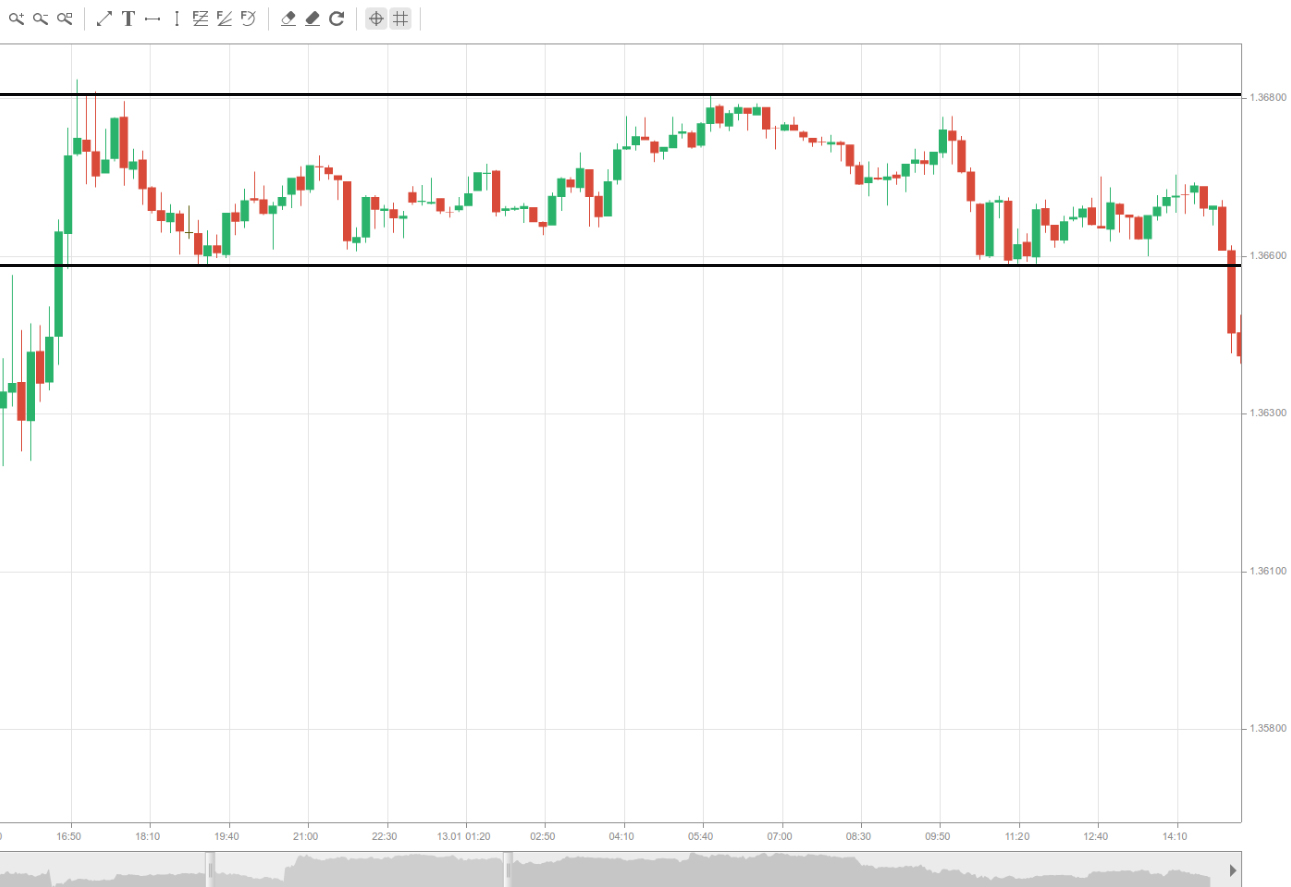
A sideways trend (flat trend) occurs when prices trade within a specific range without demonstrating significant upward or downward movement; they move up and down but remain at approximately the same level. This configuration occurs after a larger trend has reached a temporary halt. A flat trend is also called a consolidation or congestion area. You can see one in the following screenshot.
A trend is visualised by drawing trend lines. Trend lines can be based on linear regression or, in an easier way, by connecting at least three extreme points (peaks or troughs). By drawing trend lines, the trader gains an idea of price movement and its limits which, if broken, can signal the trend may reverse or flatten out into sideways trading.
Trend channel lines
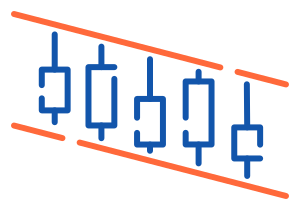 The other type of lines used in trend visualisation are the so-called trend channel lines. They are also straight, diagonal lines containing the price action but are on the opposite side of the trend lines.

- Trade Forex
- Trade Crypto
- Trade Stocks
- Regulation: NFA
- Leverage: Day Margin
- Min Deposit: $100
For example, in a bullish trend the trend line is plotted below the price action, while the trend channel line is positioned above the highs of the market movement. Conversely, in a bearish trend the trend line is above, while the trend channel line is below the price action.
The slope of the trend line and the trend channel line may vary: they can be parallel, convergent (forming descending triangles) or divergent (forming ascending triangles). Parallel lines form trend channels which, like the trend itself, can be ascending, descending or ranging. In the example below you can see a rising channel.
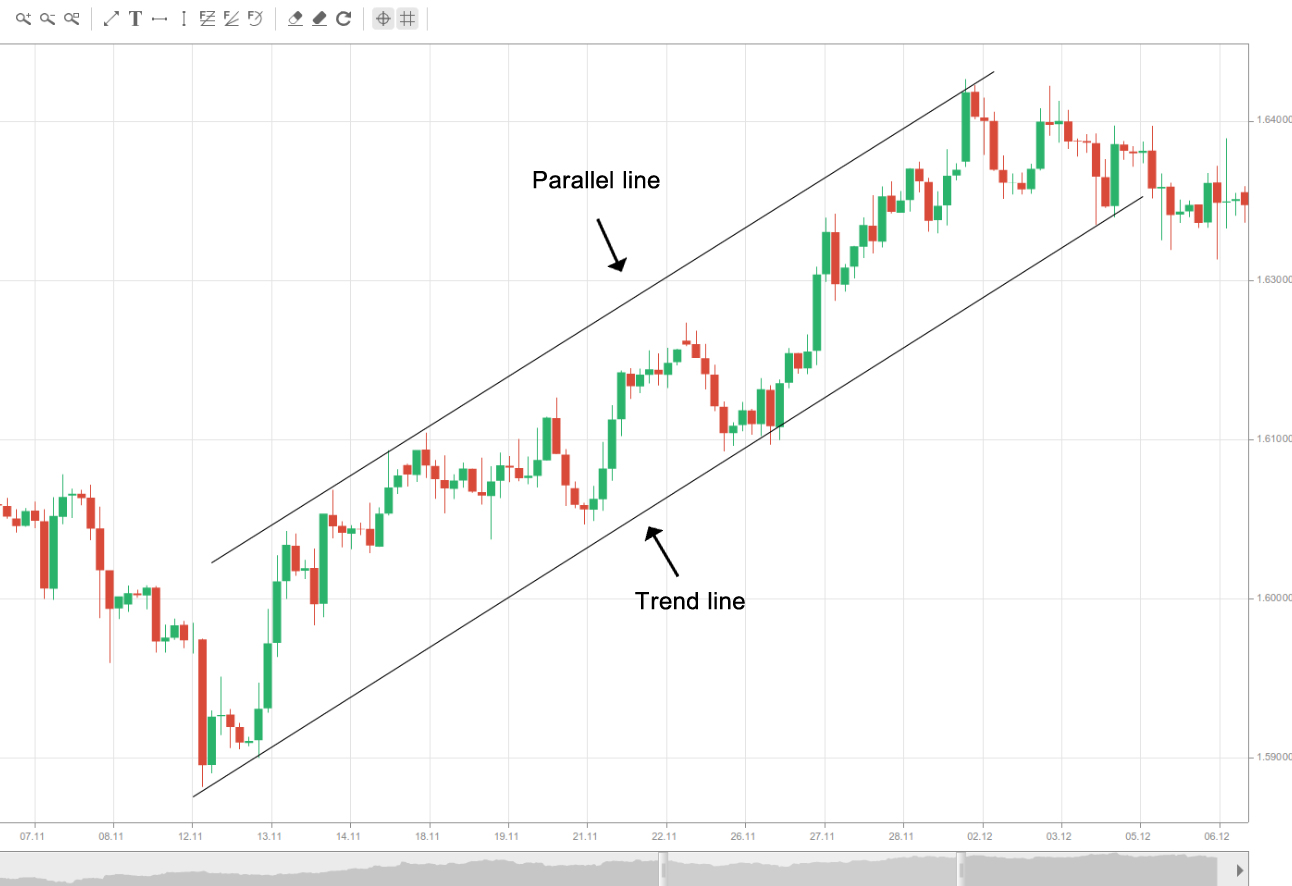
In general, trend lines are used as entry points for with-trend positions because they act as support in a bullish trend and resistance in a bearish trend. Conversely, trend channel lines most often generate counter-trend entry points, since they act as resistance in uptrends and support in downtrends.
One crucial point to remember is that market movement tends to build inertia, making markets more likely to continue doing what they have been doing instead of changing direction. This is why, more often than not, trend reversals and trading-range breakout attempts fail rather than succeed.