
Basics of pullbacks
This lesson will cover the following
- General thoughts on pullbacks
- Two-legged pullbacks – ABC patterns
- Difficulties traders experience with pullbacks
 Generally speaking, a pullback is every counter-trend move the market makes, or more strictly – each counter-trend bar that manages to break through the previous bar’s extreme (e.g. in a bearish trend, a pullback bar is a bar whose high extends above the previous one’s high).
Due to their importance as entry setups, pullbacks should be defined more broadly. We can assume that every pause in the current trend is a pullback, even if it results only in two-sided trading rather than a counter-trend move. As you know, market movement is rarely completely one-sided, which means that even the strongest trends have at least small pauses.
Pullbacks can be viewed as small trends within the larger trend, and inside them there are often even smaller pullbacks, which can be clearly seen on a lower time frame. We said in the article “Two Attempts for a Shift in Market Movement” that the market commonly tries to do something twice and, if it fails both times, usually attempts the opposite. This also means that pullbacks tend to have two legs, or even more. In most cases, if the second move fails to reverse the trend, the market will do the opposite and resume the original trend.

- Trade Forex
- Trade Crypto
- Trade Stocks
- Regulation: NFA
- Leverage: Day Margin
- Min Deposit: $100
ABC pattern
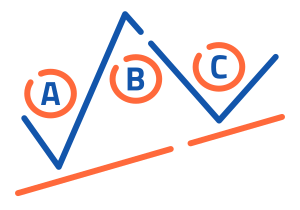 These two-legged pullbacks are commonly referred to as an ABC pullback. They consist of a counter-trend move (A), followed by a smaller with-trend move (B), and then a second counter-trend move (C). In the screenshot below you can see a succession of three ABC pullbacks, which correct the strong trend as it grinds higher.
In a bullish trend, for example, a bear trend bar can be regarded as the first leg of a pullback even if its low hasn’t managed to take out the previous bull trend bar’s low. If the next bar closes higher but its high remains below the bear trend bar’s high, this constitutes the second move of the ABC pattern. If the third bar is bearish and its low extends below the low of the preceding bullish bar, this marks the third leg, which is also the second leg down.
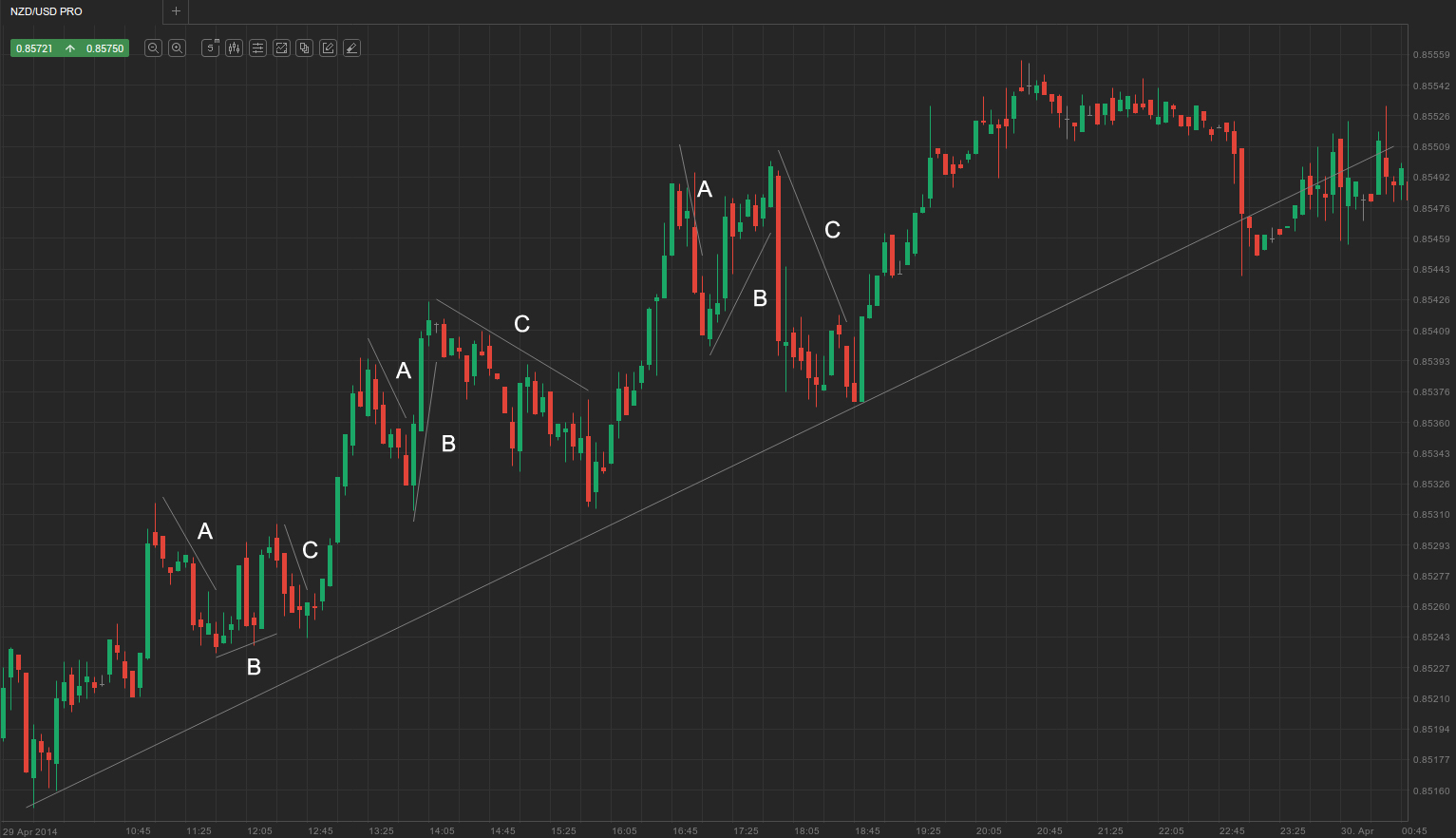
We’ve discussed in the article “What Defines a Strong Trend” that during strong trends, pullbacks are a must-enter point, because the market continues to grind higher as most reversal attempts fail. Entering on pullbacks allows you to capture additional profit, and the very fact that the pullback has ended is evidence that the trend will continue for some time.
Difficulties traders encounter
 However, we also know that pullbacks are not easy to enter for several reasons. First, many traders – especially during strong trends when pullbacks are shallow – wait for a pullback to extend deeper, and by the time they realise it won’t, it has already ended and with-trend movement has resumed.
Another difficulty traders encounter is distinguishing a pullback from a trend reversal. Pullbacks often occur after an accelerated move, which can resemble climactic exhaustion, so many market participants are reluctant to enter with-trend positions because they fear the market may reverse or move into a trading range – something typical of climaxes, especially after two, three or more climactic bars.
The key to profiting from such pullbacks is recognising when a trend is strong enough to overcome these counter-trend moves consistently. Counter-trend traders who were late to assess the trend’s strength become trapped as they bet on a reversal. At the same time, some with-trend traders who were stopped out because they thought the top had been reached will chase the market higher, adding to the buying pressure. This combination makes for a great with-trend entry at the bottom of the pullback, which very often lies near the moving average.
However, not every trend is that strong, and even strong trends come to an end eventually. Climaxes in weaker trends often lead to shifts in direction, and what first appears to be a pullback from a trend-channel-line overshoot will commonly turn into a reversal or a move into a trading range. In an uptrend, for example, the pullback from such a climax often penetrates the trend line, which is a signal to stop placing orders on the pullback from the old bullish trend and instead go short.