
 To be successful, Forex traders strive to forecast the future based on the information available in the present, but sometimes the market can be even more unpredictable than usual. Every day presents a new challenge for traders, and they must pay attention to a number of factors, including major economic events, central bank rumours and even global politics. All this can result in substantial fluctuations in currency prices and can often lead to the loss of a large portion of one’s balance.
Sooner or later, an investor will fail to recognise emerging trends and the market will start working against them. Losses are inevitable, and traders need to learn to accept them. They cannot control the market, but they can take full control of the situation by applying risk-management strategies. Cutting losses in time is extremely important, and Forex traders should know how to do it. The technique we discuss in this article is called a “stop-loss” or “stop-loss order”, and it is among the most hotly debated topics in Forex trading.
What Is a Stop Loss?
 Stop-losses are automatic trading orders that clients place with their Forex brokers to close a position once the asset reaches a particular price. They are available on virtually all trading platforms and are placed at the time of initiating a trade, after which they can be modified at any time. This may sound complicated to beginners, but it is actually one of the fundamental principles of risk management in Forex trading.
In fact, stop-loss orders are an essential part of every trading strategy, and once traders start using them they will know exactly how much they stand to lose on a given trade. These orders are designed to limit the trader’s loss on a position and are quite different from conventional market orders. When placing a market order, traders specify the volume they wish to trade at the current price; they do not specify duration or anything else. With a stop-loss order, however, they determine the point at which the position will be closed.
Let’s look at a simple example that illustrates how these stops work in a real trading environment. We buy one standard lot of the EUR/USD pair at a rate of $1.1500, expecting the price to rise so that, by the time we sell, we can make a profit. However, there is no guarantee that the value will move in the desired direction, which is why we place a stop-loss order. If we set our stop below the market price – at a level of $1.1475, for instance – we ensure that, even if the price falls, our losses are limited to 25 pips ($1.1500 – $1.1475).

- Trade Forex
- Trade Crypto
- Trade Stocks
- Regulation: NFA
- Leverage: Day Margin
- Min Deposit: $100
Importance of Stops in Forex Trading
 The example above shows that stop-loss orders can be very helpful in limiting losses. However, similar stops are often used by traders to secure a profit as well. Continuing with the example above, we have bought one lot of EUR/USD at a price of $1.1500 and, after a few hours, the rate has risen to $1.1600, following our original prediction. This means that the asset we now hold has appreciated, but our profits are not yet realised; this will happen only once we sell the lot at the higher price.
And this is where we can place a stop at $1.1560, which would protect more than half of our still unrealised profits. If the price starts to fall, we do not need to be in front of the computer to track it; the stop will trigger automatically at $1.1560, sending a market order and closing our position. In this way, we ensure a profit of 60 pips.
This type of stop order is called a “take-profit” order and is usually used in combination with the regular stop-loss. While stop-losses are set at a price worse than the opening price or the price of pending-order execution, take-profit orders are placed at a price that is better than the opening price or the price of pending-order execution.
It is important to determine appropriate price levels for the stop-loss and take-profit orders. Typically, novices are advised to set a take-profit at least as large as the stop distance so that the potential loss from the trade is never larger than the potential profit. In other words, they should aim for a healthy, long-term risk-to-reward ratio of at least 1:1. For better results, however, a ratio of 1:2 is recommended – in this case, a stop-loss 25 pips below the opening price and a take-profit 50 pips above it.
Such a strategy ensures that even if we lose more than half of our trades, we will still make a profit in the long run. Of course, it is also important to choose the stop-loss level correctly based on the size of our account, the price of the currency pair we are trading and its volatility. We explain these factors further below.
Types of Stop Loss Options
 There are two main types of stop-loss orders that can be used when initiating a trade, namely static stops and trailing stops. Of course, this depends on the software platform used, but most trading systems allow the placement of a static stop-loss, a take-profit order and a trailing stop.
Static Stops
 Static stops are the regular stops described above. Most novices start with static stops because they are simple to use and understand. When the price hits the stop-loss or take-profit threshold, the order to buy or sell is sent and the position is closed automatically. These orders are a great risk-management tool for beginners, especially if the stops are placed close to the opening price. In this way, traders may make smaller profits but they also keep risk to a minimum.
Static stops can also be based on various technical indicators available in the trader’s chosen platform. Usually, this includes the Simple Moving Average (SMA), which tracks the average closing price for a specific time period. Another popular indicator in Forex is the Moving Average Convergence/Divergence (MACD), which is used to indicate trends and measure their strength. Many traders also rely on Bollinger Bands or the Fibonacci retracement indicator to analyse the market, spot trends and place static stops accordingly.
Trailing Stops
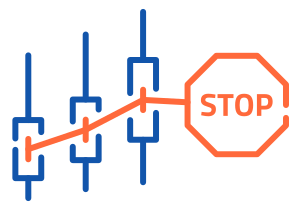 While static stops are very useful to novices who are trying different strategies and trading styles, more experienced traders usually opt for trailing stop-loss orders. These stops remain at the same level when the price moves against the trader, thereby limiting the potential losses of a bad trade. In this scenario they work exactly like static stops, but they behave quite differently if the price movement is favourable to the trader.
When the price shifts in the expected direction, the trailing stop-loss is activated and moves with the price; in other words, the stop trails the price action. Following the example above, suppose we open a long position on the EUR/USD currency pair at $1.1500 with a trailing stop-loss at $1.1475 and a take-profit level of $1.1550. This means we start our trade with a stop-loss 25 pips below the opening price, while the take-profit is 50 pips above that initial price.
After a while we check our position and notice that the price has risen to $1.1525. We also see that the two stops have moved in the same direction: the stop-loss is now at $1.1500 (the same as the opening price), while the take-profit is at $1.1575. Although both have moved up, they remain at the same distance from the price action – 25 and 50 pips respectively.
Stop Loss Methods and Strategies
 There are no set rules for how to place a stop-loss when trading Forex pairs. However, traders should follow a clear strategy or method when determining the correct levels for the stop-loss and the take-profit. Calculating the exact stop can be difficult for novices, as they must account for factors such as market volatility, the risk they are willing to take and much more. It is often wiser to select one method and stick to it if it proves effective.
Percentage Stop
 One of the fundamental ideas in Forex trading is to take risk into account whenever a trade is opened. A good rule of thumb is never to risk more than 1% or 2% of your account on a single trade. However, leverage directly affects pip value, and while risking 25 pips on a $100,000 position, as in the example used so far, may seem quite reasonable, it can lead to huge losses if excessive leverage is used. The leverage applied in Forex is an important factor because it increases both the potential profits and the risks of a trade.
For instance, let’s look at pip value for the US dollar so that we can better understand the EUR/USD pair: 100 pips equal $0.01 and 10,000 pips equal $1. Therefore, for a standard lot size of $100,000, the pip value is $10 ($100,000 × 0.0001). In our example we have opened the $100,000 trade using 1:100 leverage on a $1,000 account. To calculate the risk, we can use the following formula:
Stop Loss x Leverage / 100% = Risk
If we set the stop-loss at 25 pips, we have 25 × 100 / 100% or 2,500 / 100, which is a 25% risk. In other words, with this stop we risk 25% of our account, or $250. An even easier way to calculate it is to multiply the pip value ($10) by the number of pips in our stop-loss (25), giving the same result of $250. To achieve a lower level of risk, we need to use much lower leverage. Let’s see how the risk decreases if we trade with only 1:5 leverage – 25 × 5 / 100 = 125 / 100, which is a 1.25% risk.
Volatility Stop
 Another method for determining the stop-loss is to base it on price volatility, i.e. on how much the price tends to move over a given time. Day traders, for example, would look at daily averages to calculate the best stop-loss levels for them. This can be done by using one or more technical indicators that track volatility.
The idea is to understand the usual fluctuations in price each day or during busy trading hours. Of course, traders can use this technique in conjunction with other methods.
Chart Stop
 A more complex strategy for setting the stop-loss is to base the decision on what the charts show. Once again, traders must understand trends and be able to analyse the market using the data available on charts. Depending on the software platform they use, they may have access to different charts with more detailed data and a wider range of built-in indicators and tools.
Time Stop
 There is one more way to calculate the proper level of the stop-loss in an open position, and that is by using the predetermined time of the trade. When we initiate a trade, we may not specify a duration, but we usually know how long we want the position to remain open – during the market’s active hours (the Forex market is open 24 hours a day from Monday to Friday), within a limited trading session, and so on.
For instance, if we trade the EUR/USD currency pair we should avoid keeping the position open for too long because the pair is quite active, and we should be more conservative with the stop-loss level if we intend to keep our position open for an extended period. Minor pairs such as EUR/CHF, however, are not associated with such dramatic movements, so we should adjust our stop accordingly. Note that such positions keep equity locked and tie up margin that could be used for other, potentially more lucrative trades.