
TRIX indicator
This lesson will cover the following
- Definition
- Calculation
- Interpretation
Developed by Jack Hutson, TRIX (or triple exponential moving average) is a momentum indicator, very similar to the MACD, designed to filter out price movements that are insignificant to the broader trend. It essentially displays the rate of change of a triple exponentially smoothed moving average, from which it derives its smoothness and filtering characteristics. The trader selects a particular lookback period to create the moving average, and the oscillator then filters out cycles that are shorter than that period.
TRIX has two main advantages over other trend-following indicators. The first is that it is superior at filtering market noise, and the second is that it tends to act as a leading indicator, rather than a lagging one, because it measures the difference between each bar’s smoothed price.
Due to the similarities between the signals generated by TRIX and MACD, it is traded in largely the same manner. In fact, the main difference between the two is that TRIX is much smoother. We will discuss trading TRIX once we have explained the calculation and plotting method.
Calculation and plotting
 The TRIX indicator is the 1-period percentage rate of change of a triple smoothed exponential moving average. A triple-smoothed EMA is essentially an EMA of an EMA of an EMA. Say we choose an 18-period lookback span. The calculations will be as follows:
TRIX = 1-period percentage change of the triple-smoothed EMA
Single-smoothed EMA = 18-period EMA calculated from the closing prices
Double-smoothed EMA = 18-period EMA of the single-smoothed EMA
Triple-smoothed EMA = 18-period EMA of the double-smoothed EMA
Thus, TRIX will be positive while the triple-smoothed EMA is moving higher, and will take a negative value as soon as the triple-smoothed EMA turns lower. However, the triple smoothing ensures that the number of reversals is minimised.
The TRIX indicator can be used both as a momentum indicator and as an oscillator. When used as a momentum gauge, positive values indicate that momentum is increasing, while negative readings imply a decline.
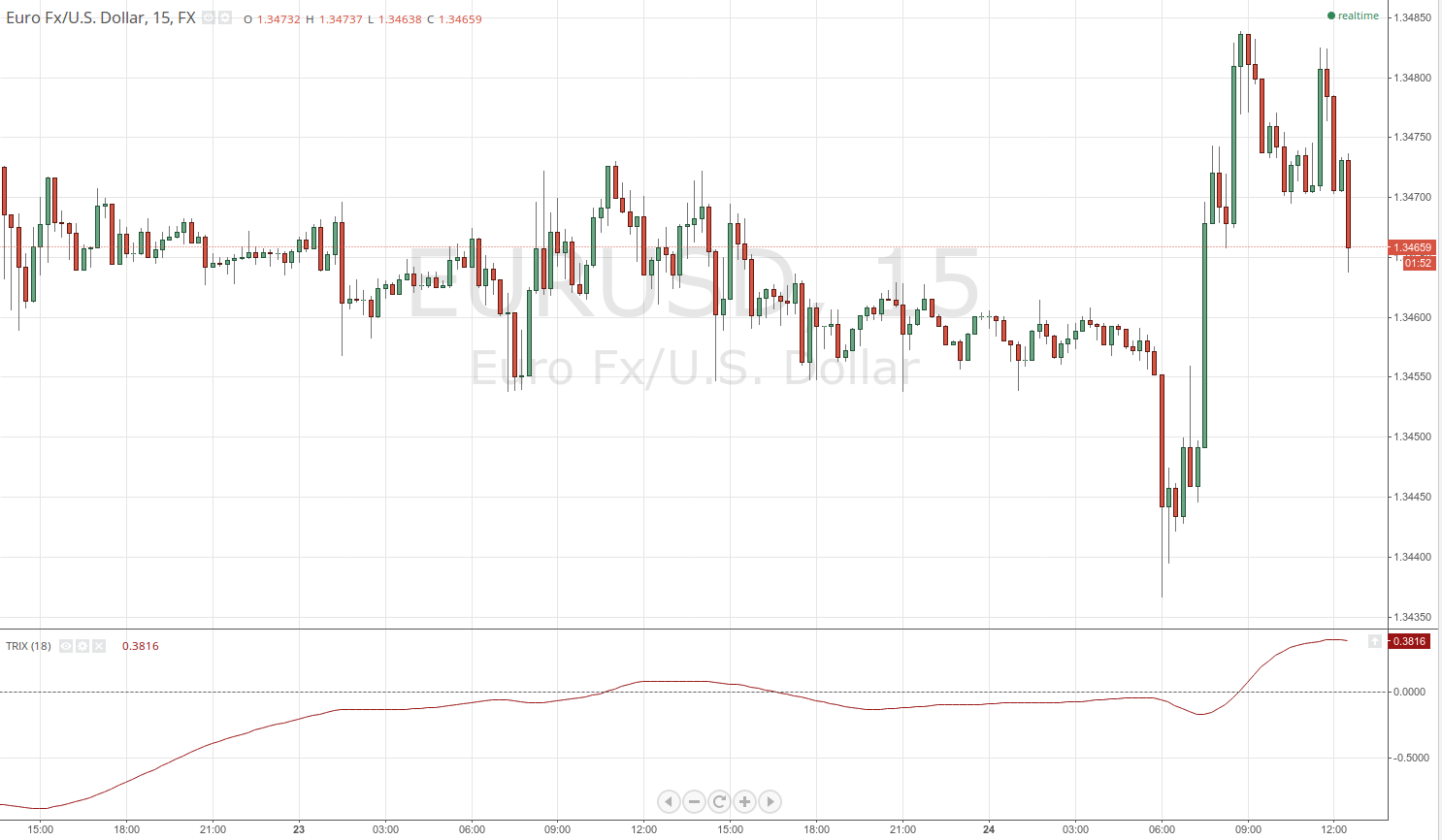
When used as an oscillator, fluctuations in its values determine whether the market is overbought or oversold, pinpointing possible reversal or at least retracement levels. Below, you can see the indicator visualised on a trading platform.
Trading TRIX
 As we said, TRIX and MACD are very similar momentum oscillators and, logically, are traded in an analogous manner. You can trade crossovers of the zero-level threshold, and you can also trade divergences between the price and the indicator.
Alternatively, and quite often, an additional signal line can be added to the indicator’s scale to produce crossovers that follow the same logic as MACD. The signal line is a moving average of the TRIX indicator. Thus, when the TRIX line crosses the signal line from below and continues higher, the crossover produces a bullish entry signal, and vice versa.
As for the zero-crossover level, the logic is simple and mirrors MACD. When TRIX turns positive, i.e. crosses the zero line from below, it implies that a bullish trend is beginning and triggers a long entry signal. Conversely, when it drops below the threshold, it generates a short signal.
Another possible way to trade this indicator is to use a combination of two moving averages with different lengths – for example, an 18-period TRIX and a 30-period TRIX. This works in a similar way to the signal line crossover – when the faster TRIX reverses and moves beyond the slower TRIX, it indicates a shift in price action momentum.