
Trend Trigger Factor
This lesson will cover the following
- Definition
- Calculation
- Interpretation
Designed by M.H. Pee, the Trend Trigger Factor’s role is to help traders detect uptrends and downtrends, enabling them to position themselves in line with the prevailing trend. Its creator argues that markets are mostly random but contain a small trend component, which is crucial for trading success. Being able to determine whether the market is in a bull or bear trend, and how strong that trend is, allows you to remain on the right side of the market for longer, capitalising as much as possible on its trending behaviour.
In his article, M.H. Pee used a 15-period look-back span to explain the calculations. The TTF formula is based on the so-called Buy Power and Sell Power. In his example, Pee labelled today as day 1, yesterday as day 2, the preceding day as day 3, and so on. Thus, the formulae are as follows:
– 15-day Buy Power = (Highest high of day 1 through day 15) – (Lowest low of day 16 through day 30)
– 15-day Sell Power = (Highest high of day 16 through day 30) – (Lowest low of day 1 through day 15)
Having estimated the two variables, we then move on to the TTF calculation itself:
– 15-day Trend Trigger Factor = [(Buy Power – Sell Power) / (0.5 × (Buy Power + Sell Power))] × 100
Thus, the denominator of the TTF is actually the average range of the two 15-day periods (day 1 through day 15 and day 16 through day 30).
The Trend Trigger Factor is similar in interpretation to the Relative Strength Index. It is plotted on a scale with the most prominent levels at +100 and -100; crosses of these levels logically signal possible trade entries. The indicator allows the trader to remain in the market most of the time. The following screenshot shows how the TTF is visualised in trading software.
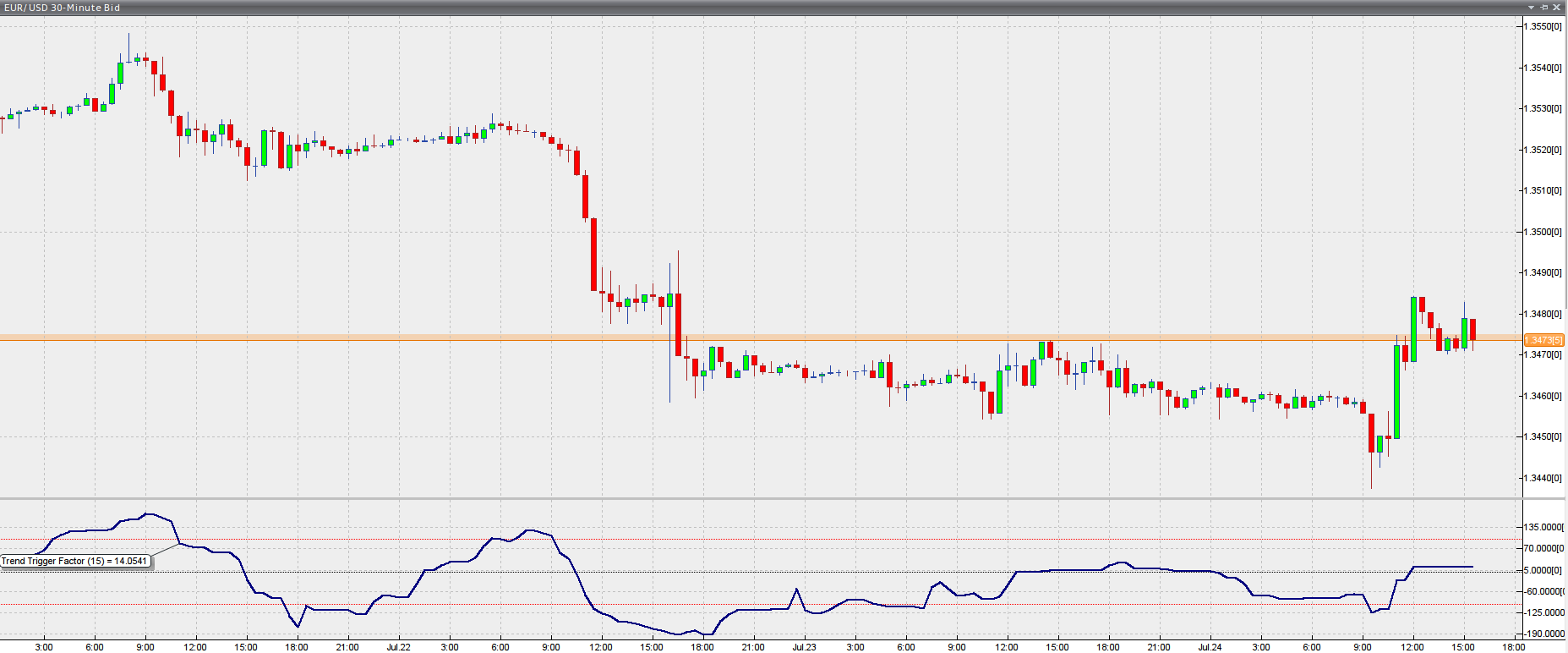
Chart source: VT Trader
A conventional trading strategy, suggested by the TTF’s creator himself, is to always stay on the long side when the indicator is above +100, which indicates that a bull trend is in motion. If you are short and the TTF jumps above +100, you should reverse your position. If the indicator’s value is below -100, reflecting a bear trend, you should focus on taking only short positions. If you already hold a position and the TTF remains between +100 and -100, you should maintain your current position.
Additionally, when the TTF reverses, you should again adjust your position. Thus, this addition to the strategy makes it an always-in-the-market system.
For example, imagine you are long but the indicator then falls below -100; this implies you should reverse to a short position. As soon as the TTF moves back above that level, you should go long. Conversely, a short entry signal will be produced when the indicator is above +100 but reverses below that level.