
 | Updated:
 Why You Might Not Be Achieving the Trading Results You’d Like
New traders enter the financial markets with high hopes and expectations. They learn to read a price quote, how to place an entry order, and begin to study some of the major trends in the market.
This new trader doesn’t feel confident that they know what they are doing. Now, with the benefit of hindsight, they watch that same trend develop in the direction they expected. ‘Next time, I’ll enter the trade and figure out where to exit later,’ they say to themselves. This new trader now believes they have what it takes to succeed.
The First Few Trades
After jumping into a handful of trades, our new trader is underwater and currently showing a loss. What happened?
Our new trader is now confused … the trends no longer make sense.
Our new trader is angry … ‘If that broker hadn’t run my stop-loss, I would be profitable,’ they think to themselves.
The answer to their confusion and anger is not always simple. The simplest answer I can share is to take a look at a three-legged stool. Let me tell you a quick story about this stool (it’ll take five minutes).
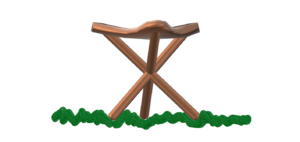
This three-legged stool pictured above summarises many truths about trading the markets.
Let me ask you … let’s say one of the legs of the stool broke. It needs to be fixed, so you run out to your garage in search of a replacement leg. There in the corner, you find a replacement piece of wood and attach it to the stool in place of the broken leg.
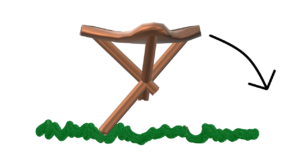 Oh no! The replacement leg of the stool is too long compared with the other two legs.
What happens to that stool when you sit on it?
You’ll topple over, as the stool cannot stay upright when one leg is too long and the other two are the same length. The stool falls over and you go with it.
Okay, so you go back to your garage, take out a saw and cut down the replacement leg.
Ah, there we go. We return to the stool and attach the new leg, which is now shorter.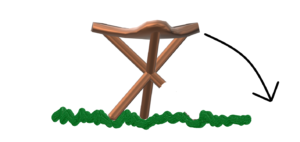
Oh no! The replacement leg of the stool is now too short compared with the other two legs!
What happens to that stool when you sit on it?
You will topple over, as the stool cannot stay upright when two legs are similar in length and one is too short. The stool falls over and you go with it.
Trading Lessons a 3-Legged Stool Teaches
There are many lessons to be learned from this three-legged stool.
First, each leg represents an aspect of trading. Here are the three legs of the trading stool.
- Entry
- Exit
- Trade Size
Too often, traders are hyper-focused on one leg – the entry. Traders keep seeking out signals.
Who has the best signals?
Whose signals can win 80% of the time?
You see, by spending all their time on signals, their entry leg of the stool becomes too large, and they experience severe losses because there is no exit plan. The stool falls over.
An Exit Plan
Other traders not only consider the entry, but also stick to an exit plan for the trade. At one price they’ll exit at a loss; at another, they will close the position for a profit.
In this scenario, the entry and exit legs are the same length, but the trade-size leg of the stool is too short. Guess what? They might experience large gains, but one big loss will wipe them out. The stool eventually falls over.
Okay, by now you may be thinking, ‘I get it! I’ll be conservative with my trade size, I’ll stick to my entry and exit signals, and then I’ll be profitable.’
I wish it were that easy.
Matching Market Conditions to Your Strategy
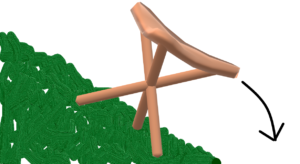 What if you placed that stool on the side of a steep hill and then sat on it? You would fall over. That stool was not made for hills; it was made for flat ground.
Similarly, we have to keep the ‘terrain’ of the markets in mind.
Sometimes markets are flat.
Sometimes markets trend upward or downward (like the side of a hill).
The strategy we use must vary with market conditions. We cannot use the same strategy all the time and expect consistent results.
We need to learn how to read the market’s mood. In essence, we must find the right terrain for our strategy, and then apply that strategy to that market.
Conclusion
Use the three-legged stool as a visual reminder to guide your trading. Then, when you dig into the price charts to learn how to read price action and make forecasts, your analysis will be grounded in the market’s terrain.
First, assess the mood of the market. Is the market trading sideways? Is the market in a trend? There are a couple of tools we will look at that can help us determine whether the market is sideways (range-bound) or in a trend. We will look at tools like the Average Directional Index (ADX), Average True Range (ATR) and Bollinger Band Width (BBW).
Second, if the market is range-bound, then buy low and sell high. If the market is trending, then trade ONLY in the direction of the trend using breakouts, throwbacks and pullbacks. For example, if the market is trending higher, then buy breakouts and buy dips. If the market is trending lower, then sell breakdowns and sell rallies.
Thirdly, manage an exit plan such that you risk less than your potential reward. We will dive deeper into this in a mini-course. Too often I have seen traders risk a lot to make a little. That type of strategy might offer short-term rewards, but it is a recipe for failure in the long run.
Lastly, make sure your trade size is appropriate for your account size. Leverage acts like a double-edged sword: you can lose as quickly as you can gain. Therefore, if you decide to use leverage for margin trading, use VERY conservative amounts.