
 | Updated:
 Breakouts
This lesson will cover the following
- What is a breakout?
- What does a trader need in order to confirm a breakout?
- Can a breakout be expected?
As we have already discussed, in order to maximise profit, a trader should join a trend as early as possible, when it is safe, and follow it until it signals a change in direction. A trend often begins with the breakout of support or resistance levels, and sometimes of a trend line.
What is a breakout?
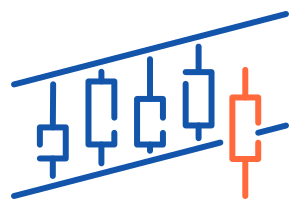 In trading, a breakout most often occurs when the price breaks above a previous level or zone of resistance and moves higher, or below a previous level or zone of support and moves lower. A breakout usually indicates a considerable change in supply and demand for a tradable instrument and also suggests that a new trend is probably beginning. This is exactly what makes breakouts extremely important signals for traders.
A breakout in the direction of the prior trend serves as confirmation that the trend is still valid, while a breakout in the opposite direction implies that the trend is probably reversing and that the trader should close their position (and possibly reverse it).
There is usually a trade-off between speed of action and conviction. Speed of action is important as the market price breaks a specific level (support or resistance), while conviction is needed to make sure the breakout is genuine, because false breakouts are commonly observed.

- Trade Forex
- Trade Crypto
- Trade Stocks
- Regulation: NFA
- Leverage: Day Margin
- Min Deposit: $100
What does a trader need in order to confirm a breakout?
 The first prerequisite for a breakout is the penetration of a prior trend line or support (resistance) zone, while the second is confirmation that this penetration represents a genuine breakout and not a so-called fakeout.
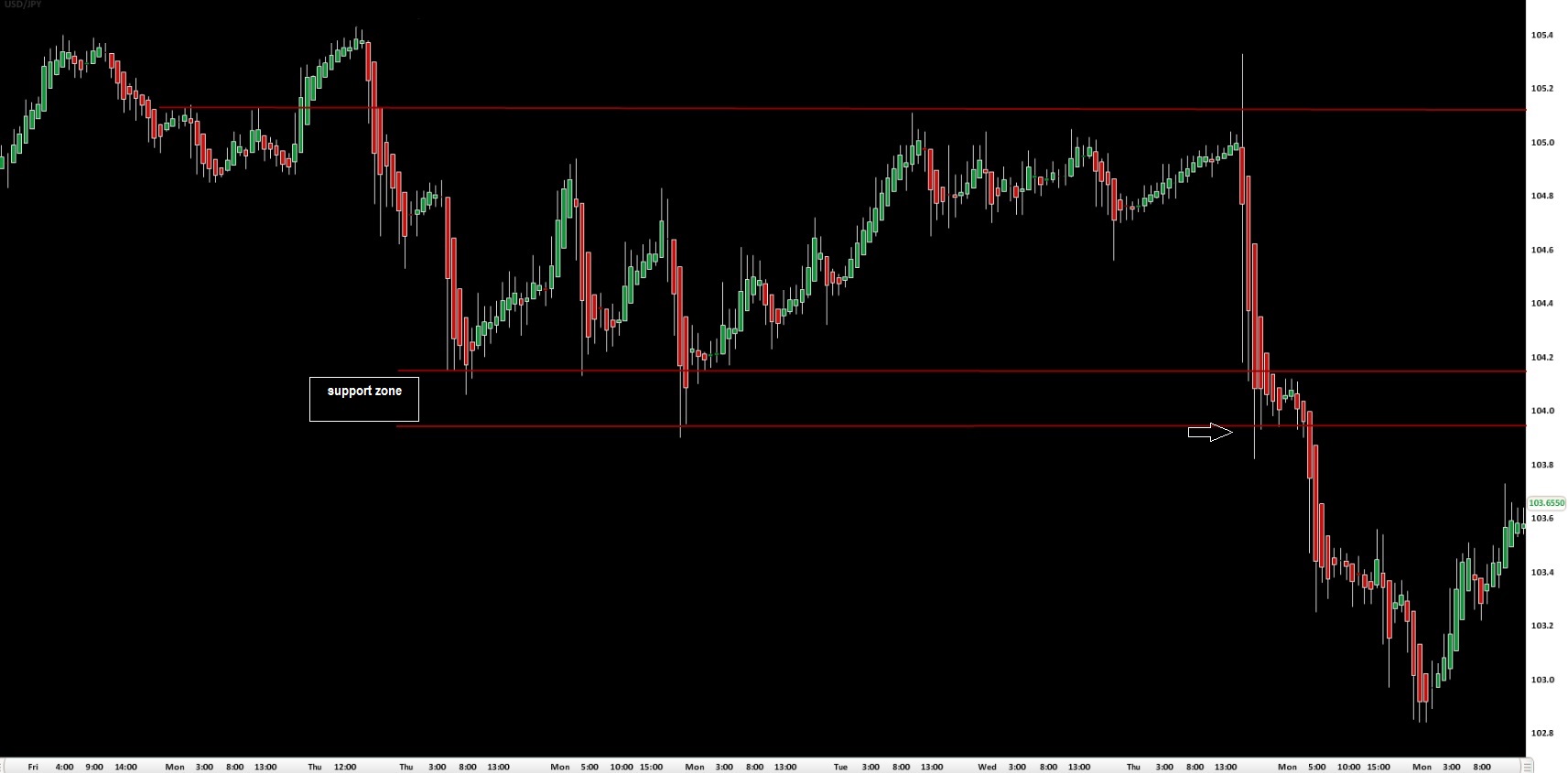
When we have a support or resistance zone, the exact breakout level remains unclear. In this case, the extreme level of the zone is usually regarded as the breakout level. This is often observed when prices trade within a range (a sideways trend) in which the support zone – a series of horizontal lines showing previous support levels – is wide. In a trading range, the lowest support line is usually considered the breakout level. Prices usually lose momentum when entering the support zone and do not break through it completely. However, a break of the lowest support level means that the entire support zone has been breached. This can be seen on the following chart.
A trend line offers a more precise breakout level, as it is simply a line. However, a penetration of the breakout level or trend line still needs to be confirmed.
Some traders wait for the close of the candle in which the breakout occurs, while others wait for more than one candle to close above resistance or below support.
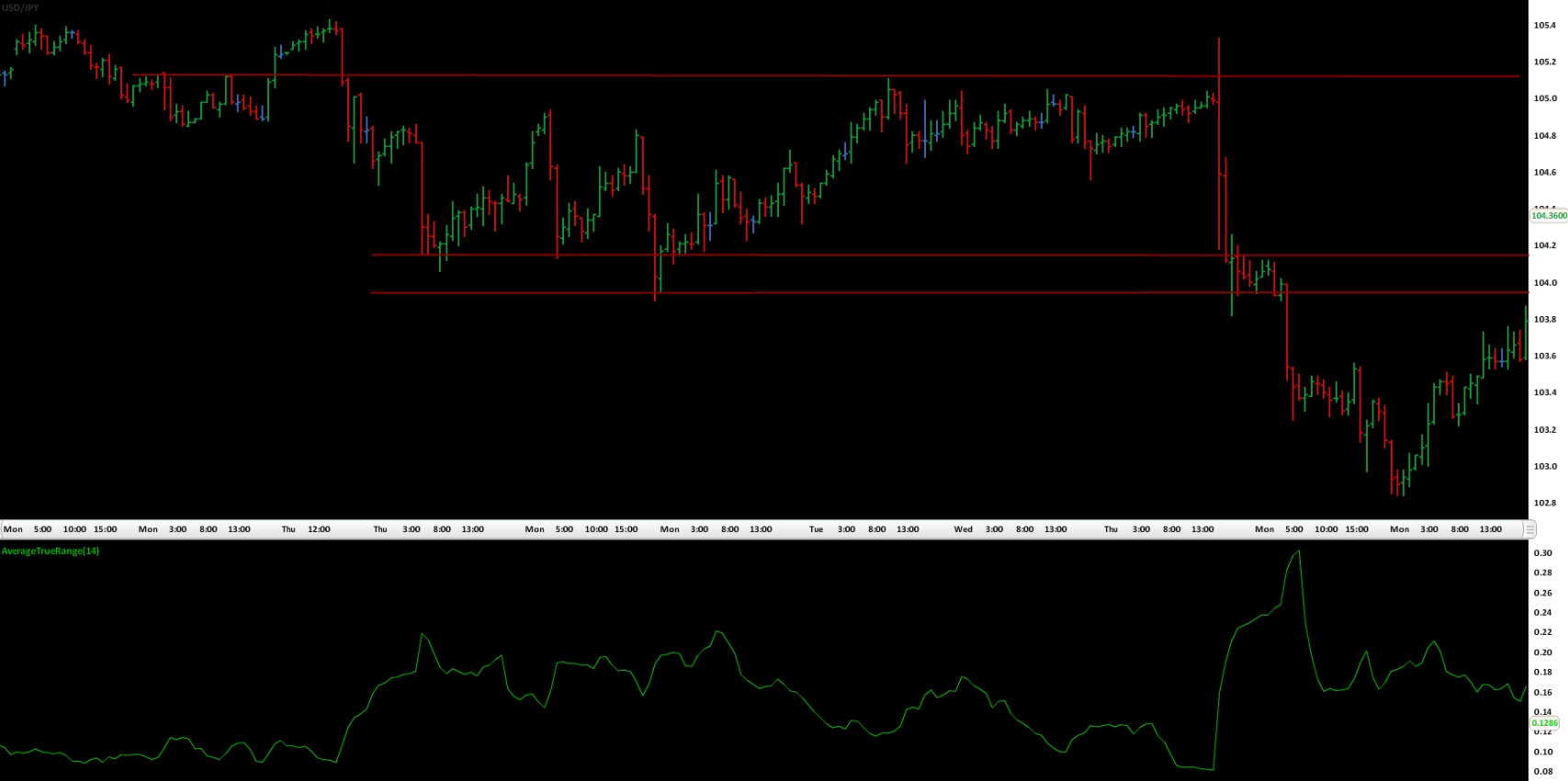
A third group waits for the price to move a certain number of pips beyond the breakout, using the Average True Range (ATR) – an indicator we shall discuss later.
Another confirmation method is to establish a breakout zone at a certain percentage beyond the breakout level. If the price penetrates both the breakout level and the zone beyond it, the penetration is regarded as genuine. Any percentage can be used, but the most common is the so-called 3% rule – a level situated 3% from the breakout point (a practice derived from the stock market).
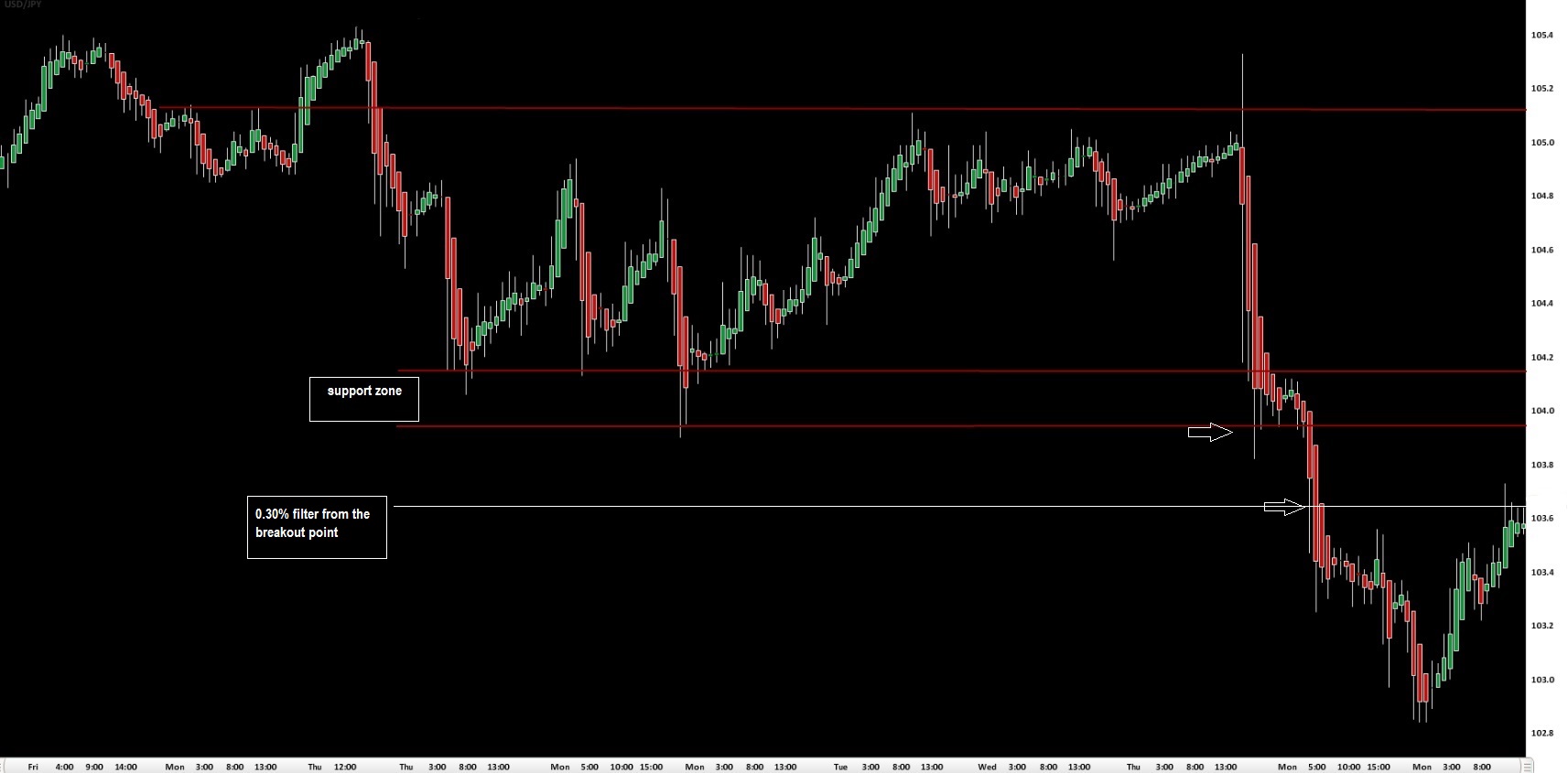
Here we experiment with a 0.30% filter from the breakout point on a 1-hour chart of USD/JPY to confirm that the breakout is genuine.
Volume as confirmation
 Volume can also be used to confirm whether a breakout is genuine. Breakouts are often accompanied by increased trading volume. Heavy volume indicates that traders are acting in the direction of the new trend and that there is strength behind the penetration. This is because rising prices coupled with rising volume are strong signs of a healthy uptrend, while falling prices accompanied by rising volume strongly suggest a healthy downtrend.
Volatility as confirmation
 All the methods mentioned above have a significant drawback – they do not account for price volatility. The three most commonly used measures of volatility are beta, the standard deviation of price, and Average True Range.
Beta is the calculation of the standard deviation of a price relative to a market benchmark, usually the S&P 500 index. Beta’s use has decreased over the years because the assumption that it is a valid measure of risk has been questioned. However, it does have an advantage: it eliminates the market trend from the volatility calculation.
The standard deviation of price encompasses a series of prices over a period in the past. Over time it has also become less useful as a breakout filter because it includes the market trend in its evaluation.
 Average True Range (ATR) is related to the Average Range, which represents the average difference between each bar’s high and low during a given period in the past. The ATR is the average of the True Range. The True Range is the greatest of :
1) the difference between the current bar’s high and low
2) the absolute value of the difference between the previous bar’s close and the current bar’s high
3) the absolute value of the difference between the previous bar’s close and the current bar’s low
The ATR is the average of the True Range over some period of time. When a multiple of the ATR is used as a price filter to confirm a breakout, the breakout level is adjusted in accordance with volatility. The ATR filter can expand and contract over time, following changes in price volatility. If price volatility rises, daily True Ranges will expand and the ATR will increase. This means there is less chance of a fakeout occurring because of the increased price volatility.
Can a breakout be expected?
 Very often a trader can use volume as a clue that a breakout is about to occur, because volume is closely related to the trend itself. If trading volume rises with the trend, this supports the trend. When prices are fluctuating beneath a zone of resistance, for example, and trading volume rises on every small upward move and declines on every minor pullback, there is a chance that the price may break through the resistance zone.
Prices may also indicate their next directional move. In a trading range, if prices begin to reverse upward slightly above the lower boundary of the range and then reverse downward at the zone of resistance, this may signal that long-position holders are becoming a little more aggressive with every minor correction. If this pattern of slightly higher lows is accompanied by rising volume on each rally, the likelihood of a breakout through the resistance zone increases.