
 | Updated:
 Simple Moving Average
This lesson will cover the following
- What is a simple moving average?
- How to estimate the value of a simple moving average?
- What do we mean when saying that the SMA is moving across price action?
- Simple moving averages may be of different lengths
- Simple moving averages and the trend
In technical analysis the most commonly used type of moving average is the simple moving average (SMA), which is sometimes called an arithmetic moving average. It is referred to as ‘simple’ because it uses a straightforward method of averaging. An SMA is usually constructed by adding a set of data and then dividing it by the number of observations during the period under examination.
How to estimate the value of a simple moving average?
 In order to estimate the value of a simple moving average, we need the following:
First, we need to define the number of trading sessions (periods) to be used in the calculation. Let us use the 10 most recent trading days (sessions).
Secondly, we must decide which type of prices we shall use. Most moving averages are based on closing prices, but they can also be calculated using highs, lows, daily means, etc. In our case we shall use the closing prices.
Thirdly, we calculate the simple average of these prices.
Let us look at the following graph (graph 1).
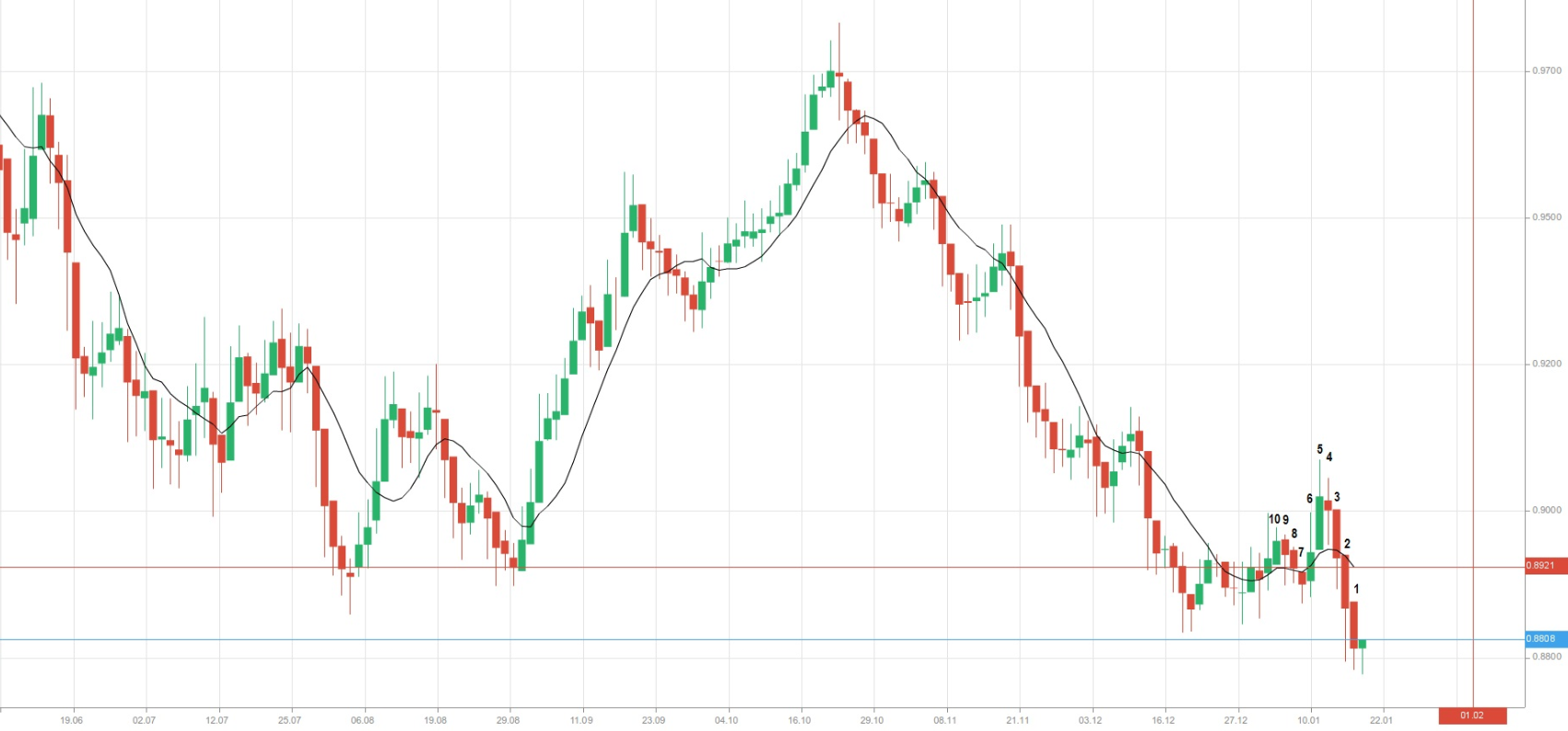
On the chart above we can see a 10-day simple moving average (the black line), with its value shown in the red rectangle (0.8921). The marked candles represent the periods (10 days, because we use a daily chart) whose closing prices are used in the calculation of the SMA. We count the candles backwards because moving averages take into account the most recent periods. The most recent green candle has no SMA value because the trading day is not yet over and, consequently, there is no closing price. Therefore, it cannot be used in our calculation. Tomorrow, in order to estimate the SMA value, candle 10 will be replaced by the current-day candle, which by then will already be closed. This is how the moving-average indicator moves across the chart.
Now, let us list the closing prices of the 10 marked candles. We have to add all the closing prices and divide the total by the number of periods (days).
| Trading Day | Close Price |
| 1 | 0.87777 |
| 2 | 0.88196 |
| 3 | 0.89143 |
| 4 | 0.89649 |
| 5 | 0.90522 |
| 6 | 0.89942 |
| 7 | 0.88975 |
| 8 | 0.88993 |
| 9 | 0.89257 |
| 10 | 0.89665 |
| 10-day SMA | 0.89212 |
Thus, the 10-day SMA has a value of 0.8921, exactly the same as that shown in the rectangle above.

- Trade Forex
- Trade Crypto
- Trade Stocks
- Regulation: NFA
- Leverage: Day Margin
- Min Deposit: $100
What do we mean when saying that the SMA is moving across price action?
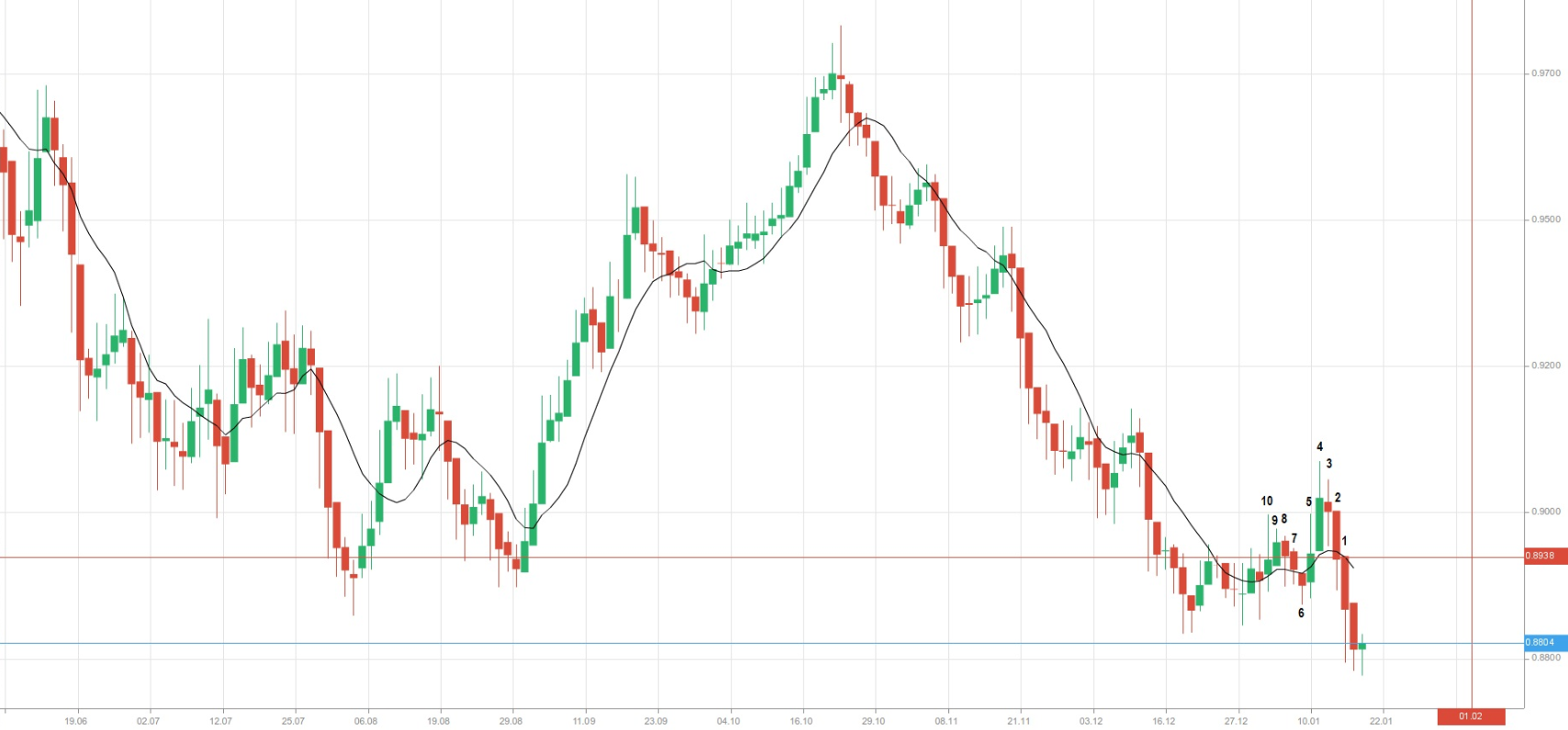
 Let us move one day back and imagine the same situation as above. Now, candle number 1 on graph 1 will not be taken into consideration when calculating the new SMA, as it has not yet closed. At the same time, we should include the candle that stands before candle number 10 on graph 1.
| Trading Day | Close Price |
| 1 | 0.88196 |
| 2 | 0.89143 |
| 3 | 0.89649 |
| 4 | 0.90522 |
| 5 | 0.89942 |
| 6 | 0.88975 |
| 7 | 0.88993 |
| 8 | 0.89257 |
| 9 | 0.89665 |
| 10 | 0.89450 |
| 10-day SMA | 0.89379 |
So, the new 10-day SMA has a value of 0.8938. What can we observe in the table above? It seems that all the closing prices remain the same with the exception of just one – that of the tenth day. Tomorrow, when calculating the SMA, the trading platform will replace candle number 10 on graph 1 with the most recent candle, or the candle for the current day.
Beginner traders should note that simple moving averages can be calculated for different time frames. If we use a 15-minute chart, where each candle represents a 15-minute period, the SMA will show the average closing price for the past 10 periods, or 150 minutes. If we apply the SMA to a one-hour chart, it will show the average closing price for the past 10 hours. This, of course, applies only if we keep the period number unchanged.
Simple moving averages may differ in length
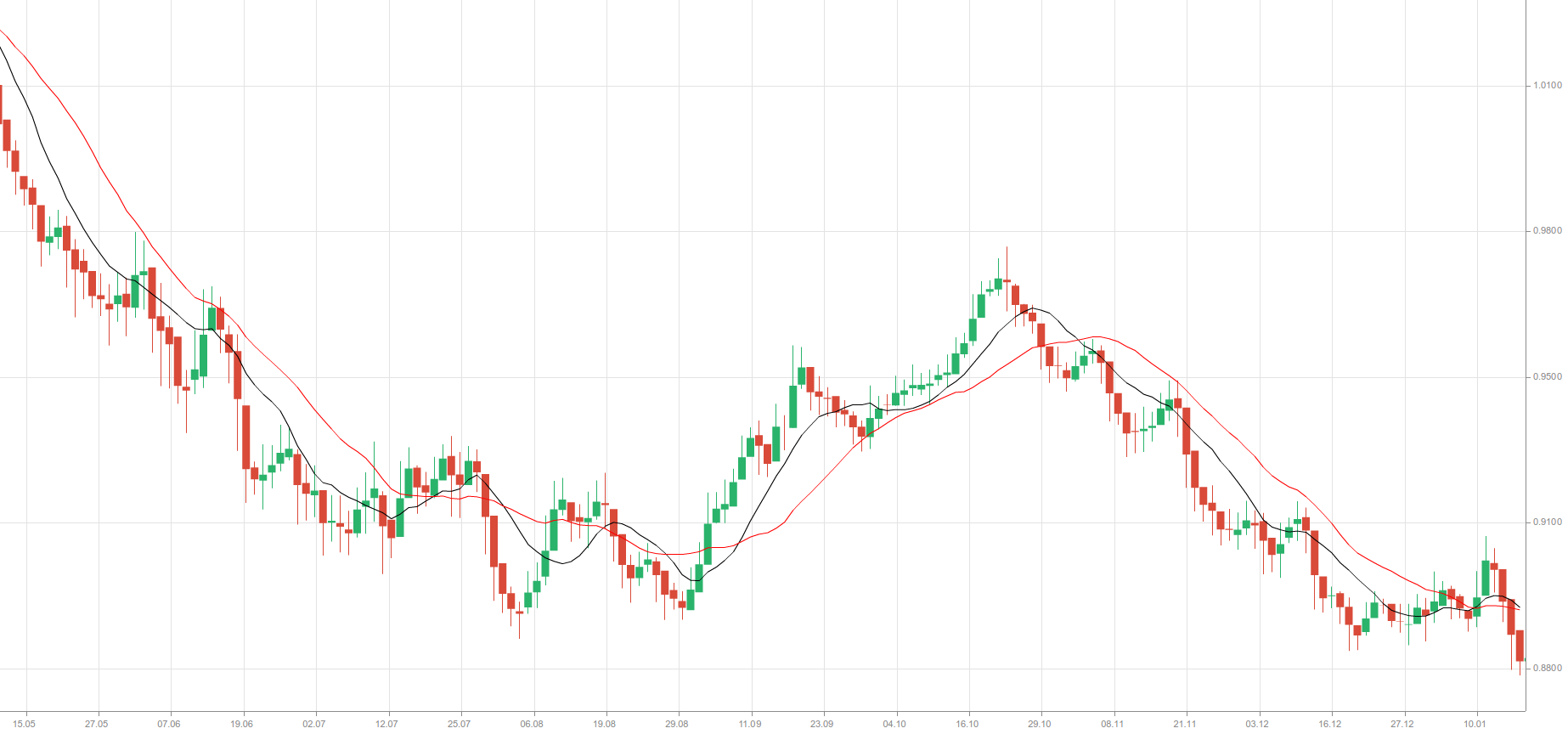
 We can construct moving averages of different lengths. On the next graph we can see another moving average, a 20-day SMA (the red line). It is calculated by adding the 20 most recent closing prices and dividing the sum by 20.
Some of the most popular daily moving averages cover periods of 200, 80, 50, 30, 20 and 10 days. These periods are considered arbitrary and were chosen in the days before the invention of computers, when calculations had to be done by hand.
The 10-day, 20-day and 80-day moving averages represent approximately two weeks, one month and four months of trading data respectively.
Longer moving averages usually pick up changes in a trend more slowly; however, they are less likely to give a false signal of a trend change because they represent a greater number of observations. The more data we include in the calculation of the SMA, the less important each day’s data becomes. A large change in value on one day would therefore not have a major impact on the longer-term moving average.
If we look again at the graph above, we can see that the 10-day SMA demonstrates more variability than the longer 20-day SMA. The latter is said to be the slower, lazier moving average. It provides greater smoothing, but it is also slower at indicating trend reversals.
SMA and the trend
 Moving averages are valuable because they smooth daily fluctuations, allowing the technical analyst to see the underlying trend without being distracted by small daily movements. A rising moving average usually signals an uptrend, while a falling moving average indicates a downtrend. Some analysts have adopted the following approach when relating the SMA to a particular trend: if the closing price of a tradable instrument is above a simple moving average, the trend is considered bullish; if the closing price is below a simple moving average, the trend is considered bearish. However, choosing a period for trend estimation is a matter of personal preference. The period of the SMA will depend on one’s trading style and chosen time frame. Selecting the appropriate period therefore comes with experimentation and, of course, experience.
Although simple moving averages help when identifying a trend, they do so only after the trend has begun. Therefore, moving averages are lagging indicators, as they are based on past prices.