| Updated:
 Open Market Operations
You will learn about the following concepts
- What do these operations affect?
- Federal Open Market Committee’s practice
- Assumptions
- and more…
Open market operations are actions – sales or purchases of government debt instruments such as Treasury bonds, Treasury bills and Treasury notes – undertaken by central banks to control or otherwise influence aspects of the economy. Open market operations generally refer to actions by the central bank intended to either increase or decrease the money supply. Other targets, such as exchange rates and interest rates, are also used to guide open market operations. Central banks use open market operations to influence macroeconomic trends, such as inflation, while a currency board may employ them to maintain a fixed exchange rate between two currencies. Open market operations can be divided into two types: permanent and temporary. Permanent OMOs are generally used to accommodate longer-term factors, whereas temporary OMOs are typically employed to address reserve needs that are considered transitory in nature.
What do these operations affect?
 Open market operations affect currency-trading prices, employment and other fundamental indicators. By using them, central banks influence the liquidity of the foreign-exchange market, which is why traders should keep abreast of such actions. These operations help stabilise the currency market, making FX trading an attractive investment arena. They occur when banks conduct sizeable currency transactions, causing the currency’s value to rise or fall accordingly.

- Trade Forex
- Trade Crypto
- Trade Stocks
- Regulation: NFA
- Leverage: Day Margin
- Min Deposit: $100
FOMC
 In the United States, a committee within the Federal Reserve, the Federal Open Market Committee (FOMC), is responsible for implementing monetary policy. It comprises the Board of Governors and five reserve-bank presidents and meets eight times per year to assess current economic conditions and decide whether to increase or decrease the money supply using the central bank’s available tools.
The Federal Open Market Committee buys and sells government securities – known as open market operations – to alter the money supply. The securities employed for this purpose are Treasury bills, bonds and notes. If the FOMC wishes to increase the money supply, it purchases securities; if it wishes to reduce it, it sells them.
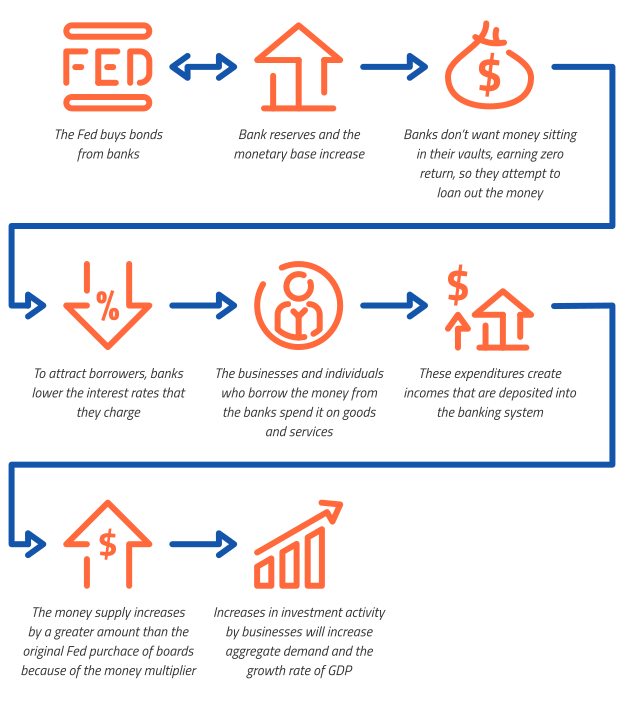
To raise the money supply, the FOMC buys securities from banks. The banks can then lend the newly acquired funds to individuals and businesses. As the amount of money available for lending increases, interest rates on these loans tend to fall, enabling more borrowers to obtain cheaper capital. This enhanced access to finance boosts investment, thereby stimulating the wider economy.
That is precisely what the Fed did after the 2008 financial crisis, injecting the economy with bond purchases worth $85 billion per month in an effort to revive growth.
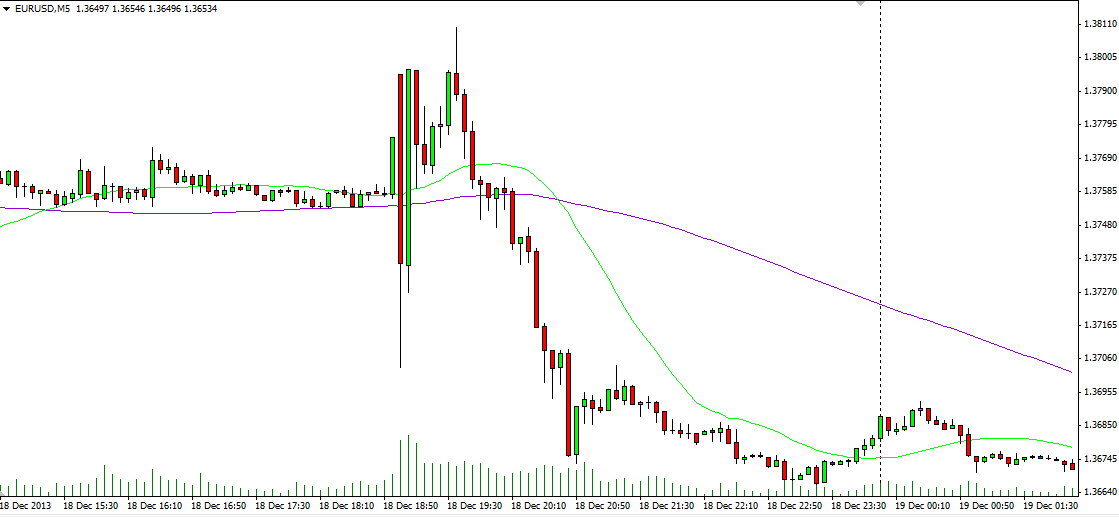
The graph below illustrates the effect that the FOMC’s decision to cut its quantitative-easing programme to $75 billion had on the EUR/USD pair. At 19:00 GMT, the dollar gained ground against the euro after the decision to restrict the money supply.
 Source: MetaTrader 4 by MetaQuotes
If the Federal Open Market Committee decides to reduce the money supply, it sells securities to banks, thereby removing funds from the banking system. The reduction in available money slows investment and spending as capital becomes more expensive to obtain (less money is available for lending). This limited access to capital can ultimately cause an economic slowdown as investment wanes.
Example
 Let us assume the Federal Reserve wants to increase bank reserves through open market operations. Banks use a portion of their customers’ deposits, which are liabilities for the bank, to purchase federally issued debt. To inject cash into bank reserves, the central bank buys some of these government bonds from them. If the Federal Reserve buys $30 million in bonds from a bank, that bank’s reserves will rise by the same $30 million. This additional money can now be lent out. The $30 million increase in bank reserves leads to an equivalent rise in the monetary base. Banks tend to lower their interest rates when they find themselves with excess funds so they can attract clients to whom they can lend.
Having received the extra $30 million in reserves, the bank will wish to lend the funds quickly to earn interest, setting the money-multiplier process in motion. As commercial banks create an additional $30 million in loans, the loan recipients spend the money on goods and services. This spending generates additional income for businesses, their employees and others. In time, most of this income finds its way back into the banking system as deposits. Consequently, through the multiplier process, the money supply increases by the change in the monetary base ($30 million in our case) multiplied by the money multiplier.