
Moving average crossover
This lesson will cover the following
- What is a moving average crossover?
- What are the Golden Cross and the Death Cross?
- What is a moving average envelope?
Different investors use moving averages for different reasons. Some apply them as their primary analytical tool, while others use them simply as a confidence booster to back up their investment decisions.
No matter how useful moving averages can be, thanks to the vital data they provide, they all suffer from one common limitation – they are lagging indicators. By the time an 89-day MA curves upwards or downwards to confirm a trend, the market has already exhausted part of that move and may even be nearing its end. Sure, a 20-day moving average will reflect price movement more swiftly, but it will still lag behind. And although exponential averages speed up signals, all MAs still join the trading party too late. This is why traders do not base their trading decisions solely on moving averages and generally wait for the strongest possible signals they generate – crossovers.
Crossovers
A moving average crossover occurs when a short-term average crosses through a long-term average, as shown in the graph below (the 20-day yellow line crosses the 80-day red line).
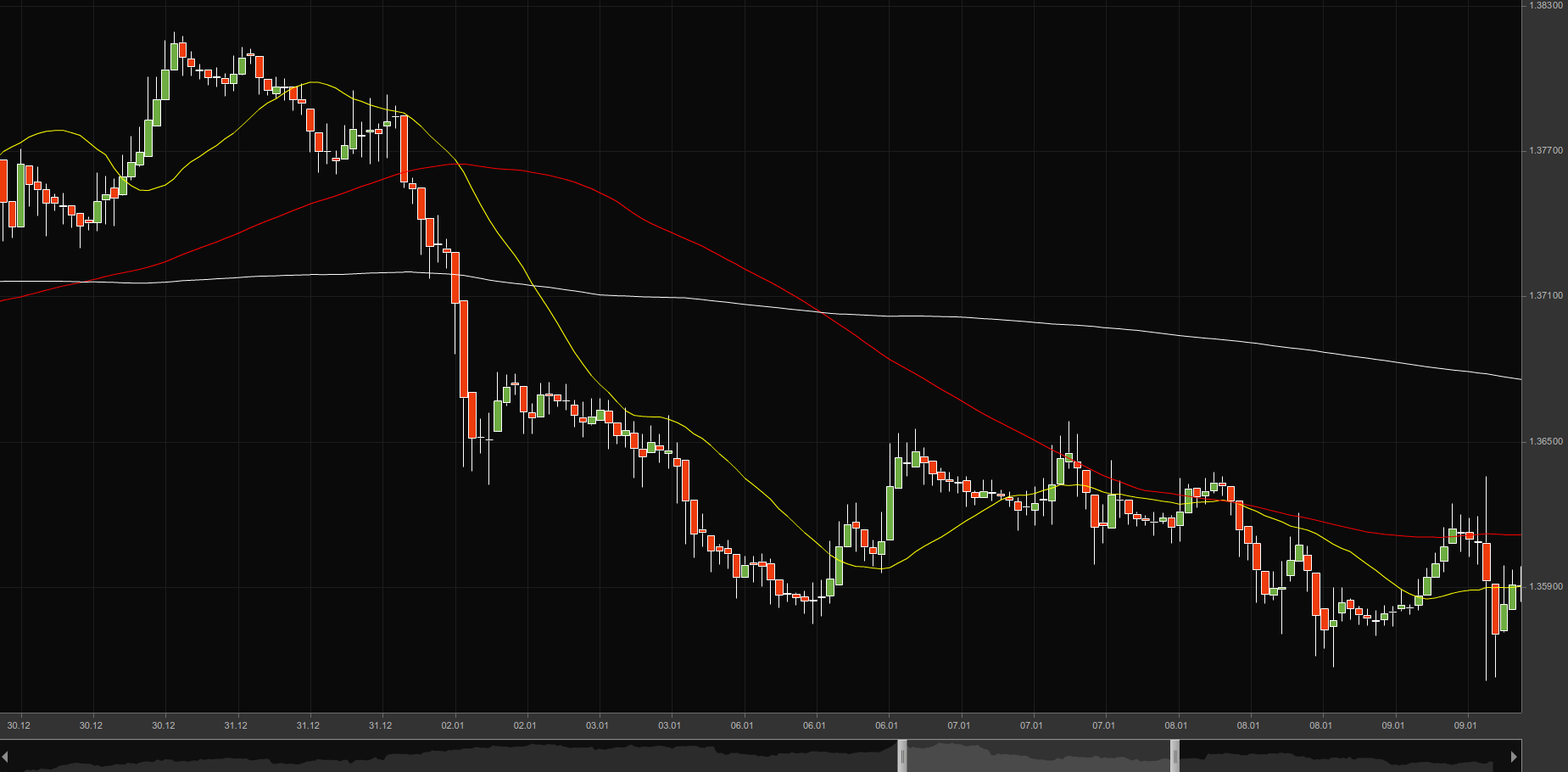
This signal indicates to traders that a strong move is likely as momentum shifts in one direction. A sell signal (as in our case) is generated when the short-term average crosses below the long-term average, while a bullish signal arises when the short-term average penetrates the long-term average and curves upwards.
Crossovers generate very strong and objective trading signals, which is why they are so popular. Apart from signifying important shifts in momentum, they also indicate changes in support and resistance levels, regardless of the holding period. They themselves act as support and resistance, something we’ve explained in the respective article, and therefore crossovers and the ensuing results are very similar to breakouts.

- Trade Forex
- Trade Crypto
- Trade Stocks
- Regulation: NFA
- Leverage: Day Margin
- Min Deposit: $100
Golden Cross and Death Cross
 Long-term crossovers are of greater significance than short-term ones, so next we will familiarise you with the concepts of the Golden Cross and the Death Cross.
The Golden Cross reflects a major shift in market sentiment when bulls prevail over bears. It is formed when a medium-term moving average, say a 50-day MA, breaks above the long-term moving average – for example, a 200-day MA.
Conversely, the Death Cross occurs when the market is once again dominated by bears, visualised by the medium-term average crossing below the 200-day MA.
Once penetrated, the 200-day MA begins to act as a major resistance level after the medium-term average drops below it, and as major support following an upward breakout. Very often you can see the price action trapped between the medium-term and the long-term averages, continuously whipsawing between their extremes. This zone presents a great opportunity for swing trades.
 Traders use crossovers as a confirmation tool in many trading strategies. However, keep in mind that moving averages are trending indicators, used to measure directional momentum. Range-bound markets limit the effectiveness of all moving averages, as the MAs eventually converge towards a single price level. When price action is so thin that it appears almost as a flat line, moving averages can provide little to no clues about market direction.
This renders them generally ineffective in ranging markets and causes them to generate false signals, so you should limit their use as a basis for decision-making to markets with a distinct trend. Such a situation (sideways trading) then calls for the abandonment of averages and the use of oscillators (such as Stochastic, RSI, etc.) to predict the next move.
Moving Average Envelopes
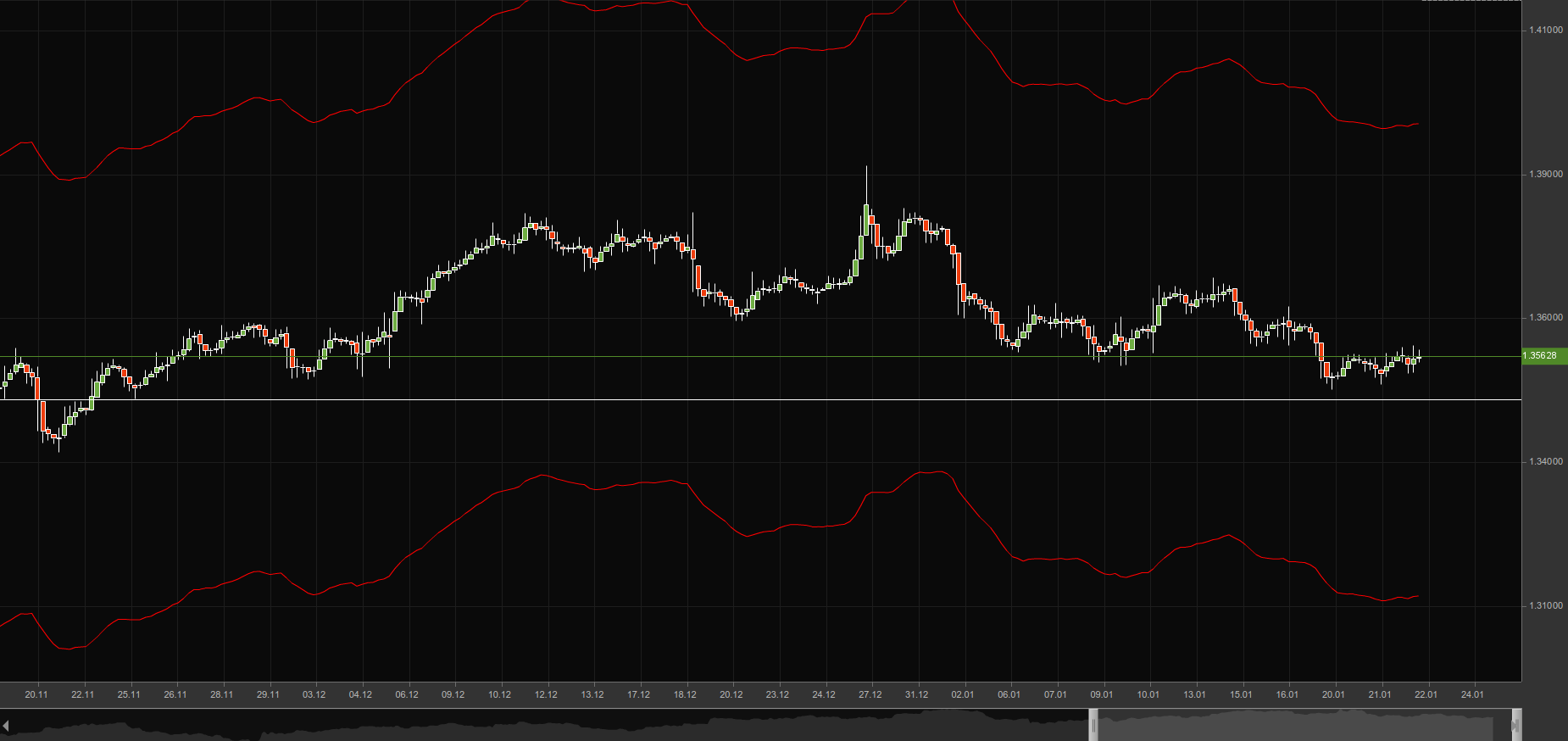
Envelopes consist of two boundaries placed at certain percentages above and below the moving average. When the price deviates too far from the moving average and hits one of the boundaries, it indicates that the market has become over-extended. Such a sudden spike often leads to a price correction, since the over-extended movement is usually not sustainable.
There is no general rule regarding how far away from the MA a trader should place the envelope, i.e. what percentage should be used. Short-term moving averages are commonly accompanied by smaller envelopes, while long-term ones are coupled with larger envelopes.
Short-term moving averages, such as a 20-day MA, are often surrounded by an envelope of 3% or even less. Long-term traders commonly use a 5% or larger envelope around medium- and long-term moving averages.
However, each trader has to decide for themselves what percentage envelope to use, depending on the instrument observed. Through trial and error you should adjust the channel so that it encompasses all or most of the recent breakouts.