
 | Updated:
 Monetary Aggregates
You will learn about the following concepts
- Aggregates – what are they?
- Measures in the US
- Aggregates in the Eurozone
- and more…
In previous articles, we described the power a central bank has to affect economic activity and the tools it uses to control money supply. In this chapter, we will turn our attention to how the money supply is measured and familiarise you with the term “monetary aggregates”.
The money supply is the total amount of monetary assets within an economy at any given time. It is important for central banks to measure and keep control over the amount of money flowing through the economy, as sudden imbalances could have harmful effects. Too much money supply will spur inflation, while too little might impair economic growth. Policymakers need to strike a balance between growth and inflation by controlling the money supply using the three types of tools previously described in the chapter – changing interest rates, altering banks’ reserve requirements and conducting open-market operations.

- Trade Forex
- Trade Crypto
- Trade Stocks
- Regulation: NFA
- Leverage: Day Margin
- Min Deposit: $100
Monetary aggregates
 In order to measure the amount of money available in the economy, central banks use the so-called monetary aggregates – broad categories used to gauge the total value of the money supply. The different types of monetary aggregates are typically classified as “M”s and range from M0, the narrowest, to M3, the broadest, but central banks base their policy decisions on different aggregates.
In this article, we will provide examples of the monetary aggregates followed by the Federal Reserve and the European Central Bank.
Measures in the US
In the United States, the Federal Reserve tracks the M1 and M2 monetary aggregates and releases reports on their values each Thursday at 4:30 p.m. EST. The central bank uses them to measure the effects of its open-market operations.
There are also M0 and MB. M0 reflects the dollar value of physical cash and coins, while MB (the Monetary Base) includes M0 plus Federal Reserve deposits, which only banks can hold with the Fed.
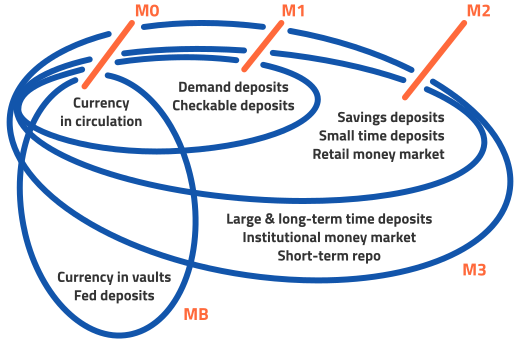
According to the Federal Reserve, M1 consists of:
– currency outside the US Treasury, the Federal Reserve and the vaults of depository institutions
– travellers’ cheques of non-bank issuers
– demand deposits at commercial banks, less cash items in the process of collection and Federal Reserve float
– other checkable deposits.
The M2 money aggregate consists of:
– the M1 aggregate
– savings deposits (including money market deposit accounts)
– time deposits of less than $100,000
– balances in retail money market mutual funds.
There is also M3; however, the Federal Reserve stopped tracking it in March 2006. It consisted of M2 plus all other certificates of deposit (such as large time deposits), eurodollar deposits and repurchase agreements.
Not so popular, but still reliable
 Since the 1990s, money-supply indicators have become less popular owing to a variety of changes in the US financial system and in the way the Fed conducts monetary policy. A lower correlation has been observed between changes in the money supply and key economic gauges such as GDP, unemployment and inflation.
At present, the central bank’s monetary policy is more clearly understood by observing the level of funds the Federal Reserve is injecting into the economy. This is why monetary aggregates rarely move markets in the short term.
However, the more widely tracked M2 is still deemed useful, as it may indicate that inflation is on the horizon, even though it no longer directly signals future spending growth as it once did. It can provide preliminary information about a possible rise in inflation when compared with GDP growth. If the rise in the money supply swiftly outpaces economic expansion, there will soon be a pick-up in prices.
Aggregates in the Eurozone
 Meanwhile, the European Central Bank has defined three aggregates used in the Eurozone – a narrow aggregate M1, an intermediate M2 and a broad M3. They comprise the following components:
– M1 = currency in circulation + overnight deposits (which can be immediately converted into cash or used for cashless payments)
– M2 = M1 + deposits with an agreed maturity of up to two years + deposits redeemable at notice of up to three months. The definition of M2 reflects the interest in monitoring a monetary aggregate that, in addition to currency, consists of deposits that are liquid.
– M3 = M2 + repurchase agreements + money market fund shares/units + debt securities of up to two years. These instruments are characterised by a high degree of liquidity and price certainty, which makes them close substitutes for deposits. Their inclusion leaves M3 less affected by substitution between various liquid asset categories than narrower definitions of money, making it more stable.