
 | Updated:
 Gross Domestic Product
You will learn about the following concepts
- How does the GDP indicator affect the Forex market?
- When is the indicator released?
- How is GDP used by traders?
- and more…
The gross domestic product (GDP) is one of the primary macroeconomic indicators used to assess the condition of a country’s economy. It represents the total monetary value of all goods and services produced over a specific period – in other words, the size of the economy. GDP is usually expressed as a comparison with the previous quarter or year. For example, if the year-on-year GDP is up 3%, it is considered that the economy has grown by 3% over the past year.
Economic production and growth – precisely what GDP measures – have a substantial impact on almost everyone within that economy. When the economy is healthy, you will typically observe low unemployment and higher wages as businesses demand labour to meet the expanding economy. A significant change in GDP, whether up or down, usually has a notable effect on the market. Investors always worry about negative GDP growth because it is one of the factors economists use to determine whether an economy is in recession.
How does the GDP indicator affect the Forex market?
 Economic data releases are essential for every Forex trader, especially reports of the utmost importance such as a country’s GDP, which reflects the overall state of the respective economy. Such data create volatility, and plenty of speculation always precedes them. Market participants monitor this critical piece of economic data to enter a new position or add to an existing one, but in most cases they use it in combination with other trend-defining factors.
The gross domestic product report carries considerable weight for currency traders. It provides evidence of growth in a productive economy and signals contraction in an unproductive one. As a result, currency traders will seek higher rates of economic growth as an indication that interest rates will move in the same direction. If an economy is experiencing a robust rate of growth, the benefits will eventually reach the consumer – increasing the likelihood of spending and expansion. In turn, higher spending will lead to rising prices, which central banks will attempt to tame should they begin to outpace the rate of economic growth, as severe inflation could arise.
Release of GDP data
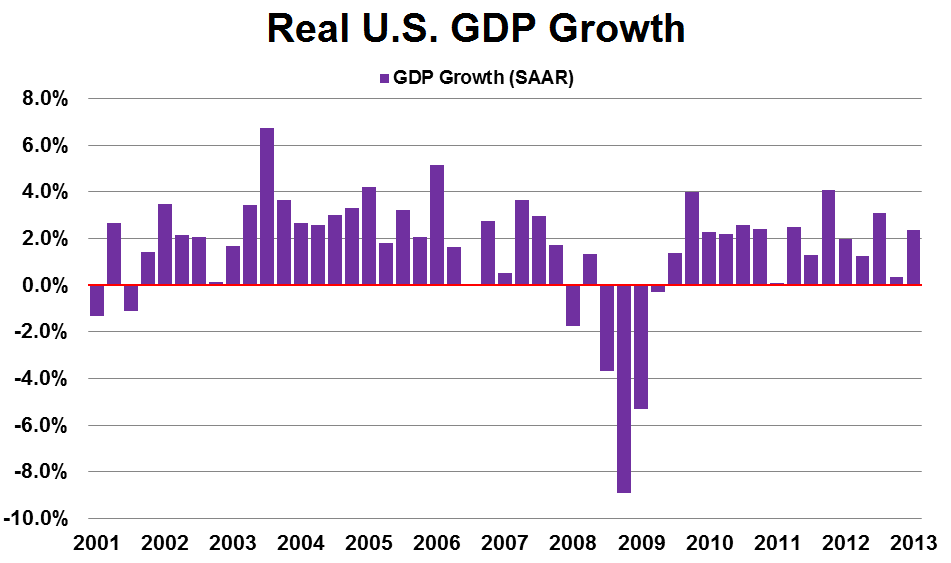
 Gross Domestic Product data are published on a monthly or quarterly basis. The body responsible for the release of US GDP statistics is the Bureau of Economic Analysis, a unit within the US Commerce Department. The BEA releases the advanced, preliminary and final quarterly numbers by the end of each month. The agency also publishes its GDP price index, which competes with both the Personal Consumption Expenditures index and the Consumer Price Index as a measure of consumer inflation.
As we’ve already mentioned, there are three versions of the GDP figures – advanced, preliminary and final. Keep in mind that it is not just the individual releases that matter, but rather the relationship between them. Experienced market players will first take into account the advanced reading when trading and will later emphasise any differences when comparing it with the two subsequent readings.
For example, a final release showing 2.0% GDP growth compared with an advanced reading of 4.5% is worse than a similar 2.0% print in both readings. An economic expansion figure always fosters positive sentiment, but its effect on the markets is at least partially muted when the final GDP figure trails the advanced reading.
 Source: US Census Bureau

- Trade Forex
- Trade Crypto
- Trade Stocks
- Regulation: NFA
- Leverage: Day Margin
- Min Deposit: $100
How is GDP used by traders?
 There are three basic types of market reaction an investor or trader can expect when it comes to the release of GDP figures.
1. A lower-than-expected GDP reading will generally prompt a sell-off of the domestic currency relative to its counterparts. For example, weaker-than-expected GDP growth in the US would signal an economic slowdown and diminish the US dollar’s appeal, as it would reduce the chances of a rise in US interest rates. Additionally, the more an actual GDP reading lags economists’ projections, the sharper the greenback will decline.
2. A reading that matches expectations will require additional analysis and comparison by market participants. Since the advanced and final values match and there is nothing to compare here, the trader will need to collate the current figure with previous quarters and, most often, with the previous year’s reading. This ensures a better evaluation of the current situation; however, because this analysis is not straightforward and investors’ opinions will vary, you can expect the resulting price action to be mixed as the market sorts out the details.
3. Faster-than-expected economic expansion will generally support the underlying currency against its trading peers. In our case, a stronger US GDP figure will benefit the US dollar and allow it to gain ground against its counter-currencies. The higher the final GDP reading, the stronger the support for the greenback and, consequently, the more it will advance.
Markets respond most to the release of GDP figures from the United States, the Eurozone, Great Britain and Japan, because the economic dynamics of these countries have the strongest effect on overall market sentiment and trends. Therefore, traders should diligently monitor the GDP numbers of these economies, but the greatest attention should be paid to growth figures from the countries whose currencies you trade. For example, if you trade the USD/CAD pair, economic indicators coming out of the US and Canada will be of major importance to you.
Example
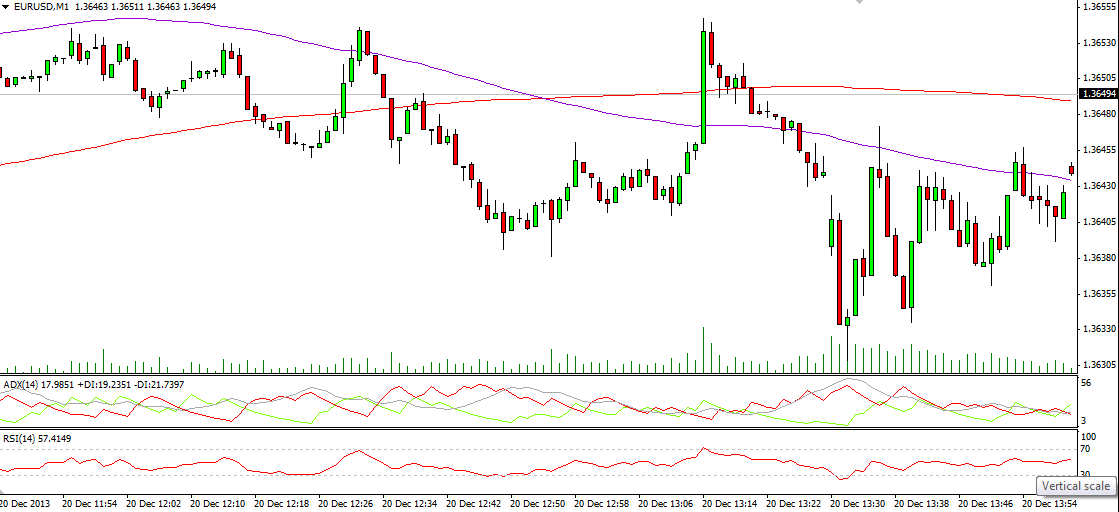
 The following graph illustrates how the release of GDP data can affect EUR/USD. You can observe the downward move of the pair caused by the stronger dollar at the time of the GDP release (13:30 GMT). The data showed a 4.1% rise, exceeding expectations of 3.6%.
 Source: MetaTrader 4 by MetaQuotes
An increase in a country’s Gross Domestic Product of between 3.0% and 3.5% generally indicates a healthy economy, while such growth levels remain moderate enough not to fuel an excessive inflation risk. Conversely, a falling GDP figure signals an economic slowdown with decreasing overall demand, leading to a rise in unemployment and a stalling business cycle.