
Current Account, Balance of Trade
This lesson will cover the following
- What is the Balance of Payments?
- Current Account
- Capital Account
- Balance of Trade and its significance
In the previous articles in Chapter 2, “Fundamental Analysis”, we explained some of the major fundamental indicators that measure the strength of an economy and its sectors, commonly referred to as market movers. But, as we know, no economy functions in isolation. Some countries, typically the developing nations, are rich in natural resources and rely on exporting them, while others have a vast industrial sector – usually the developed countries – but almost no raw materials to fuel their production. This means that imports and exports play a major role in the economic expansion of both types of countries, making the Balance of Trade a significant determinant of the economy’s current state.
The Balance of Trade is the largest component of a country’s current account, which is, in turn, one of the two primary components of the Balance of Payments, the other being the capital account.
Balance of Payments
The Balance of Payments is a statement that records all monetary transactions between a country and the rest of the world. It encompasses all payments for the country’s exports and imports of goods, financial capital, financial transfers and services. All these transactions are classified into two accounts – the current account and the capital account.
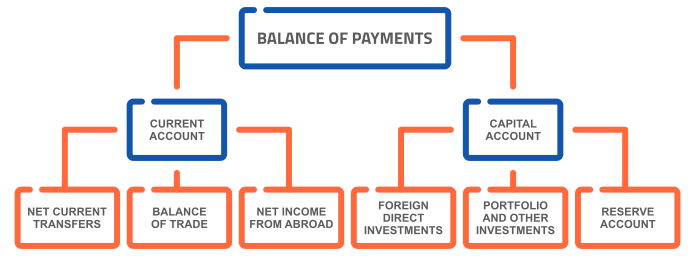 When all of the BoP components are included, the accounts should balance to zero, leaving neither deficit nor surplus. If, for example, a country imports more goods than it exports and therefore runs a trade deficit, the shortfall should be offset by another entry, such as the use of central-bank reserves, accumulating debt, etc.
The balance of payments is influenced by a government’s economic policies and reflects their outcomes. Some countries adopt policies designed to attract foreign capital into particular sectors, while others deliberately weaken their local currency in order to gain a competitive edge on international markets, boost exports and build up their currency reserves.

- Trade Forex
- Trade Crypto
- Trade Stocks
- Regulation: NFA
- Leverage: Day Margin
- Min Deposit: $100
Current account
The current account can be broadly described as the difference between a nation’s savings and its investments. It is the sum of the balance of trade, net current transfers (cash transfers) and net income from abroad (earnings from investments made abroad plus money sent by individuals working abroad to their families back home, also known as remittances, minus payments made to foreign investors).
 Note that investments are recorded in the capital account of the Balance of Payments, whereas income from those investments is recorded in the current account.
A current account surplus increases a country’s net foreign assets by the respective amount, while a deficit does the opposite. A country with a current account surplus is said to be a net lender to the rest of the world, while the reverse puts it in the position of a net borrower.
A net lender is consuming less than it is producing, which means it is saving and those savings are being invested abroad, thus creating foreign assets.
A net borrower is absorbing more than it is producing, which can only mean other countries are lending it their savings, thus creating foreign liabilities, or the country is using up its foreign currency reserves.
 Changes in the US current account are reported four times per year. The indicator is released in the last month of each quarter and reflects data from the previous quarter, e.g. the second-quarter current-account balance is released in September. This gauge causes medium volatility but can have a sizeable effect on the US dollar, especially if it exceeds expectations. A better-than-expected reading is considered bullish for the greenback, whereas a worse-than-projected value is regarded as bearish.
Generally, a current-account deficit is considered negative for the exchange rate of the local currency, while a surplus is typically positive. There are, however, some peculiarities, which we will explain when we discuss the trade balance, as it makes up most of the current account.
Capital account
 The capital account is the second major component of the Balance of Payments and reflects changes in a nation’s asset ownership. It is the net result of private and public international investments flowing into and out of a country.
A surplus in the capital account means that more money is flowing into the country, suggesting increased foreign ownership of domestic assets, while a deficit means that money is flowing out of the country, indicating that the nation is increasing its ownership of foreign assets.
The capital account is essentially the difference between the change in foreign ownership of domestic assets and the change in domestic ownership of foreign assets. If we break those down, there are four elements:
– Foreign direct investments
– Portfolio investments
– Other investments
– Reserve account
Balance of Trade
 The Balance of Trade, or commercial balance, is the difference between the monetary value of a country’s exports and imports over a period of time, calculated in the local currency. It is also identical to the difference between an economy’s output and domestic demand, i.e. what the country’s domestic production amounts to and how much it consumes. When exports exceed imports, or there is a positive balance, we have a trade surplus, while the opposite situation is called a trade deficit.
There are several factors that affect a country’s trade balance.
– exchange rate movements
– the cost of raw materials and other inputs
– prices of domestically produced goods
– the difference between the cost of domestic production and the cost in the importing country
– taxes and restrictions on trade
– differences in safety, health and environmental standards
Notice
The balance of trade is one of the most misunderstood indicators, as its interpretation is not as straightforward as that of some other major market movers.
Since a trade surplus indicates the country is exporting more goods than it is importing, there will be heightened demand for the local currency by foreign buyers, who need to acquire it in order to make payments for those goods. For example, if the US economy were running a trade surplus, increased demand for the US dollar would arise because more foreigners would be buying dollars to purchase US goods than Americans would be selling them to buy, let’s say, Chinese goods.
Logically, a trade deficit implies that more people are selling the local currency – in our case the US dollar – to purchase foreign goods than are buying it to purchase domestic goods.
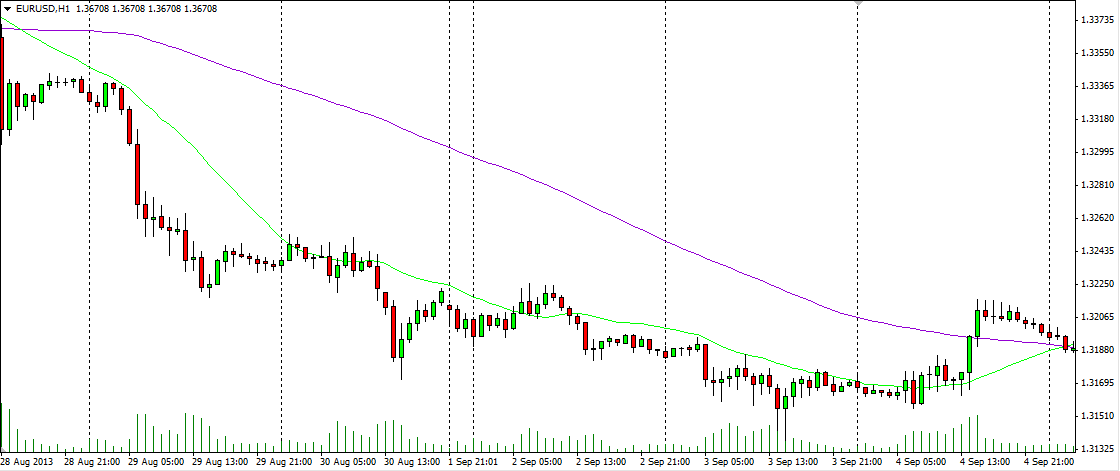
An example of the influence that changes in the US trade balance can have on the US dollar is provided in the following screenshot. It captures the release of the US trade numbers on 4 September.
Source: MetaTrader 4 by MetaQuotes Software Corp.
The Department of Commerce reported at 12:30 GMT that the US trade deficit widened to $39.147 billion in July, underperforming expectations for a smaller increase to $38.600 billion. Additionally, the preceding month’s reading was revised upward to $34.543 billion from the initially estimated $32.224 billion.
 Bear in mind that a trade deficit is not always a bad thing; it depends on the stage of the business cycle. During a recession, countries generally try to boost their exports, as this stimulates employment and has a positive effect on consumer sentiment. This, in turn, lifts consumer spending and boosts overall economic activity.
In periods of robust economic expansion, countries tend to import more, as this promotes price competition and has a deflationary effect. Strong imports also grant access to goods beyond the economy’s ability to supply without pushing prices higher. This means that, although a trade deficit should be avoided during a slowdown, it can be beneficial during a strong expansion.
Also keep in mind that, during economic expansion, the trade balance of countries with export-led growth – mainly the developing nations – will typically improve, whereas economies with domestic-demand-led growth, such as the US, will often deteriorate.
Change matters most
 It is also worth noting that what matters is not only whether the report shows a trade surplus or deficit, but also the change from the previous period. For example, if the US economy had been running a trade surplus for the past five months, what would matter most in the sixth month would be the change in the size of the surplus, rather than the simple fact that the balance remains positive. If Americans’ exports have been steadily outstripping imports for the last five months and this trend looks set to continue in the sixth, that would be of greater significance than the mere existence of a surplus, thus providing the US dollar with strong support.
Conversely, if the surplus were to decline in the sixth month after five consecutive monthly gains, this would, at least partly, offset the positive sentiment generated by the continued surplus.