
Crowd behaviour and going against the public
This lesson will cover the following
- What is the crowd’s influence on the financial markets
- Why people like being a part of it
- Why some risk going against the crowd
- Which side should you pick
As has already become clear from the previous articles in this chapter, psychology is the most important aspect of trading and the foundation for success. Without well-established discipline and tolerance towards losses, each trader is exposed to a much higher level of risk and, therefore, is more likely to lose money.
As we know, humans are impulsive and emotional beings. Some claim that we are also irrational, but this is not necessarily the case. In fact, we tend to be very rational when thinking for ourselves – that is, when we are not blindly following someone else. When a person knows that everything depends solely on them, they will usually take the time to consider all the possible outcomes of their actions. Things, however, look very different when we find ourselves in a group and our actions become part of the so-called crowd behaviour.
Being part of the group
 A crowd is a definable group of people who have a common purpose or set of emotions and who share a common behaviour. Despite their temporary similarities, each individual is prone to competing and conflicting emotions, and these changes can cause others to follow and shift the crowd’s behaviour. The same phenomenon can be observed in the financial markets.
One way to picture the financial markets is as a crowd of unorganised individuals whose goal is to predict the future mood of the crowd, or to estimate the balance between bulls and bears on the market, and position themselves.
Most books and learning centres advise new traders always to follow the trend and never fight the market in order to secure their longevity in the market. Although this is generally true, blindly following crowd behaviour can be just as devastating as going against the market unprepared, which will almost always result in a loss.
By default, every inexperienced trader should open positions in the direction of the trend while following proper risk-management strategies. A novice trader’s main goal should be to minimise risk and avoid losses as much as possible in order to remain in the market and keep learning first-hand.

- Trade Forex
- Trade Crypto
- Trade Stocks
- Regulation: NFA
- Leverage: Day Margin
- Min Deposit: $100
Why people like to act as others
 There are a couple of reasons why people are drawn to the overwhelming power of the crowd. The first is probably the strongest emotion driving the financial markets, but also one of the hardest to overcome – greed. Greed has led many people to bankruptcy, and it requires a lot of trading experience to develop the discipline needed to overcome it. Human behaviour analysts have found that people experience a greater fear of missing an opportunity for profit than of losing their life savings.
Many people also fear that by having a contrary opinion and doing something different, they could make a mistake and fail, whereas others could succeed. That concern about falling behind friends, neighbours or competitors drives many to act with the masses so that, if they lose, others will lose as well and will not outstrip them.
Seeking leadership
 Another powerful motivator behind crowd behaviour is people’s tendency to look for and follow a leader, which is quite normal for all social creatures. Leadership can be found in a single person, a group of individuals, or it could simply be the balance of the crowd’s opinion, based on the belief that the majority must be right. People look for a leader to guide them, especially through times of uncertainty. History, however, has shown that blindly following someone without conducting a proper, unbiased assessment can lead to devastating results, especially when your money is at stake.
There is one fundamental flaw in crowd behaviour: its inability to foresee the turning point of a trend. People who blindly mirror others’ actions end up losing just as much as they do. Thinking in exactly the same way as everyone else usually leads to the wrong conclusions. Humphrey Neill summarised this in his book “The Art of Contrary Thinking” by saying: “When everyone thinks alike, everyone is likely to be wrong.”
Imminent reversal
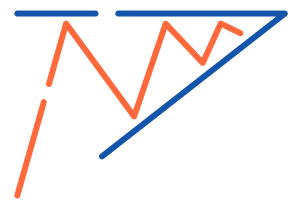 During an up-trend, individual traders – or non-professionals – tend to follow the group’s thinking and either buy for the first time or add to their existing positions. Eventually, however, prices surpass a reasonable limit and further gains become unsustainable. As long as players still have money to invest, their optimism will drive the market higher. After they become fully invested and everyone who wanted to buy has already bought, the market reaches an extreme and is considered overbought. The opposite condition is known as oversold.
At this point, prices not only halt their upward momentum but in most cases correct in the opposite direction. This gives us a viable explanation of why novice traders lose their money so quickly when trading futures. Market players are most bullish at market tops and most bearish at bottoms, right before the retracement.
Contrary opinion
 The opposite of crowd behaviour is the so-called contrary opinion. It is defined as going against the most popular or widely held opinions in the market – in short, betting against the market. Succeeding with such a strategy, however, is considered very difficult, especially when the current market movement is supported by a steady flow of fundamental indicators. Such strategies carry a lot of risk and are usually employed by highly experienced professionals.
OK, but if sharing the crowd’s behaviour could eventually lead to losses, and following our own well-analysed decisions could yield profits but with a high degree of risk, what strategy should one use? The answer is quite simple – follow the crowd when it coincides with your own established trading strategy and get out of the trade as soon as the market turns against you, even if you are not yet in profit.
Greed is bad
 However, at this point you will encounter the problem we spoke of earlier – overcoming greed. Inevitably, the crowd’s behaviour will diverge from the individual trader’s initial intentions and they will face a dilemma – should they follow their pre-planned strategy and hit the brakes, or stay in the market a while longer and aim for additional profits? As in every other case, deviating from your system may benefit you in certain situations, but in the long term you will achieve profitability only through discipline and by holding on to your predetermined strategy.
This is no easy decision to make, as when the crowd’s behaviour confirms the individual trader’s analysis, it gives them a false sense of security, thus raising their confidence. Granting increasing credibility to the group’s decisions is particularly dangerous in the medium and long term because it builds over time and dulls your senses, making it far harder to foresee an imminent price crash.
The only viable way to learn not to stray from your own analysis and pre-planned strategy is to survive as long as possible in the market so that you can keep learning and practising. In time, you will gain confidence in self-decision-making and improve your self-awareness, thus giving yourself an advantage over the crowd. Indeed, exiting a position and missing out on probable profits is hard to do and runs against human nature, but it is something you need to overcome to achieve success.